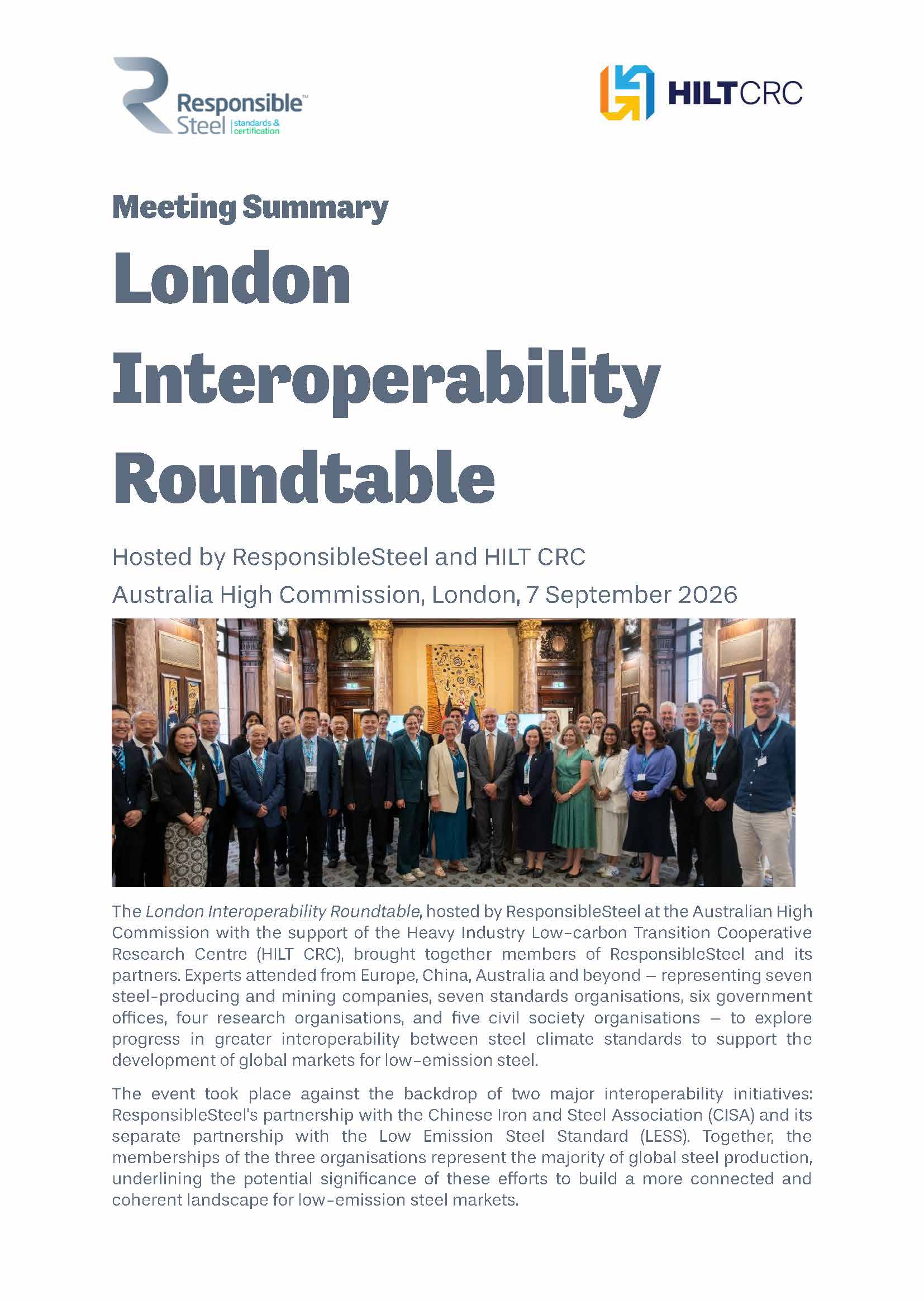
ResponsibleSteel Progress Report 2026
ResponsibleSteel’s 2026 Progress Report captures a year marked by deepening global alignment and strengthened member commitment to building the ecosystem that enables responsible, low‑emission and near‑zero steelmaking to thrive.
Heading


Despite a challenging operating environment marked by geopolitical volatility, shifting supply chain risks and heightened scrutiny of corporate transition plans, our latest report demonstrates how ResponsibleSteel continues to convene members and stakeholders to drive credible, independently verified progress across the global industry.
Last year, we celebrated a major milestone in aligning global approaches to low emission steel. ResponsibleSteel concluded landmark agreements with the Low Emission Steel Standard (LESS) in Europe and with the China Iron and Steel Association (CISA), extending common approaches to GHG measurement and classification across a collective membership covering roughly 60% of global steel production. These partnerships lay the foundations for interoperability mechanisms that will bring greater clarity to markets, reduce fragmentation and enable investment in the world’s largest steel producing regions.
The year also saw major buyer and investor engagement initiatives, including the Strength to Strength campaign, US investor roadshow, and new guidance from Microsoft and Carbon Direct recognising ResponsibleSteel Progress Levels as benchmarks for supplier expectations.
The report details strong progress across ResponsibleSteel’s certification and membership programmes:
- Seven new certified sites across Europe, the Middle East and India
- 100% recertification uptake for expiring certificates
- Nearly 90 certified sites across 19 countries, representing a combined 142 million tonnes of annual steel production
- Over 262,000 workers covered by ResponsibleSteel certification
- 12 new members, bringing total membership to 167 organisations headquartered across 36 countries.
As our membership grows and global partnerships deepen, ResponsibleSteel continues to serve as a unifying force, bringing together industry, civil society, policymakers and finance to accelerate pathways to responsibly produced low-emission and near-zero steelmaking.
Explore related content
View All