
ResponsibleSteel’s Principle 10: A checklist to assess steel industry progress on fossil fuel phase-out
ResponsibleSteel’s Principle 10: A checklist to assess steel industry progress on fossil fuel phase-out
ResponsibleSteel’s Principle 10: A checklist to assess steel industry progress on fossil fuel phase-out
As global emissions continue to rise, the need to rapidly scale up clean solutions and phase out fossil fuels to align with a 1.5°C pathway has never been greater. For the steel industry, one of the world’s most complex and emissions-intensive sectors, this raises critical questions around how progress should be driven, assessed, and reported transparently.
Real change is reflected not only in boardrooms and corporate strategies, but in the day-to-day operations and decisions at individual production sites. Yet the granular detail that truly reflects the asset-level investments happening at site level is often missing. Without a comprehensive and consistent approach to greenhouse gas (GHG) emissions assessment, comparing progress across sites, regions, and production routes becomes nearly impossible. That’s why global standards, and the rigour to apply them consistently, are essential to understanding where the industry stands today and how far it still needs to go.
Principle 10 of ResponsibleSteel’s International Production Standard, which addresses GHG emissions and climate change, is ideally placed to assess the credibility and implementation of a steelmaker’s fossil fuel phase-out strategy. It provides independent, third-party verification of climate performance, demanding a holistic approach to fulfilling climate commitments and effectively bridging the gap between corporate pledges and site-level action.
Certification against ResponsibleSteel’s International Production Standard supports steel procurers and specifiers, financiers, and policymakers among others, by providing verifiable evidence that a steelmaker has, and is effectively implementing, a credible strategy to achieve net-zero emissions by 2050 or earlier.
Integrating renewable energy is increasingly central to the business case for decarbonised steelmaking. This has formed a major part of discussions with ResponsibleSteel stakeholders and was a key theme at ResponsibleSteel’s policy convenings in Delhi and Brussels last year. ResponsibleSteel members are also already beginning to deploy increasing amounts of renewable energy in the production of steel. But to build clean industries of the future, this needs both augmentation and acceleration through both public and private sector initiatives. An example is the work of a member of ResponsibleSteel, We Mean Business Coalition (WMBC), which launched a ‘Fossil to Clean’ campaign, working with companies to phase out fossil fuels by 2040 and to advocate for a well-managed and just transition globally.*
For Certified Steel, ResponsibleSteel applies a fair and consistent approach to calculating GHG emissions, including emissions associated with renewable energy use. Our methodology incorporates specific safeguards for the use of market-based electricity instruments like Power Purchase Agreements (PPAs) and Guarantees of Origin (GOs), as well as bio-based fuels, as set out in our “Fundamentals for GHG Emissions Accounting and Classification”.
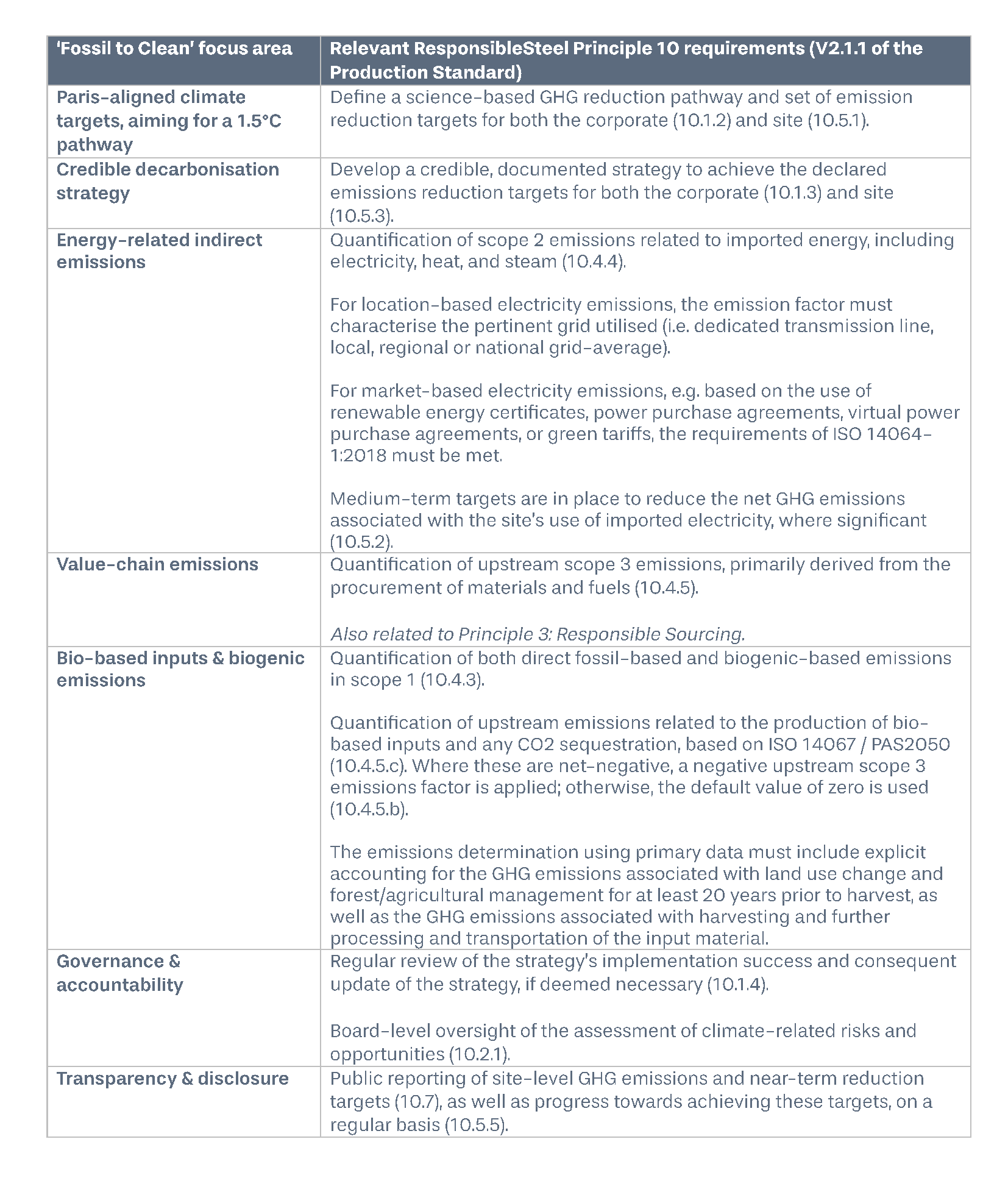
As part of our mission - to be a driving force in the socially and environmentally responsible production of near-zero steel - we have mapped the requirements of the Production Standard against the Fossil to Clean campaign’s focus areas and developed a checklist which can be used as a tool for steelmakers to not only demonstrate alignment with the a ‘Fossil to Clean’ campaign, but also for broader industry stakeholders to recognise and track progress towards a clean industrial transformation.
Decarbonisation and Fossil Fuel Phase-Out Checklist
The checklist is available for download here.
Advancing expectations to demonstrate commitment to climate action
ResponsibleSteel is currently in the process of revising Principle 10’s approach to climate transition plans, under the three guiding principles of ambition, feasibility and simplicity. Based on recent stakeholder consultations, including extensive meetings with a member-based Working Group and independent Technical Advisory Group, Version 3.0 of the Production Standard will likely see a reshaping of the related requirements at corporate (criterion 10.1) and site (criterion 10.5) levels to strengthen credibility.
Credible climate transition plans, as defined by ResponsibleSteel, must include several components to ensure a comprehensive plan, assessment and ongoing management of emissions that balances decarbonisation ambition and investment feasibility, both in the near and long-term. The strategy must be driven by the corporation, cascade down to production sites, and integrate feedback loops to ensure decarbonisation outcomes are realised over time.
The credibility framework for climate transition plans is presented in the following figure:
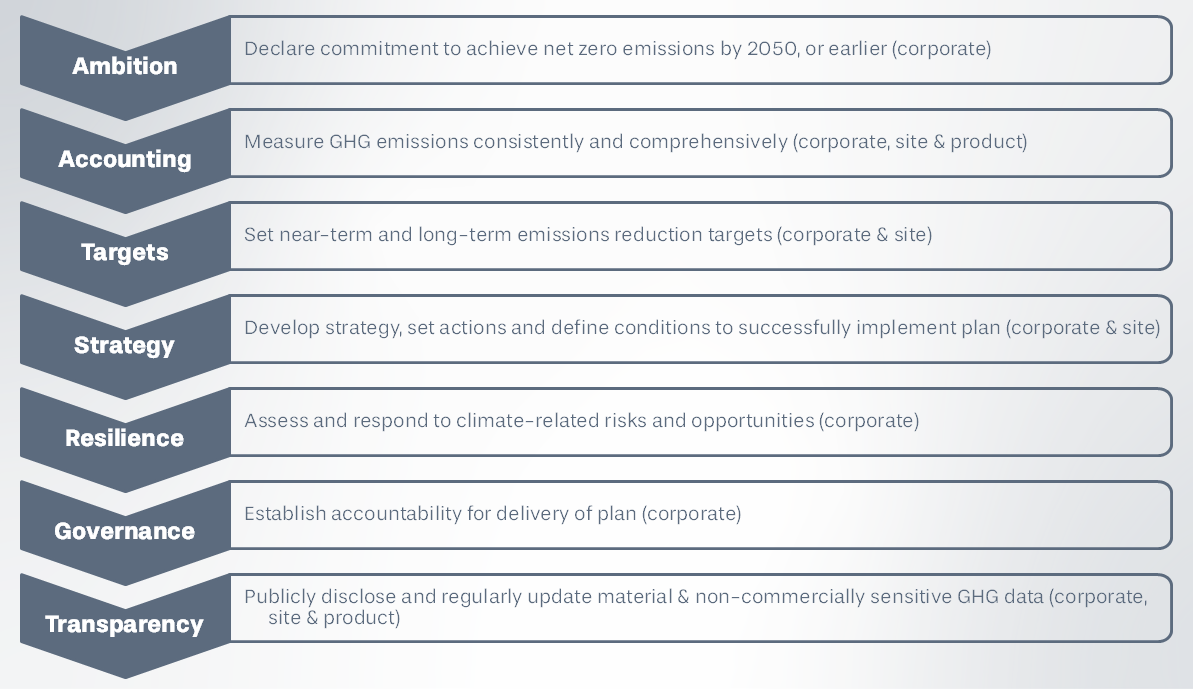
Beyond the presented credibility framework, the revision of Principle 10 will likely include a more holistic and systematic approach to climate transition plans, including improved clarity in how to demonstrate corporate-level ambition, greater alignment across emissions measurement methodologies, and clearer expectations for material scope 3 emissions inclusion.
ResponsibleSteel holds steelmakers accountable whilst celebrating decarbonisation progress
ResponsibleSteel continues to push the industry towards more ambitious decarbonisation outcomes, not only through the Production Standard’s Core requirements, but also through the Decarbonisation Progress Levels, a market mechanism for the trade of low- and near-zero-emissions steel products.
ResponsibleSteel Certification gives civil society organisations, steel buyers, financial institutions, and policymakers the confidence that a steelmaker has a credible transition plan in place, and that meaningful progress is being made towards its implementation. Now, this checklist provides steelmakers with another practical tool to effectively demonstrate progress on decarbonisation and fossil fuel phase-out.
*WMBC’s ‘Fossil to Clean’ campaign aims to catalyse and guide the shift from fossil fuels to clean solutions, calling on companies to phase out fossil fuel use (especially coal); electrify operations where possible; switch to 100% renewable electricity; eliminate new fossil fuel infrastructure; align climate action with a 1.5°C pathway; and use purchasing power and policy advocacy to accelerate the transition. We Mean Business funded ResponsibleSteel’s policy project in 2025.

Alli Devlin is ResponsibleSteel's Decarbonisation Lead. She has a strong interest in the application of engineering solutions to benefit communities and ecosystems. She completed the Bachelor of Civil and Environmental Engineering at the University of Technology, Sydney, during which she received the 2017 New Colombo Plan Fellowship to study and complete internships in Vietnam for 14 months. Following, Alli spent over 5 years with Lendlease in the construction industry as a Site Engineer, working on significant Australian transport infrastructure projects. Alli has recently completed her DPhil in Engineering Science at the University of Oxford as a 2020 John Monash Scholar. Her thesis was titled “The New Steel Map: Reconfiguring Supply Chains Around Renewable Resources.“
