The Decarbonisation Progress Levels
This two‑pager outlines ResponsibleSteel’s decarbonisation approach and how progress levels track site‑level action toward near‑zero steel.
Heading

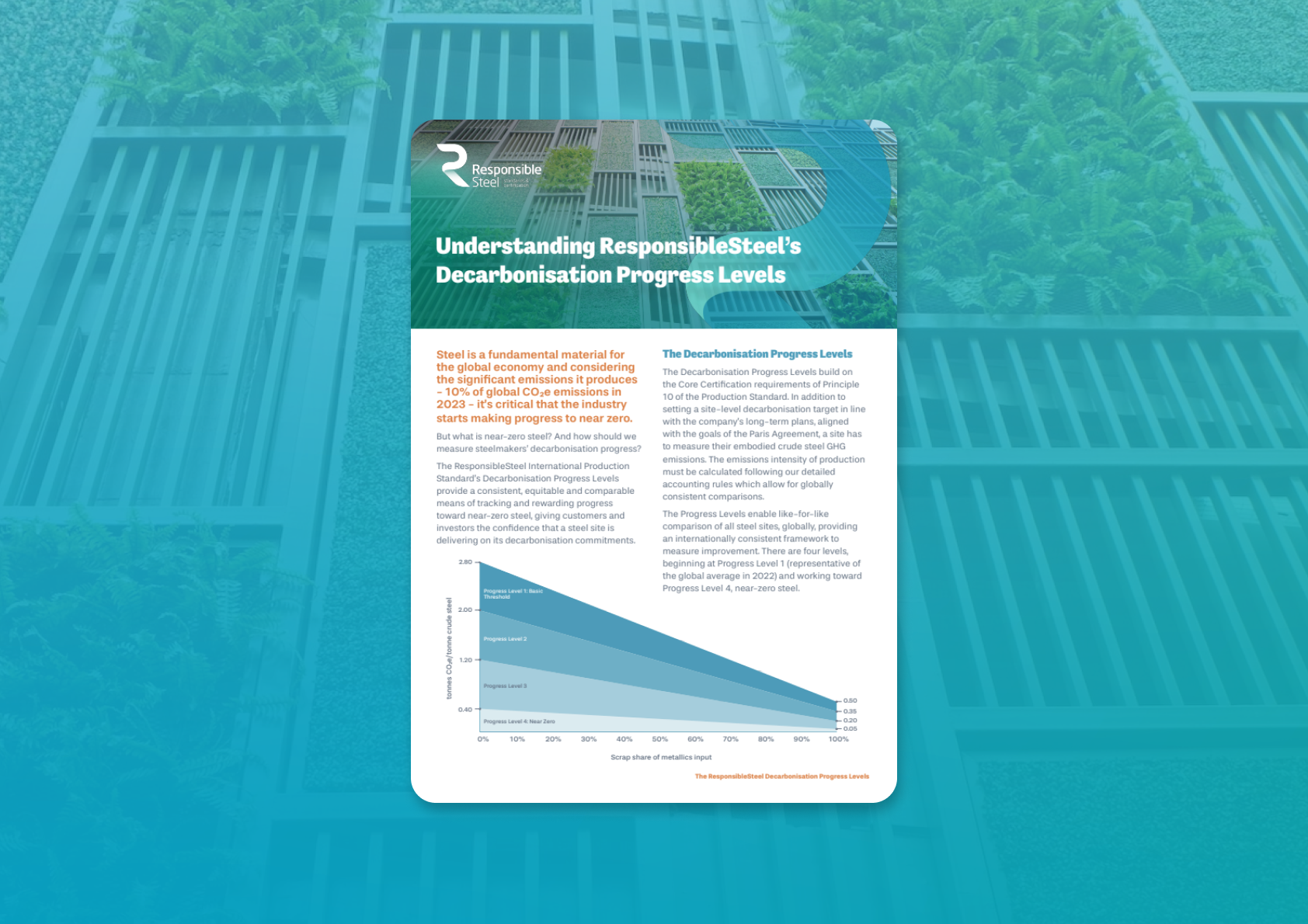
Steel is a fundamental material for the global economy and considering the significant emissions it produces - 10% of global CO2e emissions in 2023 - it’s critical that the industry starts making progress to near zero.
But what is near-zero steel? And how should we measure steelmakers’ decarbonisation progress? The ResponsibleSteel International Production Standard’s Decarbonisation Progress Levels provide a consistent, equitable and comparable means of tracking and rewarding progress toward near-zero steel, giving customers and investors the confidence that a steel site is delivering on its decarbonisation commitments.
The Decarbonisation Progress Levels
The Decarbonisation Progress Levels build on the Core Certification requirements of Principle 10 of the Production Standard. In addition to setting a site-level decarbonisation target in line with the company’s long-term plans, aligned with the goals of the Paris Agreement, a site has to measure their embodied crude steel GHG emissions. The emissions intensity of production must be calculated following our detailed accounting rules which allow for globally consistent comparisons.
The Progress Levels enable like-for-like comparison of all steel sites, globally, providing an internationally consistent framework to measure improvement. There are four levels, beginning at Progress Level 1 (representative of the global average in 2022) and working toward Progress Level 4, near-zero steel.
An equitable approach to driving progress
ResponsibleSteel’s Decarbonisation Progress Levels are based on a scrap-variable approach, designed to incentivise all steelmakers, regardless of their existing technology, location, or scrap availability, to invest in decarbonised production processes. Scrap is the most direct route to decarbonising the steel industry. But global scrap supplies are constrained and unequally distributed, greater in developed regions as more steel has been consumed over previous years. A scrap-variable approach is critical to preventing carbon leakage due to the reallocation of scrap, ensuring both an equitable transition and a net gain for the climate.
Today, at least 50% of global steel production is certifiable to at least Progress Level 1. To achieve Progress Level 1, a site with 20% scrap utilisation requires an emissions intensity equal to or less than 2.34 t CO2e/t crude steel (inclusive of scope 1, scope 2, and upstream scope 3 emissions). For comparison, a site with 80% scrap utilisation must meet an emissions intensity threshold of 0.96 t CO2e/t crude steel.
To be certified, steelmaking sites undergo rigorous audits conducted by independent certification bodies recognised by ResponsibleSteel. Sites that achieve certification to at least Progress Level 1 for decarbonisation and materials sourcing are permitted to label and market their products as ‘Certified Steel’. Progress Levels track the site’s journey towards Level 4, which represents near-zero emissions.