Understanding ResponsibleSteel Certification
ResponsibleSteel certification supports steelmakers and rewards progress toward responsible, near-zero steel with the highest levels of traceability
Heading

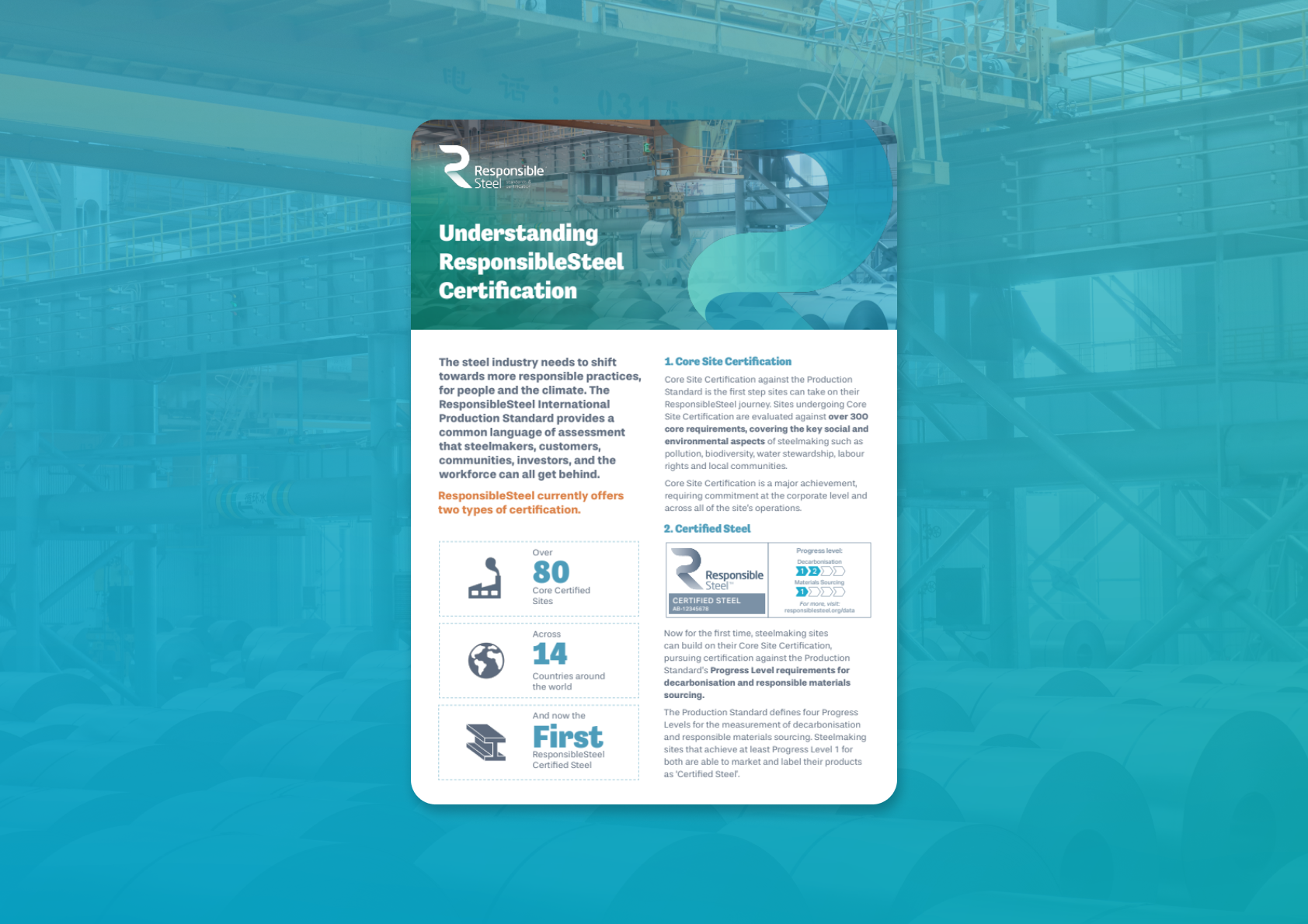

The steel industry needs to shift towards more responsible practices, for people and the climate. The ResponsibleSteel International Production Standard provides a common language of assessment that steelmakers, customers, communities, investors, and the workforce can all get behind. ResponsibleSteel currently offers two types of certification.
1. Core Site Certification
Core Site Certification against the Production Standard is the first step sites can take on their ResponsibleSteel journey. Sites undergoing Core Site Certification are evaluated against over 300 core requirements, covering the key social and environmental aspects of steelmaking such as pollution, biodiversity, water stewardship, labour rights and local communities. Core Site Certification is a major achievement, requiring commitment at the corporate level and across all of the site’s operations.
“ResponsibleSteel certification not only validates our efforts but also enhances our credibility as a responsible global steel producer.” - Rajiv Mangal Vice President (Safety, Health & Sustainability), Tata Steel
2. Certified Steel
Now for the first time, steelmaking sites can build on their Core Site Certification, pursuing certification against the Production Standard’s Progress Level requirements for decarbonisation and responsible materials sourcing. The Production Standard defines four Progress Levels for the measurement of decarbonisation and responsible materials sourcing. Steelmaking sites that achieve at least Progress Level 1 for both are able to market and label their products as ‘Certified Steel’.
“This certification gives customers and stakeholders confidence that steel is on the path to near zero and helps to ensure a responsible practice across our supply chain.” - David Burritt CEO, U. S. Steel
The Decarbonisation Progress Levels build on the core requirements of Principle 10 (Climate Change and Greenhouse Gas Emissions). In addition to setting a site-level decarbonisation target in line with the company’s long-term plans, a site must measure its embodied crude steel GHG emissions. Sites are assessed using a scrap-variable approach taking into account the proportion of scrap used. The Production Standard’s four Decarbonisation Progress Levels are designed to track and reward improvement and drive global progress toward Level 4, near-zero emissions.
The Materials Sourcing Progress Levels contained in Principle 3 (Responsible Sourcing of Input Materials) build on the core requirements specified in Principle 2 (Environmental, Social and Governance Management Systems) of the ResponsibleSteel International Production Standard. The aim of these levels is two-fold – to recognise well-performing suppliers and to help improve ESG performance across supply chains.
How does it work?
Steelmaking sites undergo rigorous audits conducted by independent certification bodies recognised by ResponsibleSteel. The audit report is reviewed by ResponsibleSteel and an independent Assurance Panel before a certification decision is taken. Certificates are valid for three years, but certified sites must undergo a surveillance audit around 18 months in, demonstrating progress on any non-conformities identified in the initial audit.
Benefits of Certification
Proactively manage sustainability risks: Improve on-site and supply chain practices, identify potential risks, and go beyond legal compliance on all aspects of sustainability.
Enhance commercial value: Be externally recognised and rewarded, draw green premiums, and create foundations for investment in low- and near-zero emissions steel.
Bolster company reputation: Become a leader in decarbonisation and sustainable practices, support lead market generation, enhance brand recognition, and build trust.
Build the decarbonisation toolkit: Ensure a comprehensive approach to managing and reducing GHG emissions is adopted and track site-level emissions to near zero.