

Reflections from China: ResponsibleSteel's CEO Annie Heaton discusses building interoperability across global standards
Interoperability: Building a bridge between global standards
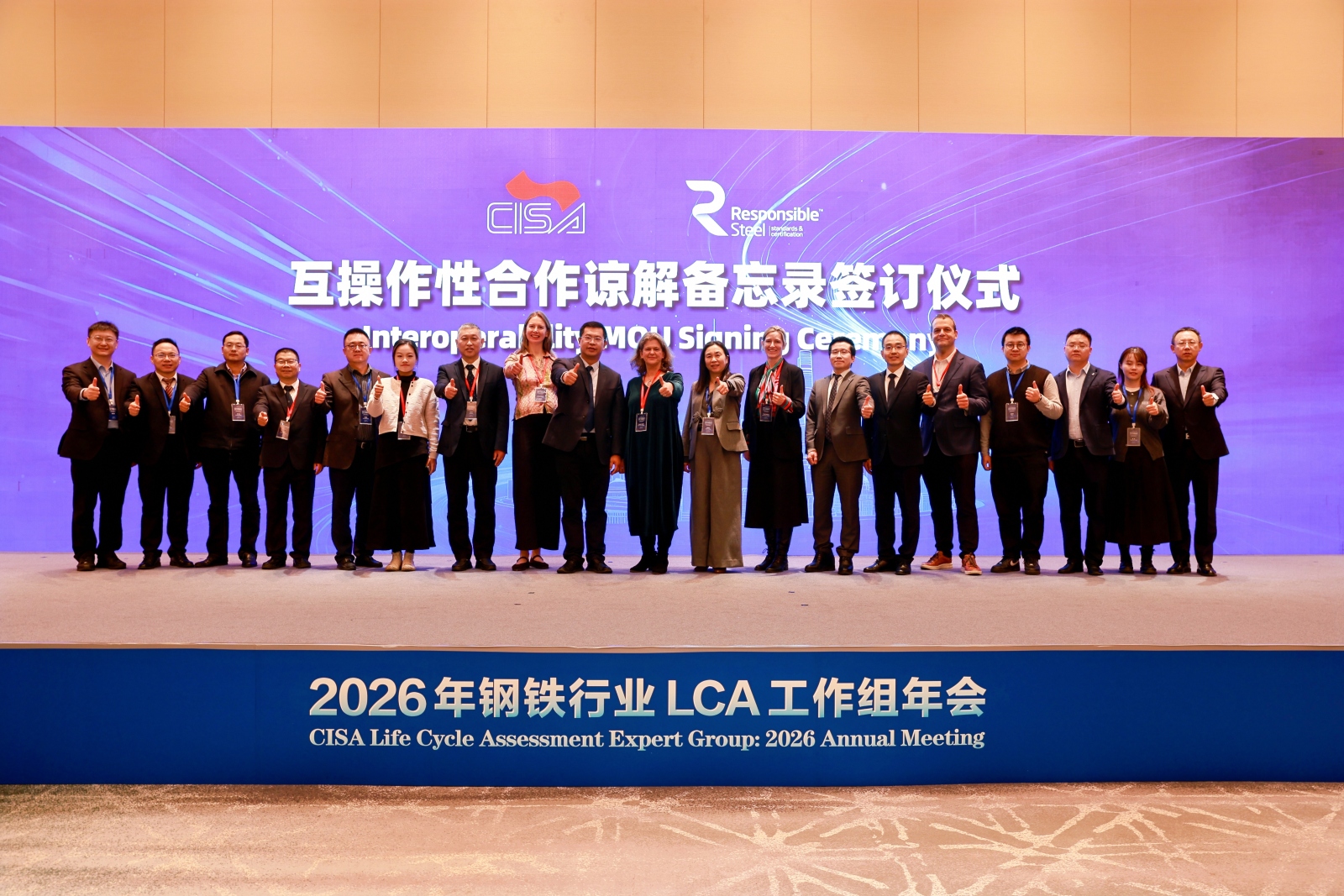
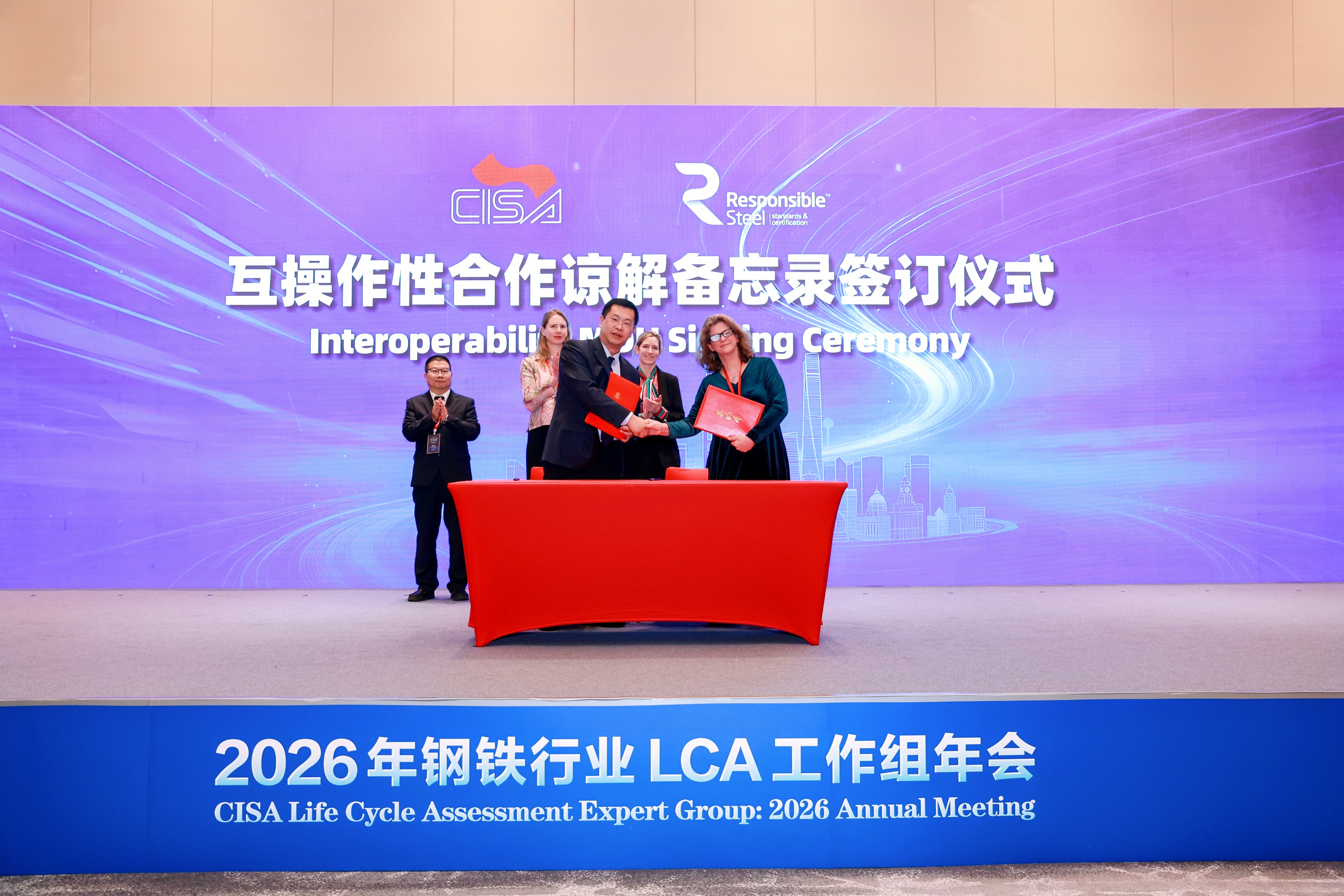
ResponsibleSteel's quest for a coherent market for decarbonised steel in 2026 got off to a constructive start this month. Following the announcement of our landmark agreements with the Chinese Iron and Steel Association (CISA) and the Low Emission Steel Standard (LESS) at COP30, ResponsibleSteel was in China in January to kick off our work on interoperability with CISA. This work in China complements our parallel project with Brussels-based LESS.
The goal? To build trusted data and claims on decarbonisation.
During our trip, our Director of Programmes, Amy Jackson, our Decarbonisation Lead, Alli Devlin, and myself had the opportunity to:
- Present to the Chinese steel value chain our C2F (China's low-carbon emission steel standard) interoperability MoU at CISA's annual LCA conference.
- Connect with our Chinese members, including SKF, World Resources Institute (WRI), Climate Group, VAMA (Valin ArcelorMittal Automotive JV), Penglai Dajin, and some of our certification bodies working in China, including Afnor and China Quality Certification Centre (CQC).
- Get to work on our C2F-ResponsibleSteel Interoperability Project, structuring the discussions around our Framework for Credible Interoperability.
- Visit the 15mtpa Zhanjiang steel plant, where a new DRI-EAF line was launched in Dec 2025. This has involved the production to date of iron reduced with hydrogen in a 1mtpa DRI plant. Whilst this is currently produced from refined coke oven gas, the project is a hugely significant demonstration of the potential to produce hydrogen-based DRI at an industrial scale.
.jpg)
What do ResponsibleSteel's interoperability projects look like in practice?
In short, interoperability means measuring emissions using rules that are as aligned as possible, and recognising the differences, to enable comparison on a like-for-like basis. Imagine the benefit this would bring for anyone wanting to distinguish what good looks like, for example, procurement teams, investors, and policymakers.
But making interoperability work in practice requires a lot more if we want a reliable, credible and sustainable system that generates high-quality, comparable data.
We've outlined the key components of this in our Framework for Credible Interoperability, which will inform both our work with LESS and CISA:
- Aligned GHG accounting rules
- A reliable calculation tool
- A robust assurance mechanism
- Credible claims protocols
- Good governance, oversight and resourcing
- Appropriate data management
- Strong operations management systems
This is how markets are built: first with innovation, then with the necessary rules and systems that enable good information to flow – so that steel buyers can understand, investors can evaluate, and steelmakers can compete, based on emissions performance that everyone can trust.


Methane and Steel
A few months ago, the United States, the European Union, and partners formally launched the Global Methane Pledge, an initiative to reduce global methane emissions to keep the goal of limiting warming to 1.5 degrees Celsius within reach. A total of over 100 countries representing 70% of the global economy and nearly half of anthropogenic methane emissions have now signed onto the pledge. Methane emissions are particularly relevant to the steel industry. Below you can read Ember’s view on the importance of dealing properly with methane emissions from metallurgical coal, the responses steel makers could have to this challenge. We also asked one of our members North Coal what they were doing to address this issue at their proposed site.
Steel’s Methane Footprint – Ember
For steel industries, there are two reasons that methane is a major climate change imperative. Firstly, combined coal mine methane emissions have an enormous impact on climate change in the short term, outstripping the EU’s total carbon emissions according to Ember analysis. Secondly, the steel industry is a major consumer of metallurgical coal, which is associated with some of the highest methane emissions of any type of coal mining.

We estimate that coal mine methane associated with steel production generates 15.9 billion cubic meters of methane per year. This is equivalent to the total CO2 emissions of Germany and the United Kingdom combined, substantially to the global warming effect of blast furnace steel. These emissions should be included in corporate scope 3 emissions, but to date, they have not.
So what can the industry do? Steel companies can take the initiative and demand that their suppliers of coke or coking coal 1) properly measure the methane emissions associated with its production and, 2) take aggressive action to mitigate unnecessary venting of coal mine methane. Our analysis shows that much of this methane can be profitably utilized to generate electricity, or otherwise destroyed via flaring or oxidation at very low cost.
This will also help future-proof supply chains, as it is increasingly likely new regulations will affect methane emissions from coal. The United Nations Climate Change Conference in Glasgow in November (COP26) put methane on the top of the climate agenda, with over 100 countries signing the Global Methane Pledge. The United States and the European Union are both following up with ambitious legislative packages, which could push coal companies to measure, report and mitigate methane emissions.
North Coal
ResponsibleSteel Members with coal mines are very well aware of the challenges caused by methane emissions which is why they are taking actions. For example, North Coal agrees that steel companies should demand properly measured emissions from all raw materials sourced, and raw material providers should take action to mitigate their Scope 1 and 2 emissions including mine methane. It is a position North Coal supports and has taken action on. North Coal is focused on providing steelmakers with carbon-neutral metallurgical coal with minimal Scope 1 and 2 emissions and has partnered with the Bradshaw Research Institute for Mining and Minerals (BRIMM) at the University of British Columbia to quantify emissions and develop a strategy and tactical plans to net-zero. This will include a mine design that minimizes emission emitting equipment while also taking advantage of available clean hydroelectricity. Working with BRIMM we will also accurately measure fugitive seam emissions and look to develop strategies to drain fugitive methane pre-mining and explore alternative uses for the gas that lowers its emission footprint.
North Coal has also partnered with Circulor Limited to establish metallurgical coal traceability and dynamically track CO2 and environmental, social, and governance (ESG) performance. Traceability allows North Coal to demonstrate both carbon and other sustainability performance and the higher value-in-use that net-zero coal has for blast furnace steelmakers. This data is increasingly critical to steel manufacturers’ growing imperative to ensure their supply chain has the lowest possible CO2 emissions and to demonstrate ethical sourcing.
North Coal – https://northcoal.ca/
North Coal and Circulor partnership: https://www.worldcoal.com/coal/02112021/north-coal-and-circulor-partner-to-support-esg-transparency/
BRIMM at University of British Columbia – https://brimm.ubc.ca/
Circulor – https://www.circulor.com/


2021 in review
2021 has been a breakthrough year for ResponsibleSteel. This video looks at our year in review as well as signalling ahead to the huge opportunities that 2022 will bring.

ResponsibleSteel’s Standard incorporated into CRU’s Emissions Analysis Tool
ResponsibleSteel, the steel sector’s first global multi-stakeholder certification and standard initiative, and CRU Group, the leading global mining, metals and fertilizer market intelligence company, have signed a Memorandum of Understanding (MOU) which includes the integration of the ResponsibleSteel Standard into CRU’s Emissions Analysis Tool.
The CRU Emissions Analysis Tool is a digital platform that compares emissions across global value chains. The tool compares asset level sustainability data which will now include acknowledgement that a steel site has been audited and passes the rigorous standards laid out in ResponsibleSteel’s certification programme.
The MOU between ResponsibleSteel and CRU allows the industry to accelerate its sustainability journey. Key benefits of the partnership include:
- Increase global knowledge and awareness of steel and steelmaking raw materials value chains and their material sustainability issues,
- Maximise opportunities for improvement in value chain sustainability, through increased transparency,
- Enhance analysis and transparency of steel and steelmaking raw material assets-, products-, corporates-, and sector-related performance for all stakeholders,
- Develop and share science- and data-based approaches to supply chain risk mitigation and resilience.
On the partnership, Chief Executive of ResponsibleSteel Anne-Claire Howard stated: “I am delighted to formalise our collaboration with CRU through this Memorandum of Understanding. The integration of ResponsibleSteel published information on ResponsibleSteel certification status into the CRU Tool will increase stakeholders understanding of sustainability efforts in the steel sector, allow comparability across the sector and along supply chains and provide transparency of where improvements are taking place and we hope that in 2022 we will be able to add certified steel to this.
CRU’s Head of Research Development, Lavan Mahadeva echoed Howard, “Most of the headlines on sustainability in steel have been on carbon emissions and the industry’s large carbon emissions footprint. CRU developed our expert cost model carbon emissions calculations for the steel value chain and our Emissions Analysis Tool data portal to bring evidence to this debate. We are delighted to represent ResponsibleSteel in our data portal and to support them in their task of promoting and enlightening on all aspects of the responsible sourcing, production, use and recycling of steel, a material that we cannot do without.”
Discussing the partnership and developments along the pathway to sustainable steel, ReponsibleSteel and CRU will host a webinar in January 2022. Steel producers, sustainability leaders, policymakers and investors are encouraged to attend the free session. Register your interest here.

November 2021 Newsletter
Please view our November 2021 newsletter by clicking the link below:

voestalpine Steel Division awarded ResponsibleSteel Certification
15th November: ResponsibleSteel is delighted to announce that one of its first steel producer members – Steel Division of the voestalpine Group – has successfully passed an independent audit against the ResponsibleSteel Standard – the global sustainability standard for the steel sector.
voestalpine – a globally leading steel and technology group with a unique combination of materials and processing expertise – has been a member of ResponsibleSteel since 2019 – and has been instrumental in helping to develop the ResponsibleSteel Standard over the past three years.
The ResponsibleSteel audit process enables each steel making site to prove that its production processes meet rigorously defined standards across a broad range of social, environmental and governance criteria including:
- Climate change and greenhouse gas emissions
- Water stewardship and biodiversity
- Human rights and labour rights
- Community relations and business integrity
The Standard is based on 12 principles with a variety of criteria and underlying requirements. To be awarded ResponsibleSteel Site Certification, each site has to undergo a detailed third-party audit, including an on-site visit, interviews with internal and external stakeholders, an expert Assurance Panel reviewing the audit report and an independent Certification Committee making the final certification decision.
Anne-Claire Howard, ResponsibleSteel CEO said: “I am delighted that voestalpine has been awarded certification for their Linz-based Steel Division in Austria. The ResponsibleSteel Standard, created by the steel sector’s only truly global multi-stakeholder initiative, contains a very exacting set of ESG criteria which we hope gives business and consumers confidence that the site at which the steel is being produced is operated responsibly.”
“I would like to congratulate the teams at voestalpine who supported the development of the ResponsibleSteel Standard and are now able to see it implemented. We look forward to continuing to work together on the next phase of our journey – Steel Certification.”
voestalpine has drawn up an ambitious phased plan for green steel production (greentec steel): Using a hybrid technology and electric arc furnaces would allow CO2 emissions to be reduced by around 30% in a first step to 2030. Over the long term, the goal is to successively increase the share of green hydrogen used in steel production, arriving at carbon-neutral steel by 2050. Over the past decades voestalpine has already reduced air emissions and energy consumption to the minimum technologically possible. The group has set the global benchmark in this field.
To achieve certification, voestalpine was audited by LRQA, formerly part of Lloyd’s Register, – one of the world’s leading providers of business assurance services. Paul Butcher, LRQA CEO said:
“As business leaders, we are all striving to make our operations more sustainable and to achieve these changes at pace and at scale. ResponsibleSteel certification is helping to ensure that across the steel sector, its standard is driving sustainability strategies that are as relevant, effective and
impactful as they can possibly be. Congratulations to voestalpine for living up to their slogan “one step ahead” and becoming one of the first international companies to achieve ResponsibleSteel certification for their Linz operations.”
In 2022, ResponsibleSteel will launch additional requirements for the certification of steel products, which will include stringent requirements for input materials supply chains and greenhouse gas emissions intensity.
ENDS
About ResponsibleSteel
ResponsibleSteel is an international, non-profit multi-stakeholder membership organisation. Businesses from every part of the steel supply chain, civil society groups, associations, and other organisations with an interest in a sustainable steel industry from anywhere in the world are welcome to join. To view the ResponsibleSteel membership list visit: https://www.responsiblesteel.org/about/members-and-associates/
ResponsibleSteel’s vision is that steel’s contribution to a sustainable society is maximised. Its mission is to enhance the responsible sourcing, production, use and recycling of steel by:
- Providing a multi-stakeholder forum to build trust and achieve consensus;
- Developing standards, certification and related tools;
- Driving positive change through the recognition and use of responsible steel.
- The ResponsibleSteel Standard is designed to support the responsible production of steel, as a tool for the achievement of ResponsibleSteel’s vision.
Find current issued certificates and their public audit summaries here.
For more information about ResponsibleSteel please visit: https://www.responsiblesteel.org/
The voestalpine Group
In its business segments, voestalpine is a globally leading steel and technology group with a unique combination of materials and processing expertise. This global Group comprises about 500 Group companies and locations in more than 50 countries on all five continents. It has been listed on the Vienna Stock Exchange since 1995. With its top-quality products and system solutions, it is a leading partner to the automotive and consumer goods industries as well as the aerospace and oil & gas industries; it is also the world market leader in railway systems, tool steel, and special sections. voestalpine is fully committed to the global climate goals, and its greentec steel program represents a clear plan for decarbonizing the production of steel. In the business year 2020/21, the Group generated revenue of EUR 11.3 billion, with an operating result (EBITDA) of EUR 1.1 billion; it had about 48,700 employees worldwide. www.voestalpine.com

The relevance of ResponsibleSteel standards to the implementation of climate policies such as CBAM
The trade in goods and associated supply chain greenhouse gas (GHG) emissions have become more prominent in climate policy discussions over recent years. Intensive negotiations at COP26 on nationally determined contributions (NDC) are of course essential, however, trade in goods between countries and continents does somewhat complicate the question of who is responsible for production emissions. Whilst many countries have signed up to a net zero target by 2050, their NDCs don’t include the often rising amount of embodied emissions from imported goods. An opportunity for countries to support each others’ efforts to reduce their own emissions, for mutual benefit, is being missed.
A recent report on counting carbon in global trade suggests that as much as 38% of global emissions emanate from traded goods, meaning that countries are very much interconnected in the global fight to reduce GHG emissions. Whilst there is no standardised global accounting method for measuring embodied emissions in traded goods, proposals are already afoot to take these emissions into account in new climate policies.
Several countries, including the EU and US, have recently announced plans to introduce a form of carbon border adjustment mechanism (CBAM) with the intention to ensure a level playing field when it comes to the climate compliance costs of manufacturing. Also related specifically to steel, the United States and the European Union have just committed to “negotiate a carbon-based arrangement on steel and aluminium trade…to address carbon intensity of steel… ….and to encourage the production and trade of low-carbon steel.” (White House briefing 31st October 2021).
A CBAM goes some way towards introducing, and partly incorporating, the externality cost of carbon emissions into the price of purchased products. Some industries would argue that they have to absorb higher climate compliance costs when operating in regions such as the EU, which operates an emissions trading scheme, compared to some of the countries exporting to the EU. The border adjustment seeks to make a tax adjustment at the border when goods are imported from a country that enjoys relatively lower compliance costs. Part of the proposed approach by the EU includes having to measure the embedded emissions (in tonnes of CO2e per tonne) of the product that is being imported, and this is where standards, verification and certification come in.
WTO rules make provision for countries that wish to take steps on domestic environmental protection and conservation, and can make reference to international standards. ResponsibleSteel has spent considerable time with its member organisations and other steel sector stakeholders in developing an international standard incorporating rules for the consistent measurement and reporting of the GHG emissions intensity of steelmaking. The standard covers scope 1 and 2 emissions, and crucially the upstream scope 3 emissions for crude steel production. The EU CBAM proposal looks to be very similar in its approach but will also extend to more processed downstream steel products. The existing and developing carbon measurement methodologies in the steel sector, such as those proposed by ResponsibleSteel (for steelmaking sites) and the Net Zero Steel Pathway Methodology Project (at the corporate level), should contribute towards a basis for a common assessment method and setting the right system boundaries under a CBAM policy. At the very least, companies that measure and benchmark their product GHG emission intensities through ResponsibleSteel, will be in a better position to assess the implication of a CBAM on their markets.
Michael Liebreich goes into more details on the issues already mentioned and sets out the characteristics on an effective CBAM. Whilst the primary aim of CBAM is to create a level playing field, or as critics claim as a protectionist measure, time will tell as to the potential wider implications of climate polices such as CBAM in incentivising climate action in, and diverting finance towards, low GHG steelmaking technologies, not only in more developed nations but also in developing countries that may be at earlier stages of their decarbonisation journey.
Either way, we believe that ResponsibleSteel international standard has a critical role to play in providing a globally consistent, verifiable basis for comparing the GHG emissions intensity of steelmaking at different sites around the world.

Achieving Net Zero
In an article written for the Chatham House Sustainability Accelerator, ResponsibleSteel GHG Lead Matthew Wenban-Smith outlines the emissions challenge for the steel sector globally and emphasises that the world needs both more material efficiency and more greenhouse gas efficient steelmaking. The article highlights the importance of stakeholders taking account of the proportion of scrap used for incentivizing more carbon-efficient steelmaking and ultimately, achieving net zero.
Read the full article here: https://accelerator.chathamhouse.org/article/achieving-net-zero-steel

October 2021 Newsletter
Please view our October 2021 newsletter by clicking the link below:
ResponsibleSteel’s membership expands into Russia
ResponsibleSteel is delighted to welcome its first Russian steelmaker – Severstal.
Severstal is one of the largest steel making companies in Russia and is one of the world’s leading vertically integrated steel and steel related mining companies, with major operations in Russia as well as investments in other regions of the world.
Severstal joins over 100 global business and civil society organisations who are members of ResponsibleSteel and representing the whole steel supply chain from mining through steel production to buyers of steel from the automotive and construction sectors, as well as civil society organisations focused on human rights, biodiversity, climate change and other key issues. ResponsibleSteel is the only global multi-stakeholder standard and certification initiative with a mission to maximise steel’s contributions to a sustainable society.
Russia is the 5th largest steel producer in the world, responsible for 7.5% of global steel production. Today greenhouse gas emissions from the steel sector alone account for around 7% of global annual emissions, and this is projected to rise in line with increasing demand. There is less than 10 years to halve global carbon emissions to get the world on track to reach net zero by mid-century and decarbonising steelmaking needs to be a critical part of that journey.
Anne-Claire Howard, CEO ResponsibleSteel, said “We are delighted to welcome Severstal as a member of ResponsibleSteel. We work with organisations from every stage of the steel supply chain from mining, steel producers and downstream companies. Partnering with companies such as Severstal – one of the top 50 steel producers in the world – will help demonstrate the opportunity to produce steel in a responsible way and accelerate the steel industry to become net zero by 2050.”
“Joining ResponsibleSteel demonstrates Severstal’s strong commitment to help drive decarbonisation of the steel industry and sends a clear signal to other steel companies to follow in their footsteps. For us to be within a fighting chance of transitioning the steel sector to one which is net zero in less than thirty years is a massive undertaking and will require the leadership and vision of many companies in the steel sector.” She said.
Alexander Shevelev, CEO of Severstal, commented: “Joining ResponsibleSteel reflects Severstal’s commitment to collaborating with the industry and its stakeholders to set and demonstrate new best-in-class standards for responsible steel production. As the first member from Russia, Severstal is excited to promote the principles of ResponsibleSteel in our country, which is a major steel-producing region.
We look forward to contributing to the development of the ResponsibleSteel standard, which aims to recognise steel sites that are operated in a responsible manner, looking at environmental, social and governance issues. It is increasingly important that we can demonstrate to our stakeholders, including our customers, that we take a responsible and sustainable approach to every aspect of our operations. Due to its 100% recyclability and durability, steel has an important role to play in the circular economy. However, steel can only be considered a sustainable material if producers continue to reduce their impact on the environment and make a positive contribution to society.”
ResponsibleSteel – A not-for-profit organisation, ResponsibleSteel is the steel industry’s first global multi-stakeholder standard and certification initiative.
Our mission is to maximise steel’s contribution to a sustainable society. This can only be achieved through cooperation and mutual commitment by companies at all levels of the steel supply chain, representatives of civil society and other stakeholders. ResponsibleSteel provides the forum for this multi-stakeholder approach. We are committed to open dialogue with all our stakeholders and to collaboration with the best equivalent schemes wherever possible to help achieve our mission. Welcoming members from every stage of the steel supply chain, we have developed an independent certification standard and programme via a process that aims to align with the ISEAL Codes of Good Practice.
The world’s largest materials industry, steel generates a turnover of 1 trillion US dollars and is 10 times larger than the aluminium industry, 7½ times larger than the copper industry and 4 times that of the cement industry. https://www.responsiblesteel.org/
For media enquiries, contact:
Anne-Claire Howard, CEO +44 (0) 7787 411 461
Ali Lucas, Communications Director +44 (0) 7786 546 724
PAO Severstal is one of the world’s leading vertically integrated steel and steel related mining companies, with assets in Russia, Latvia and Poland. Severstal is listed on RTS and MICEX and the company’s GDRs are traded on the LSE. Severstal reported revenue of $6 870 million and EBITDA of $2 422 million in 2020. Severstal’s crude steel production in 2020 reached 11.3 million tonnes.
Severstal is looking for startups and innovative companies. You can get acquainted with the directions of interest and leave a request on the website innovations.severstal.com. www.severstal.com

Membership Commitments Consultation – Now Open
Consultation for 30 days: New ResponsibleSteel Membership Commitments By-Law and Associated Membership Application
We are holding a 30-day consultation period for proposed new Membership Commitments. Please find the proposal here and please submit comments to info@responsiblesteel.org.
All comments should be received by 11th November 2021.
Membership Commitments are of fundamental importance for members and ResponsibleSteel alike. There is a close relationship between the commitments that members make, individually and collectively, on joining ResponsibleSteel, and the value that members can subsequently derive from their membership of ResponsibleSteel.
Membership commitments are fundamental to the achievement of ResponsibleSteel’s vision and mission for the following reasons:
- The membership requirements and commitments define what it means to be a member of ResponsibleSteel.
- Members have the right to stand for election to become Directors, to vote to elect Directors, to change the Constitution and to approve ResponsibleSteel Standards: if ResponsibleSteel is to achieve its vision and mission it is essential that its members are committed to that vision and mission.
- The achievement of ResponsibleSteel’s vision and mission depends on its ability to create value for all ResponsibleSteel members.
For civil society members, value is ultimately defined through ResponsibleSteel’s social and environmental impact. For business members, value means the business value that is generated through ResponsibleSteel membership and certification. - For both business and civil society members value comes from the practicability as well as the credibility of the ResponsibleSteel Standards. This is based on the participation of both business and civil society members in the development and approval of those standards.
- Credible and practicable Standards are necessary to the achievement of the ResponsibleSteel vision and mission but are insufficient alone. Impact is only achieved through implementation. Implementation, in turn, depends on the creation of business value
Please also find here an overview of previous discussions on membership commitments.

September 2021 Newsletter
Please view our September 2021 newsletter by clicking the link below:

SKF joins ResponsibleSteel and SteelZero
21 September 2021, London – SKF – global ball bearing and seal manufacturer, has joined ResponsibleSteel – and at the same time SteelZero – demonstrating their strong commitment to drive decarbonisation of the steel industry.
SKF joins over 100 other global organisations who are members of ResponsibleSteel – the only global multi-stakeholder standard and certification initiative with a mission to maximise steel’s contributions to a sustainable society.
SteelZero is led by the Climate Group and in partnership with ResponsibleSteel. By joining SteelZero, SKF commits to using 100% net zero steel by 2050 and joins ten other businesses that have already made this pledge, including Lendlease, Mace Group and Ørsted.
Today greenhouse gas emissions from the steel sector alone account for around 7% of global annual emissions, and this is projected to rise in line with increasing demand. Given we have less than 10 years to halve global carbon emissions to get the world on track to reach net zero by mid-century, decarbonising steelmaking needs to be a critical part of that journey.
SKF offers solutions around the rotating shaft, including bearings, seals, lubrication, condition monitoring and maintenance services.
Rickard Gustafson, CEO SKF, said: “Steel is by far the biggest source of carbon emissions upstream in SKF’s supply chain. The transition from the current global steel production infrastructure to one which is carbon neutral is a massive undertaking. We are already working with our steel suppliers on this, but there are limitations on how much change we can drive unilaterally. We will be working together with other like-minded industrial users of steel to advocate for the structural changes needed and we will do this through our active membership of the SteelZero and ResponsibleSteel initiatives.”
Anne-Claire Howard, CEO of ResponsibleSteel, said: “We are delighted to welcome SKF as a member of ResponsibleSteel. We work with organisations from every stage of the steel supply chain – and partnering with companies who have the influence to drive the market demand for steel supplies to be sourced and produced responsibly will help accelerate the steel industry to become net zero by 2050.”
Mike Pierce, Director of Corporate Partnerships of the Climate Group, said: “Action is needed now to decarbonise the steel industry. SKF’s commitment demonstrates a clear drive to tackle climate change and sends a strong demand signal for net zero steel to the industry. We’re delighted that SKF has joined SteelZero. More businesses need to follow in SKF’s footsteps for us to be within a fighting chance of limiting global temperature rise to below 1.5C.”
-ENDS-
For any media enquiries, including interview requests, please contact:
Hannah Fairley, senior communications officer at Climate Group at hfairley(at)theclimategroup.org
Alison Lucas, communications director at ResponsibleSteel at alucas(at)responsiblesteel.org
Sian How, Manager Group PR at SKF at sian.how(at)skf.co
Notes to editors
About ResponsibleSteel
ResponsibleSteel’s mission is to maximise steel’s contribution to a sustainable society. A not-for-profit organisation, ResponsibleSteel is the industry’s first global multi-stakeholder standard and certification initiative. With members from every stage of the steel supply chain, ResponsibleSteel is developing an independent certification standard to ensure businesses and consumers can be confident that the steel they use has been sourced and produced responsibly at every stage.
About SteelZero
SteelZero is a global initiative bringing together forward-looking organisations to speed up the transition to a net zero steel industry. Led by international non-profit the Climate Group in partnership with ResponsibleSteel, organisations that join SteelZero make a public commitment to procure, specify or stock 100% net zero steel by 2050. By harnessing their collective purchasing power and influence, SteelZero is sending a strong demand signal to shift global markets and policies towards responsible production and sourcing of steel. #SteelZero
About Climate Group
Climate Group drives climate action. Fast. Our goal is a world of net zero carbon emissions by 2050, with greater prosperity for all. We focus on systems with the highest emissions and where our networks have the greatest opportunity to drive change. We do this by building large and influential networks and holding organisations accountable, turning their commitments into action. We share what we achieve together to show more organisations what they could do. We are an international non-profit organisation, founded in 2004, with offices in London, New Delhi, and New York. We are proud to be part of the We Mean Business Coalition. Follow us on Twitter @ClimateGroup.
About SKF
SKF’s mission is to be the undisputed leader in the bearing business. SKF offers solutions around the rotating shaft, including bearings, seals, lubrication, condition monitoring and maintenance services. SKF is represented in more than 130 countries and has around 17,000 distributor locations worldwide. Annual sales in 2018 were SEK 85,713 million and the number of employees was 44,428.
At SKF we drive improvements and create economic, environmental and social value in two main ways. By the business we make with our customers – the products, services, and business models we provide. And the way we make business, running our operations and those in our supply chain as a responsible business partner, employer, and corporate citizen.
SKF products and solutions are critical in enabling the transition towards a carbon free economy. SKF is a key enabling partner to many of the mature and emerging clean-tech sectors – from Wind power to Electric Vehicles, from Tidal power to remanufacturing. SKF engineers and technicians apply solutions like uptime contracts to help customers in more traditional process industries to understand and reduce their impact. For our own operations, we have been measuring and acting on the carbon emissions for more than 20 years – achieving sustained economic growth of the business while reducing the greenhouse gas impact in real terms. Looking upstream, we work with our partners in the supply chain to reduce the greenhouse gas emissions associated with the materials (mainly steel) that we purchase. www.skf.com
