

Reflections from China: ResponsibleSteel's CEO Annie Heaton discusses building interoperability across global standards
Interoperability: Building a bridge between global standards
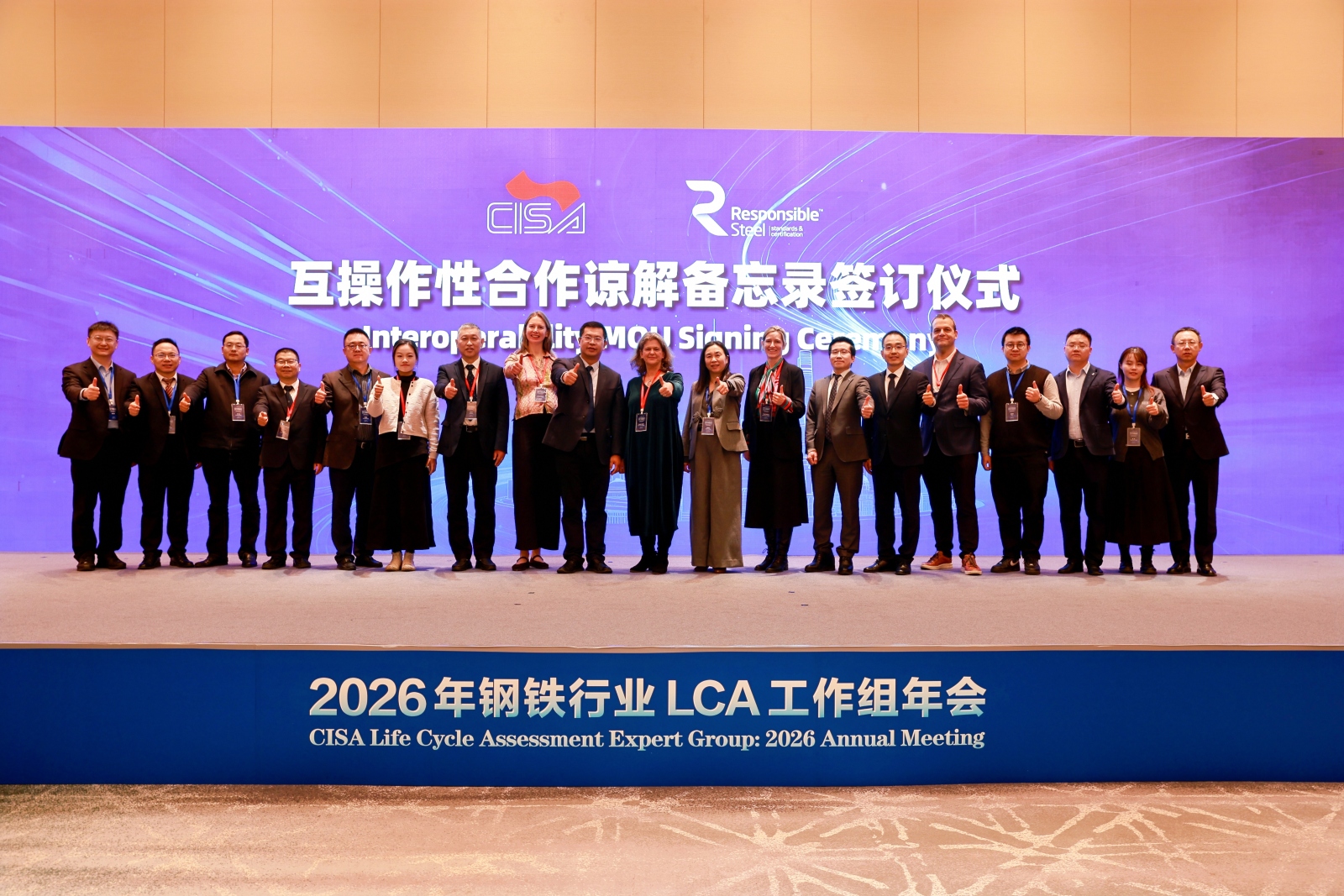
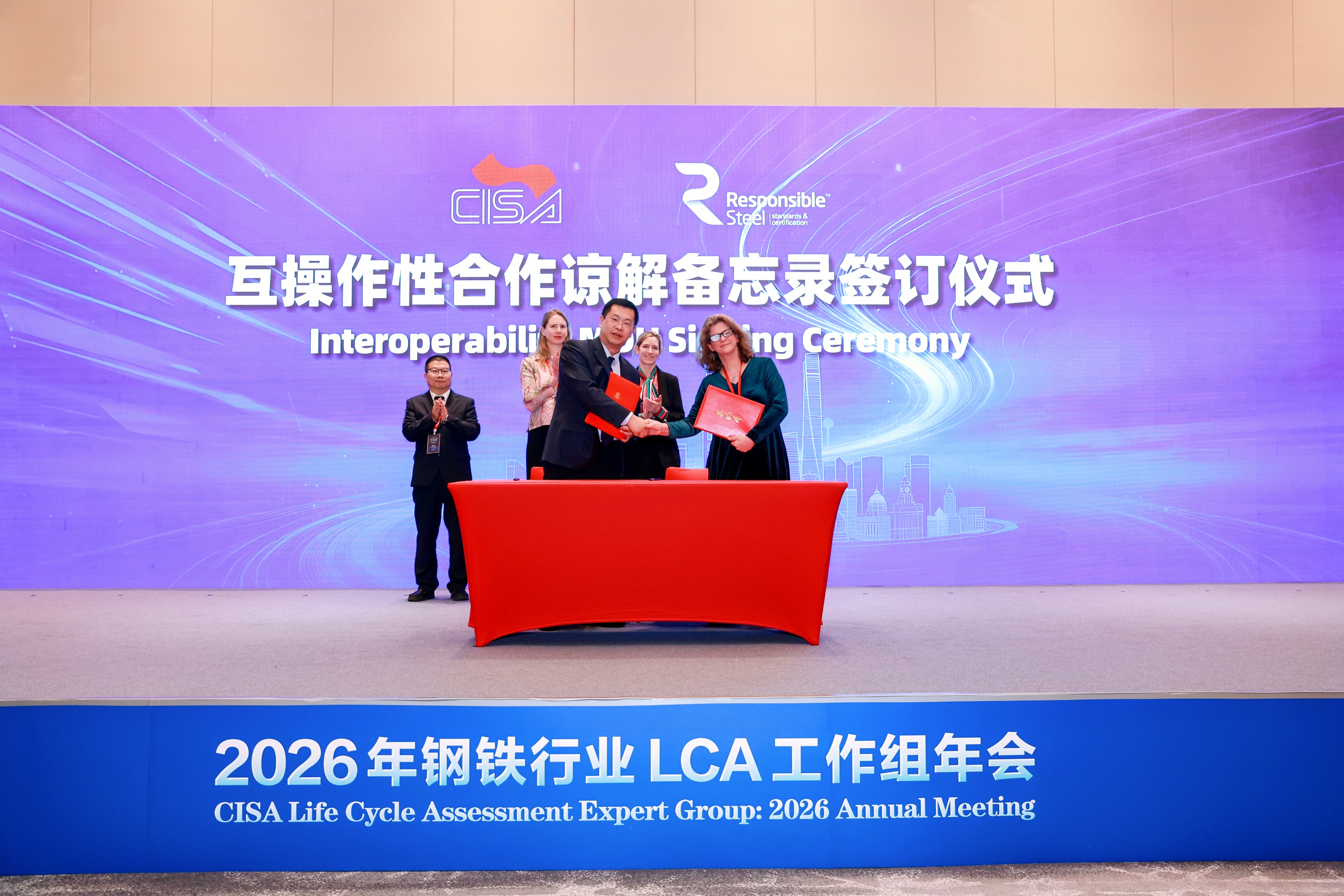
ResponsibleSteel's quest for a coherent market for decarbonised steel in 2026 got off to a constructive start this month. Following the announcement of our landmark agreements with the Chinese Iron and Steel Association (CISA) and the Low Emission Steel Standard (LESS) at COP30, ResponsibleSteel was in China in January to kick off our work on interoperability with CISA. This work in China complements our parallel project with Brussels-based LESS.
The goal? To build trusted data and claims on decarbonisation.
During our trip, our Director of Programmes, Amy Jackson, our Decarbonisation Lead, Alli Devlin, and myself had the opportunity to:
- Present to the Chinese steel value chain our C2F (China's low-carbon emission steel standard) interoperability MoU at CISA's annual LCA conference.
- Connect with our Chinese members, including SKF, World Resources Institute (WRI), Climate Group, VAMA (Valin ArcelorMittal Automotive JV), Penglai Dajin, and some of our certification bodies working in China, including Afnor and China Quality Certification Centre (CQC).
- Get to work on our C2F-ResponsibleSteel Interoperability Project, structuring the discussions around our Framework for Credible Interoperability.
- Visit the 15mtpa Zhanjiang steel plant, where a new DRI-EAF line was launched in Dec 2025. This has involved the production to date of iron reduced with hydrogen in a 1mtpa DRI plant. Whilst this is currently produced from refined coke oven gas, the project is a hugely significant demonstration of the potential to produce hydrogen-based DRI at an industrial scale.
.jpg)
What do ResponsibleSteel's interoperability projects look like in practice?
In short, interoperability means measuring emissions using rules that are as aligned as possible, and recognising the differences, to enable comparison on a like-for-like basis. Imagine the benefit this would bring for anyone wanting to distinguish what good looks like, for example, procurement teams, investors, and policymakers.
But making interoperability work in practice requires a lot more if we want a reliable, credible and sustainable system that generates high-quality, comparable data.
We've outlined the key components of this in our Framework for Credible Interoperability, which will inform both our work with LESS and CISA:
- Aligned GHG accounting rules
- A reliable calculation tool
- A robust assurance mechanism
- Credible claims protocols
- Good governance, oversight and resourcing
- Appropriate data management
- Strong operations management systems
This is how markets are built: first with innovation, then with the necessary rules and systems that enable good information to flow – so that steel buyers can understand, investors can evaluate, and steelmakers can compete, based on emissions performance that everyone can trust.


May 2022 Newsletter
Please view our May 2022 newsletter by clicking the link below:


ResponsibleSteel Appoints New CEO to Lead Growth Agenda
The Board of ResponsibleSteel today announces that it has appointed leading steel industry sustainability expert, Annie Heaton, as its new Chief Executive Officer, effective June 13, 2022.
Following an international search and selection process, led by a combined RS civil society and business selection panel, Annie was chosen as the preferred CEO, from a strong field of candidates.
Annie has spent the last eight years shaping ArcelorMittal’s sustainability agenda. Prior to this, she worked with the global renewable energy company RES and several non-profit organisations, including ActionAid and Save the Children.
ResponsibleSteel Chairman, Gerry Tidd, said; “This vital role attracted talented executives from around the world, demonstrating how important sustainability is in the global steel sector. Annie Heaton was chosen for her expertise and experience and her clear vision and strategy for taking ResponsibleSteel to the next phase of growth and development.”
“Annie joins us from a senior sustainability role with major international steelmaker, and founding RS member, ArcelorMittal. Her appointment comes at a critical and exciting time for ResponsibleSteel; our membership is growing, steelmaking sites are being audited and certified, and the world’s first standard for certification of steel products is nearing completion and being prepared for launch,” Mr Tidd said.
Based in London, Annie Heaton will lead the RS Secretariat to drive sustainability through the steel industry, with a keen focus on expansion in Asia and North America.
Of her selection as CEO, Ms Heaton said, “I am proud and delighted to be joining ResponsibleSteel to lead it into a new phase of growth and significance. The world understands that consistent credible sustainability standards are needed to support the steel sector’s progress to a sustainable, decarbonised industry. ResponsibleSteel is ready to meet this need.”
She continued, “2022 is an exciting year for ResponsibleSteel, its Members, and the decarbonisation of the steel industry. I am delighted to be taking the helm at such an important time and look forward to starting in June.”
Contacts:
Ali Lucas, Acting CEO:
alucas@responsiblesteel.org
+44 7786 546724
Savannah Hayes, Communications Manager:
shayes@responsiblesteel.org
+44 7588 785909
Denise Meredith, Communications and Media Consultant:
denisemeredith1857@gmail.com

April 2022 Newsletter
Please view our April 2022 newsletter by clicking the link below:

ResponsibleSteel announces world’s first certified steelmaking site in North America: U.S. Steel’s Big River mill in Osceola, Arkansas
The Big River Steel mill in Osceola, Arkansas owned and managed by U. S. Steel has been awarded the first-ever ResponsibleSteel™ site certification in North America.
Big River Steel received the site certification after SRI Quality System Registrar (SRI) conducted an independent third-party audit and determined the mill met the stringent requirements of the ResponsibleSteel Standard, the industry’s only global multi-stakeholder standard and certification initiative. The rigorous audit consisted of gathering comprehensive materials, onsite visits and worker and stakeholder interviews.
As an innovative steel producer, Big River Steel is setting a new gold standard for North America. Customers want rigorous standards that have been independently verified to help them achieve their own sustainability goals, and ResponsibleSteel provides the common platform for all assets of the steel value chain.
Alison Lucas, acting CEO said, “We are delighted that U. S. Steel’s Big River site has become the first site in North America to successfully pass an independent audit against the ResponsibleSteel Standard – the global sustainability standard for the steel sector. This is a significant achievement. Our Standard, developed by the only international multi-stakeholder steel initiative, ensures that steelmaking sites comply with a comprehensive selection of criteria that reflect the full breadth of the ESG spectrum. So meaning they are not only taking steps towards decarbonization but also of prioritizing the health and safety of workers and operating with the utmost respect for human rights and labour rights and care for the natural environment.”
Lucas concluded, “As one of the largest steel-producing countries globally, getting steelmakers in the US certified is crucial. We are looking forward to working closely with US Steel on the next stage of their journey.”
The audit identified three areas that will require further improvement from Big River Steel. Two of these are related to paid annual leave and paid maternity leave. The ResponsibleSteel Standard aligns with the International Labour Organization (ILO) on these two issues. The United States has not ratified the related ILO Conventions, therefore U.S.-based companies grant paid annual leave and maternity leave to their employees differently. ResponsibleSteel will consult with stakeholders on how these two requirements should be applied in the United States.
For more on the story click here.

Suspension of certain auditing activities
ResponsibleSteel expresses grave concern about actions that compromise global peace and give rise to humanitarian crises. The principles which form the ResponsibleSteel Standard emphasise, among other matters, the importance of protecting and promoting human rights, labour rights, and safe and healthy workplaces, as well as legal compliance. The current and ongoing actions of aggression of the Russian Federation in Ukraine do not align with ResponsibleSteel’s principles, and ResponsibleSteel agrees that such actions violate International Law.
Due to the evolving nature of Governmental sanctions affecting certain organisations and individuals in the international steel industry, as imposed by the EU, Australia and other countries and organisations, ResponsibleSteel has decided that it is necessary to impose a suspension on the auditing of facilities of certain members.
At this stage, because of the circumstances described above, as well as the order of the International Court of Justice for the Russian Federation to immediately cease its military operations in Ukraine, this action only affects members who ResponsibleSteel considers have significant operations in, or substantive connections to, the Russian Federation.
All members affected by this ResponsibleSteel decision will be individually contacted to have the situation explained to them. A suspension of auditing does not alter an affected member’s membership rights in ResponsibleSteel.
ResponsibleSteel will reconsider this decision regularly. ResponsibleSteel is hopeful that as soon as is possible, bearing in mind prevailing sanctions regimes, geopolitical stability, and other relevant circumstances, auditing suspensions will be promptly lifted.
This decision of ResponsibleSteel should not be taken to imply that any particular member of ResponsibleSteel, or any officer or employee of a member of ResponsibleSteel, has engaged in any wrongdoing or other inappropriate conduct. ResponsibleSteel simply believes that a generalised, and consistent, position on suspension of auditing is an effective measure to ensure that ResponsibleSteel does not breach any of its obligations under international or domestic laws, that personnel involved in the auditing process can carry out their duties independently and effectively and are not subject to any increased risks to their personal health and safety, and that engagement of stakeholders in the auditing process can be effective.
It may be that, over time, Governmental sanctions and other circumstances require ResponsibleSteel to take further action, including expanding limitations on auditing activities, and action affecting memberships, but such steps are not being considered at this stage.
For enquiries or comments, please contact:
Ali Lucas, Acting CEO and Communications Director +44 (0) 7786 546 724

March 2022 Newsletter
Please view our March 2022 newsletter by clicking the link below:

First certified steelmaking site in Latin America announced: ArcelorMittal Tubarão, Brazil
ResponsibleSteel has awarded the world’s first certification to a steelmaking site in Latin America. ArcelorMittal Tubarão is the first industrial plant in Latin America to receive the sustainability certification for its operations.
Ali Lucas, acting CEO for Responsible Steel, said “The steel sector has been strongly affected by the Covid-19 pandemic and its recovery is essential to the region. But growth cannot, and should not, occur at all costs. For this reason, being granted the first ResponsibleSteel certificate is extremely important. This is not an easily achieved accomplishment and the highlights of the sector are not focused only on decarbonization processes but also on the respect for human rights, labour rights and local communities always ensuring that health and safety remain a priority and focusing on the larger spectrum of ESG principles. The importance of a responsible steel supply chain is in line with the Latin America stakeholders, who know very well the connections between mining and steel production. This is the reason why a responsible supply chain will become an important and growing part of the ResponsibleSteel certification process. We applaud ArcelorMittal Tubarão on this momentous achievement.”
For more on ResponsibleSteel’s certification and Standards click here: https://www.responsiblesteel.org/certification
For more on the story click here: https://brasil.arcelormittal.com/sala-imprensa/noticias/tubarao/arcelormittal-tubarao-obtem-certificacao-em-sustentabilidade-inedita-nas-americas

International Women’s Day
Today is International Women’s Day. A day to celebrate women leaders everywhere who are campaigning for a better, more sustainable and just world. To highlight the day, we asked two women from ResponsibleSteel – Hayley Jarick and Ali Lucas- to tell us what International Women’s Day means for them.
Hayley Jarick is Director ResponsibleSteel, CEO and Company Secretary of the Supply Chain Sustainability School Limited, worked many roles in many industries, mentor, volunteer, wife, and mum.
Ali Lucas is ResponsibleSteel’s Acting CEO. Ali worked on the launch of the Forest Stewardship Council and leading campaigns against the illegal trade in wildlife. She was a co-founder of The Climate Group and led WWF UK’s marketing and communications work delivering annual income of £70 million. Ali joined ResponsibleSteel in 2019.
What does International Women’s day mean to you?
HJ: It is a day where women are socially permitted to celebrate their achievements without the negative stigma that typically follows boasting. However, it is also a day to reflect on the zealousness of your ambitions and those you officially/unofficially lead.
AL: It’s a reminder – a time to reflect on women in leadership and know that seeing women in different roles of leadership is important in changing the future for young girls
Tell us how you first became involved in the environment movement?
HJ: I was born. It’s always been a core value of mine, but I only started working in the field after being inspired by an amazing woman, Amy Luscombe, who showed me how to unite my personal values with my career.
AL: I was drawn to working for an organisation that I had supported during my childhood – World Wildlife Fund – which worked globally to save species and their habitats
What’s the best thing about your job?
HJ: The best thing about my job is working for purpose. I know that one day I can sit back and tell my kids and grandkids that I spent my time and used my talent in the pursuit of making the world a better place for them and future generations.
AL: Being able to see how different sectors can achieve real impact by working together – not always an easy conversation !
Your proudest “environmental or ESG” moment? Why?
HJ: I work with a diverse group of people from various industries and sized organisations. And the one thing that gives me pride, above all others, is the look in an individual’s eye when they first realise the opportunities and benefits of sustainability for themselves, their family and their career.
AL: Launching The Climate Group at a time when, unbelievably, the issue of climate change was just emerging into mainstream dialogue.
What role does gender play in the climate crisis do you think?
HJ: I don’t think gender plays a role explicitly, but the lack of diversity more broadly in crucial decision-making positions is a significant contributor to human-induced climate change.
AL: The real impacts of climate change are more than often felt at a devastating human level – for example floods and drought where women tend to be on the front line of dealing with the practical problems – quite literally, survival.
Are there enough women leaders in climate change? And if not, how can we change this?
HJ: There are plenty of women leaders in climate change; you just have to look at groups like 1 Million Women {https://www.1millionwomen.com.au/}. The problem is we need more followers of all genders.
AL: There are many pioneering women working on climate change around the globe. It’s an exciting arena for women representing many different aspects of this issue – including science. Women everywhere are rising to the challenge and leading on solutions. I find many women in this field, including the women I work with and our members, very inspiring. They give me hope.
What does Responsibility mean to you?
HJ: Responsibility is owning the impact of our actions and apathy, intentional or incidental, whether detrimental or delightful.
AL: It really is every person playing their own part on a daily basis – small changes in personal behaviour can have a big influence and a real impact.
Through history, which famous environmental or social justice (or both) leaders have inspired you and why?
HJ: When I was a teenager, I was privileged enough to hear a live address from Hafsat Abiola, an inspiration advocate for democracy, gender equality and women’s leadership in Africa and around the globe. She responded to her father’s imprisonment and assassination of her mother by founding the Kudirat Initiative for Democracy (KIND) and continuing the progress her parents started. After hearing her story, many of us in the room wanted to know how we could help her. Her response has stuck with me ever since. She didn’t want us to help her. Instead, she wanted us to find a cause that had meaning for us and to be passionate about that.
AL: Christiana de Figueres. She is such as icon and recognised leader on global climate change. Assuming responsibility for the international climate change negotiations after the failed Copenhagen conference of 2009, she was determined to lead the process to a universally agreed regulatory framework – and she did it!
Do you have a favourite ecosystem/flagship species? If so, what is it and why?
HJ: Not favourites, but the connections between species still intrigue me.
AL: I’ve always been drawn to the Arctic – very enigmatic and mysterious – that very fragile ecosystem of giant expanses of ice and snow, huge icebergs, drifting in the arctic seas supporting a myriad of plant and animal life …and a huge indicator of how the world’s climate is changing
In a sentence, what is leadership?
HJ: Leadership is inspiring and helping others become their best selves.
AL: Having a clear vision – being able to listen but having confidence to take the decisions
Inspiring stuff! Meanwhile, we’d also love to know from all our members and supporters who inspires you? Please do leave a comment on our Twitter or LinkedIn.

February 2022 Newsletter
Please view our February 2022 newsletter by clicking the link below:

ResponsibleSteel announces world’s first certified steelmaking site in Australia: BlueScope Port Kembla Steel Works
ResponsibleSteel has awarded the world’s first certification to a steelmaking site in Australia. The BlueScope Australian Steel Products Manufacturing site in Port Kembla, Australia manufactures plain carbon steel, low alloy steel and large structural steel products including continuously cast slabs, hot rolled plate, and hot rolled, cold rolled, metal coated and organic coated flat steel strip in coil form.
ResponsibleSteel acting CEO, Ali Lucas said :
“Having the first ResponsibleSteel certified site in Australia is critically important. Australia’s steel industry generated $29 billion in annual revenue and employs over 110,000 Australians. Australia is also one of the most critical biospheres on earth.”
“The successful assessment of a steel making site against the very exacting criteria within the ResponsibleSteel Standard highlights the importance of a steel sector not only focused on decarbonisation but also on ensuring that health and safety remains of paramount importance, respecting human rights, worker rights and local communities, and focused on the whole ESG spectrum.”
“We applaud BlueScope on this momentous achievement and look forward to working with them closely on the next stage of their journey – certified Steel, which will further reassure business and consumers that the steel they use has been not only produced responsibly but also sourced responsibly at every stage of its journey.”
BlueScope’s commitment will send a clear and strong message to markets, investors, financiers and governments about the steel industry’s intent to not only decarbonise steel production, but also to ensure responsible ESG practices in steelmaking, has well and truly begun.”
For more on story click here. https://www.bluescope.com/sustainable-steel/responsiblesteel

January 2022 Newsletter
Please view our January 2022 newsletter by clicking the link below:

December 2021 Newsletter
Please view our December 2021 newsletter by clicking the link below:
