

Reflections from China: ResponsibleSteel's CEO Annie Heaton discusses building interoperability across global standards
Interoperability: Building a bridge between global standards
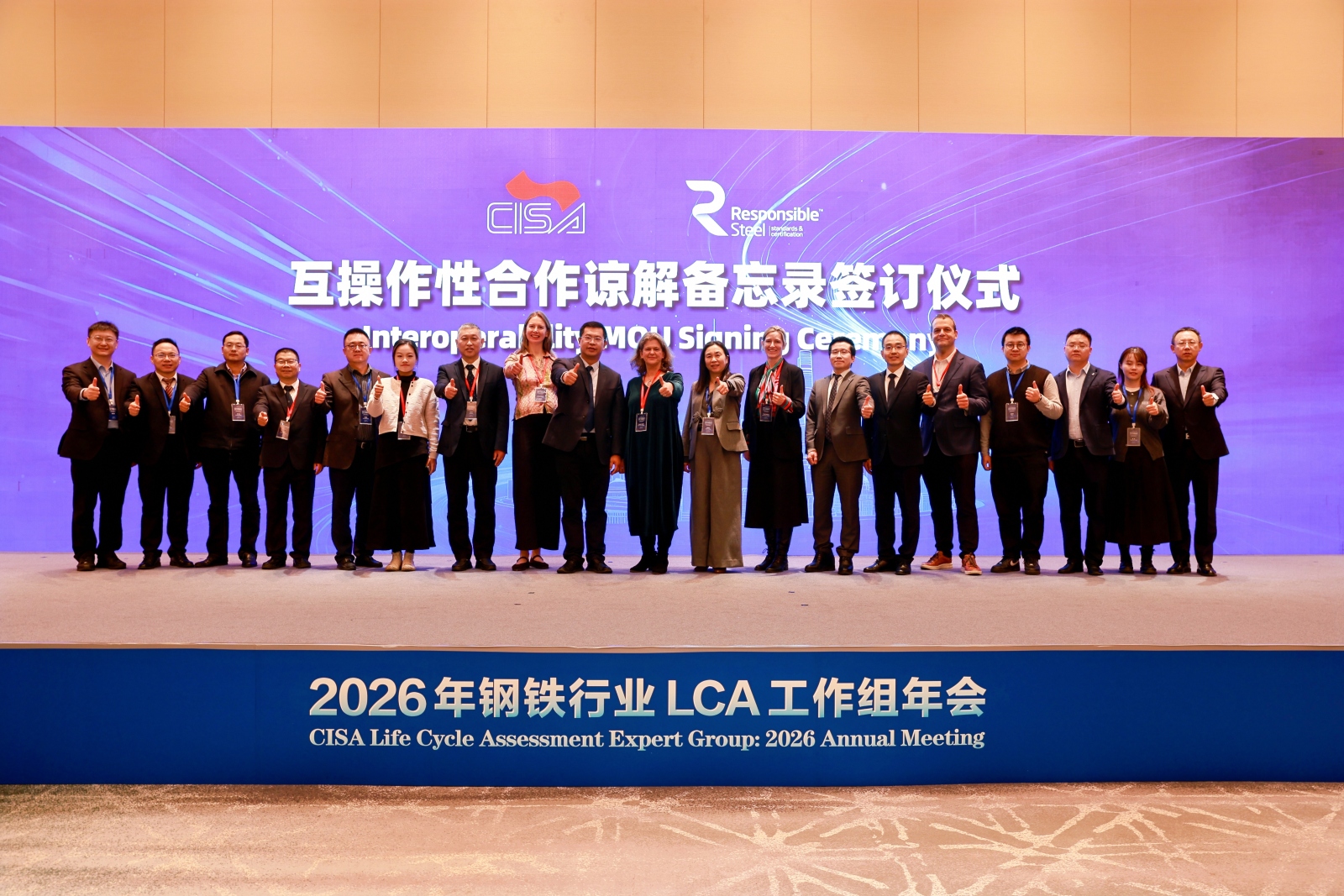
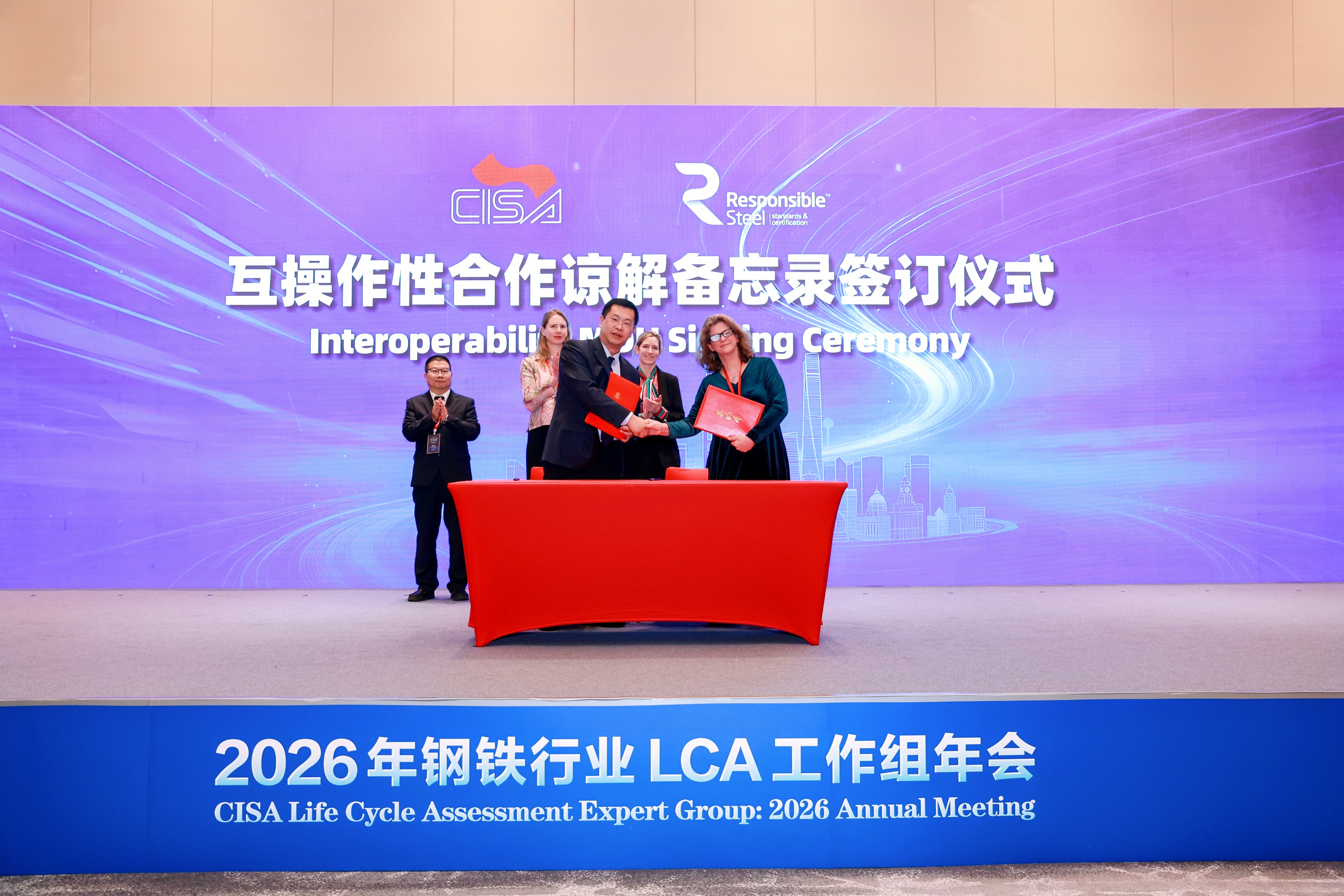
ResponsibleSteel's quest for a coherent market for decarbonised steel in 2026 got off to a constructive start this month. Following the announcement of our landmark agreements with the Chinese Iron and Steel Association (CISA) and the Low Emission Steel Standard (LESS) at COP30, ResponsibleSteel was in China in January to kick off our work on interoperability with CISA. This work in China complements our parallel project with Brussels-based LESS.
The goal? To build trusted data and claims on decarbonisation.
During our trip, our Director of Programmes, Amy Jackson, our Decarbonisation Lead, Alli Devlin, and myself had the opportunity to:
- Present to the Chinese steel value chain our C2F (China's low-carbon emission steel standard) interoperability MoU at CISA's annual LCA conference.
- Connect with our Chinese members, including SKF, World Resources Institute (WRI), Climate Group, VAMA (Valin ArcelorMittal Automotive JV), Penglai Dajin, and some of our certification bodies working in China, including Afnor and China Quality Certification Centre (CQC).
- Get to work on our C2F-ResponsibleSteel Interoperability Project, structuring the discussions around our Framework for Credible Interoperability.
- Visit the 15mtpa Zhanjiang steel plant, where a new DRI-EAF line was launched in Dec 2025. This has involved the production to date of iron reduced with hydrogen in a 1mtpa DRI plant. Whilst this is currently produced from refined coke oven gas, the project is a hugely significant demonstration of the potential to produce hydrogen-based DRI at an industrial scale.
.jpg)
What do ResponsibleSteel's interoperability projects look like in practice?
In short, interoperability means measuring emissions using rules that are as aligned as possible, and recognising the differences, to enable comparison on a like-for-like basis. Imagine the benefit this would bring for anyone wanting to distinguish what good looks like, for example, procurement teams, investors, and policymakers.
But making interoperability work in practice requires a lot more if we want a reliable, credible and sustainable system that generates high-quality, comparable data.
We've outlined the key components of this in our Framework for Credible Interoperability, which will inform both our work with LESS and CISA:
- Aligned GHG accounting rules
- A reliable calculation tool
- A robust assurance mechanism
- Credible claims protocols
- Good governance, oversight and resourcing
- Appropriate data management
- Strong operations management systems
This is how markets are built: first with innovation, then with the necessary rules and systems that enable good information to flow – so that steel buyers can understand, investors can evaluate, and steelmakers can compete, based on emissions performance that everyone can trust.


Tata Steel joins ResponsibleSteel: Tata Steel operations globally have today become a member of ResponsibleSteel
Tata Steel makes further commitment to responsible steelmaking around the globe
Tata Steel today [24 September] announced it has joined forces with global steel-making standards organisation ResponsibleSteelTM, giving customers and consumers even more confidence the company is committed to reducing greenhouse gas emissions as well as creating jobs and protecting communities.
All of Tata Steel’s operations in 26 countries have signed up to ResponsibleSteel the industry’s first globally-present standards and certification scheme for sustainability. Tata Steel is one of the largest steelmakers in the world to become a member.
The move is a further demonstration to the company’s customers of its commitment to acting responsibly in all of its activities, from looking after its workforce to managing the environmental impact of its steelmaking operations, from respecting and supporting its local communities to greening its supply chain. Through this early membership, Tata Steel will be supporting the further development of the ResponsibleSteel standards used to guide the sector’s future actions.
Tata Steel Limited CEO and MD, Mr T V Narendran, said: “We are pleased to become a member of ResponsibleSteel, the steel sector’s first and only globally present, multi-stakeholder standard and certification initiative for sustainability. We have always emphasized our commitment to sustainable business practices and responsible supply chains. We view sustainability as integral to our business and our policies demonstrate our commitment towards sustainable development and guide us in formulating and implementing our long-term sustainability strategy.”
“The membership of ResponsibleSteel will provide an ideal platform to build on these credentials of Tata Steel and enable a responsible ecosystem for the steel industry.”
ResponsibleSteel is a not-for-profit organisation with members from every stage of the steel supply chain. It has developed an independent certification standard and programme which aims to align with a globally recognised framework used by credible sustainability standards known as the ISEAL Codes of Good Practice.
Steel is the world’s most widely used material and those who use it in the transport, automotive, infrastructure, packaging, construction, energy and white goods sectors have a growing expectation that the materials they work with are responsibly sourced and produced.
Tata Steel Europe CEO, Henrik Adam, said: “As part of the Tata Steel family, this membership gives our customers even greater confidence that they are buying their products from a company which is committed to responsible business practices.
“That is important because it is increasingly what consumers are quite rightly expecting of them.
“ResponsibleSteel also provides us with a framework through which we will achieve our mission to build the leading European steel business that is sustainable in every sense.”
The ResponsibleSteel certification framework is of direct benefit to producers already maintaining high standards and expected to bring benefits industry-wide, by encouraging those who could operate more responsibly to raise their game.
Ali Lucas, Executive Director, ResponsibleSteel, said: “We are absolutely delighted to welcome Tata Steel as a business member of ResponsibleSteel. As one of the world’s leading steel producers, Tata Steel brings huge depth, breadth and influence to help us achieve our mission and goals.”
She added: “Working within the world’s largest materials industry – responsible for more than 7% of global greenhouse gas emissions – ResponsibleSteel represents members from every stage of the steel supply chain. Businesses from multinational mining organisations, global steel producers, processers and end users, as well as civil society, are working with us to find solutions to producing steel in a responsible way. As the world’s only multi-stakeholder standard and certification initiative for the steel sector, we work by building collaborative relationships that create real impact for both the planet and society. We know that the clock is ticking in both finding and implementing solutions to the global environmental crisis. Working with Tata Steel will help us significantly accelerate our vision towards a world where only responsible low CO2 steel is produced.”
-ends-
For further information: Damien Brook on +44 (0)7818 588545 or damien.brook@tatasteeleurope.com
About Tata Steel’s European operations
Tata Steel is one of Europe’s leading steel producers, with steelmaking in the Netherlands and the UK, and manufacturing plants across Europe. The company supplies high-quality steel products to the most demanding markets, including construction and infrastructure, automotive, packaging and engineering. Tata Steel works with customers to develop new steel products which give them a competitive edge. The Tata Steel group is among the top global steel companies with an annual crude steel capacity of 34 million tonnes. It is one of the world’s most geographically-diversified steel producers, with operations and a commercial presence across the world. The group’s turnover (excluding its South East Asia operations) in the year ending 31 March 2020 was US $19.7 billion.


ResponsibleSteel™ welcomes Turkish steel company BDC into Membership
BDC is a steel mill located in the midwest of Turkey with a production set up of induction furnaces, ladle furnace, CCM and rolling mill to produce rebar for building industries. Actual production per annum is 350,000 Tons.
Muammer BILGIC, Managing Director says “We are excited to enter a new challenging period in the history of this very young steel company” he went on to say “BDC is honoured to be a member of the ResponsibleSteel family and hopes to make a contribution to the industry’s sustainability future from our own country.”
BDC is dedicated to recycling, and committed to designing a complete steel production chain that has minimum impact on the environment and a positive impact on society. This minimum impact is not a fixed set of red lines to BDC, effects are not limited by any regulation, public acknowledgement, or common rules. As a scrap steel recycler, all parameters of interrelations of BDC’s activities chain are always subject to internal scrutiny and re-evaluation to refine our knowledge, to better understand what we can do to establish ongoing progress in our development.
Being a member of ResponsibleSteel will force us to prove our ethical and environmental commitments. Zero waste is not a marketing trick, it is a fundamental target for BDC. Responsibility educates, we are ready to be taught by our responsibilities and fulfil its requirements. We are in the era in which we should say ‘new words’ to protect our World.”
We are delighted to welcome BDC into ResponsibleSteel as a Business Member. BDC are our first member based in Turkey. We very much hope that BDC’s decision to join ResponsibleSteel will pave the way for other businesses working in the Turkish steel sector to engage with us” said Ali Lucas, Executive Director – ResponsibleSteel.
“We are very much looking forward to learning from BDC through our various membership workstreams and projects, and hope that they will also benefit from engagement with our organisation as well as our other members.”

Global architecture firm Grimshaw joins ResponsibleSteel™
Grimshaw was founded by Sir Nicholas Grimshaw in 1980. The practice operates worldwide, across all major sectors, with offices in Los Angeles, New York, London, Paris, Dubai, Melbourne and Sydney, employing over 500 staff.
Grimshaw’s mission has always been to deliver lasting, meaningful design that brings value and joy to clients and users. With each project Grimshaw delivers, there is an innate respect of the fragility of the planet and its depleting resources. Building on this history, the practice’s future global objectives are to design net zero carbon ready buildings and infrastructure by 2025 and to deliver socially and environmentally regenerative buildings by 2030.
Dr. Paul Toyne, Practice Leader for Sustainability at Grimshaw said: “To address the climate emergency, we need participation from all parts of the construction supply chain. Steel contributes to global greenhouse gas pollution, so we are proud to join ResponsibleSteel in their efforts to support the steel sector to reduce emissions and ensure sustainability and responsibility in every stage of steel’s value chain.”
“It is very exciting to welcome our first member from the Architecture/Design sector to ResponsibleSteel.” said Ali Lucas, Executive Director, ResponsibleSteel. “Working with, and learning from an organisation like Grimshaw, with their wealth and depth of experience globally in designing socially and environmentally sustainable buildings, will bring a new level of insight into our programme and project planning and discussions. I am sure that other ResponsibleSteel members will also benefit greatly from having Grimshaw participate and share their expertise.”

New forestry initiative Emergent is holding its first New York Climate Week event
We wanted to take this opportunity to do something different and invite you to Emergent’s New York Climate Week webinar: Every Tool We’ve Got, on Friday, September 25th from 2-3PM EST. Emergent is linked to a couple of our Civil Society members and sustainable forestry is a passion for all of ResponsibleSteel’s secretariat.
Emergent is a non-profit organization with the sole mission of accelerating the speed and scale of tropical forest conservation to combat the climate crisis. With an international team of world-class climate experts and a board with deep private and public sector experience, Emergent is supported by a coalition including the Environmental Defense Fund (EDF), the Rockefeller Foundation, and the Norwegian government’s International Climate and Forest Initiative (NICFI).
Addressing the current climate and deforestation emergencies require systemic and transformative solutions. Emergent was created to catalyze this type of action by supporting countries that successfully reduce deforestation, delivering climate impacts and other vital benefits for the people and animals that call the forest home.
The private sector has the potential and opportunity to mobilize its power to halt and reverse deforestation. But it’s not happening fast enough. The world loses 7 million hectares of tropical forest annually — the equivalent of 40 football fields a minute, every minute. And once it’s gone, it’s gone.
If interested please sign up as soon as possible, as the deadline is looming.

GHG and Steel: mapping the landscape of initiatives
Steel’s contribution to – and potential role in reducing – the world’s emissions of greenhouse gases is shooting up the global agenda. ResponsibleSteel welcomes this recognition and growing sense of urgency. But it brings challenges. One of those is the proliferation of initiatives, projects, programmes and calls for action that affect the steel sector.
The context and overall goal for all of these is the same, but the very number of initiatives makes it hard to engage effectively. Steel’s ubiquity as material means that is affected by a multitude of different efforts – whether they are focussed on leveraging finance and investment, materials for low carbon buildings and infrastructure, steel for automotive manufacturing, or new policy initiatives focussed on public procurement, the ‘Green Deal’ or post Covid-19 support for industry. And steel also has a role as the major customer for mined materials, including iron ore and coking coal.
ResponsibleSteel and its steelmaker and civil society members are at the heart of many of these initiatives. The first ResponsibleSteel standard was published in November 2019, and steelmaking sites are currently undergoing assessment. The Climate Group’s ‘SteelZero’ project, in collaboration with ResponsibleSteel, aims to build momentum and help align demand for ‘low GHG emission’ steel. We are active supporters of the We Mean Business Coalition and we and many of our members are involved with and support the work of ETC. But how do all these initiatives fit together?
On 29th September ResponsibleSteel will be hosting two member webinars – one at 09.00 BST, and then repeated at 17.00 BST – to present and discuss the results of a mapping exercise we are carrying out to better understand the landscape of GHG initiatives that affect the sector and ResponsibleSteel’s role and relationships with those initiatives. This will be the first of our series of ResponsibleSteel Member webinars. We will be sending out invitations this week – Members and Associates, please mark your schedules if you would like to attend.

Stakeholder Q&A on draft ‘GHG Emission Requirements for the Certification of Steel Products’
ResponsibleSteel is hosting two Q&A sessions for stakeholders interested in the draft ‘GHG Emission Requirements for the Certification of Steel Products’, to take place on Wednesday 30th September, and Wednesday 7th October, with both sessions repeated at 09.00 and 17.00 BST.
At the beginning of the month we launched a 60-day public consultation on draft requirements to allow ResponsibleSteel certification of steel products: You can find the draft requirements, background information, options and consultation questions here.
The Q&A sessions will give stakeholders the opportunity to seek clarification on the intent or meaning of the draft requirements, in advance of any written feedback.
The sessions will include a short presentation followed by questions from participants. The sessions on 30 September will focus on Criterion 8.6, and the sessions on 7 October will cover the remaining criteria.
Participation is by invitation. ResponsibleSteel Members, Associates and Working Group members will receive their invitation in the coming days. If you are not a Member, Associate or currently participating in a working group but would like to attend please contact George Deslandes (gdeslandes@responsiblesteel.org) as soon as possible.

Audit of ArcelorMittal Bremen and Bottrop sites announced
ArcelorMittal, the world’s largest steel producer, seeks ResponsibleSteel certification of two of its sites in Germany, namely its steel mill in Bremen and its coking plant in Bottrop.
Certification body GUTcert will assess both sites against the ResponsibleSteel Standard version 1-0 and invites stakeholders to announce if they are interested in providing input to the audit. Stakeholder engagement is an important feature in ResponsibleSteel audits as it supports the collection and review of information from rich and varied sources, strengthening the credibility of audit results.
The ArcelorMittal Bremen and Bottrop audit will take place between 07 and 10 September. Stakeholders can find further information here.

ERM Joins ResponsibleSteel™
ResponsibleSteel is proud to announce that ERM has joined as an Associate Member.
ERM is one of the world’s leading sustainability services consultancies with more than 5000 practitioners in over 40 countries and territories that help address many of the sustainability challenges their clients face. This ranges from managing issues in facing the transition to a low carbon economy, to the operational issues such as health and safety in mining and manufacturing.
ERM’s relationship with the metals, mining and manufacturing sectors cuts across all types and size of business and has created an informed and client driven approach. ERM has helped clients on many schemes related to the Responsible Steel Standard providing technical, sustainability and social experts to ensure our outputs reflect the goals of our clients in driving improvements in systems implementation and performance through the value chain.
“ERM’s broad and deep experience in working globally with businesses along the steel supply chain will be a great asset in helping ResponsibleSteel and our members develop relevant and groundbreaking solutions towards achieving low carbon steel in the future” said Ali Lucas, Executive Director or ResponsibleSteel, “we are delighted to welcome ERM as an Associate member and benefiting from their insight and experience.”
Dirk Nuyens, global account director steel & mining from ERM commenting on this said : “The steel & mining sectors are currently facing a game changing transition towards a low-carbon economy, the Responsible Steel standard & certification initiative has an important role to play within this context. ERM is looking forward working with Responsible Steel to help drive steel producing companies, their upstream base material suppliers and their customers towards more responsibly sourced and produced steel.”

Responsible Sourcing Consultation Closes Soon
ResponsibleSteel has developed further requirements for the responsible sourcing of input materials used for steel making and steel processing. Meeting these requirements in addition to the already approved ResponsibleSteel Standard will allow steel sites to not only make claims about the way their site is operated, but also about their sourcing of input materials and the steel products they sell. The new requirements will be important to push demand for credible third-party verification of suppliers such as mine sites.
We are keen to receive your feedback on our proposals!
Consultation is open until 02 October and you can find the draft requirements, background information, options and consultation questions here.
Please provide your feedback by 02 October 2020 via the form provided on https://forms.gle/RbS1rT2F7i3sA11K7.
Make use of this opportunity to help shape the steel sector of the future and create responsible supply chains!

Consultation on Standard Interpretations – Now Open
In November 2019, the ResponsibleSteel Standard was launched, covering 12 Principles on environmental, social and governance (ESG) issues associated with the steel sector. Over the last few months, we have received enquiries from stakeholders, asking us to interpret some of the criteria and requirements in the Standard. Interpretation might be necessary because a criterion or requirement can be read in different ways, or because a certain situation was not considered when drafting the Standard.
The ResponsibleSteel team has drafted interpretations that we are now publishing for stakeholder feedback. Because our interpretations will become binding for all steel companies and auditors applying our Standard, it is important that we agree with stakeholders on what our requirements mean.
The consultation is open until 02 October 2020 and you can find further information here.

Reminder: ResponsibleSteel auditor training session still has spaces available
Being trained and approved as an auditor is a prerequisite for conducting certification audits against the ResponsibleSteel Standard. The next online auditor training, being the last one in 2020, will take place from 29 September to 01 October 2020 with sessions each day from 14:00 CET to 19:00 CET. The participation fee is 300 USD per auditor.
Auditors wanting to participate in the online training, must:
- Review the auditor approval and qualification requirements in the ResponsibleSteel Assurance Manual to ensure they meet our requirements (chapter 1.5 and Annex 3)
- Complete the auditor application form in the Assurance Manual (Annex 2)
- Send the completed application form, a full and up to date CV and all mentioned documentation to assurance@responsiblesteel.org by 15 September
- Prior to the training, study the ResponsibleSteel Standard and Assurance Manual, which can be accessed via https://www.responsiblesteel.org/certification/.
Only auditors that are affiliated with a certification body who is an Associate Member of ResponsibleSteel and has been approved by ResponsibleSteel may carry out audits against the ResponsibleSteel Standard.
The first certification bodies to become approved were AFNOR Certification and GUTcert.
They have recently been joined by ERM CVS, the independent certification, verification and assurance business of ERM Group. ERM CVS provides clients with a full suite of certification & assurance services, assuring & verifying corporate sustainability reports, GHG inventories and footprints, as well as certifying EHS management systems and programs. ERM CVS has been an Associate Member of ResponsibleSteel since March 2020, in a move that now sees them add the ResponsibleSteel Standard (RSS) to a growing suite of Metals & Mining services, including the Initiative for Responsible Mining Assurance (IRMA) and the Aluminium Stewardship Initiative (ASI).

Out for Consultation: Draft Requirements for Responsible Sourcing
The existing ResponsibleSteel Standard with its 12 Principles covering environmental, social (ESG) and governance issues allows certified steel sites to claim that their site is operated in a responsible manner. While the approved Standard asks for a high-level commitment to responsible sourcing and for evidence that this commitment is being implemented, it does not provide incentives to steel companies and their suppliers to work towards high levels of ESG performance in supply chains.
ResponsibleSteel is in the process of defining further requirements for the responsible sourcing of input materials used for steel making and steel processing. Meeting these requirements in addition to the already approved Standard will allow steel sites to not only make claims about the way their site is operated, but also about their sourcing of input materials and the steel products they sell.
Following plenty of discussion with our Members and our Board, we have now published a draft version of the responsible sourcing requirements and are keen to hear your views on them. These requirements will be important to push demand for credible third-party verification of suppliers such as mine sites.
You can find the draft requirements, background information, options and consultation questions here on our website.
Please provide your feedback by 02 October 2020 via this google documents form.
Make use of this opportunity to help shape the steel sector of the future and create responsible supply chains!
