

Reflections from China: ResponsibleSteel's CEO Annie Heaton discusses building interoperability across global standards
Interoperability: Building a bridge between global standards
ResponsibleSteel's quest for a coherent market for decarbonised steel in 2026 got off to a constructive start this month. Following the announcement of our landmark agreements with the Chinese Iron and Steel Association (CISA) and the Low Emission Steel Standard (LESS) at COP30, ResponsibleSteel was in China in January to kick off our work on interoperability with CISA. This work in China complements our parallel project with Brussels-based LESS.
The goal? To build trusted data and claims on decarbonisation.
During our trip, our Director of Programmes, Amy Jackson, our Decarbonisation Lead, Alli Devlin, and myself had the opportunity to:
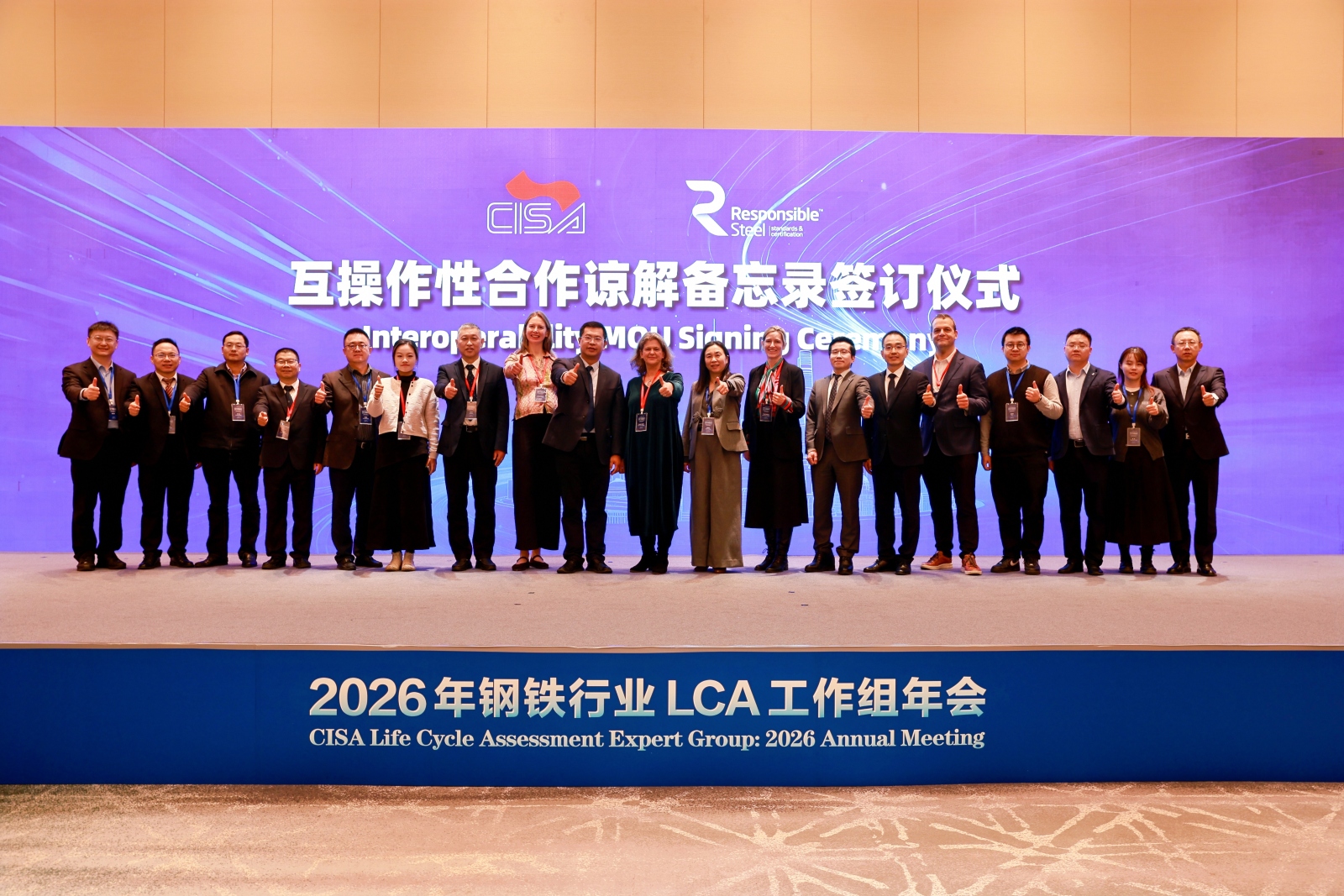
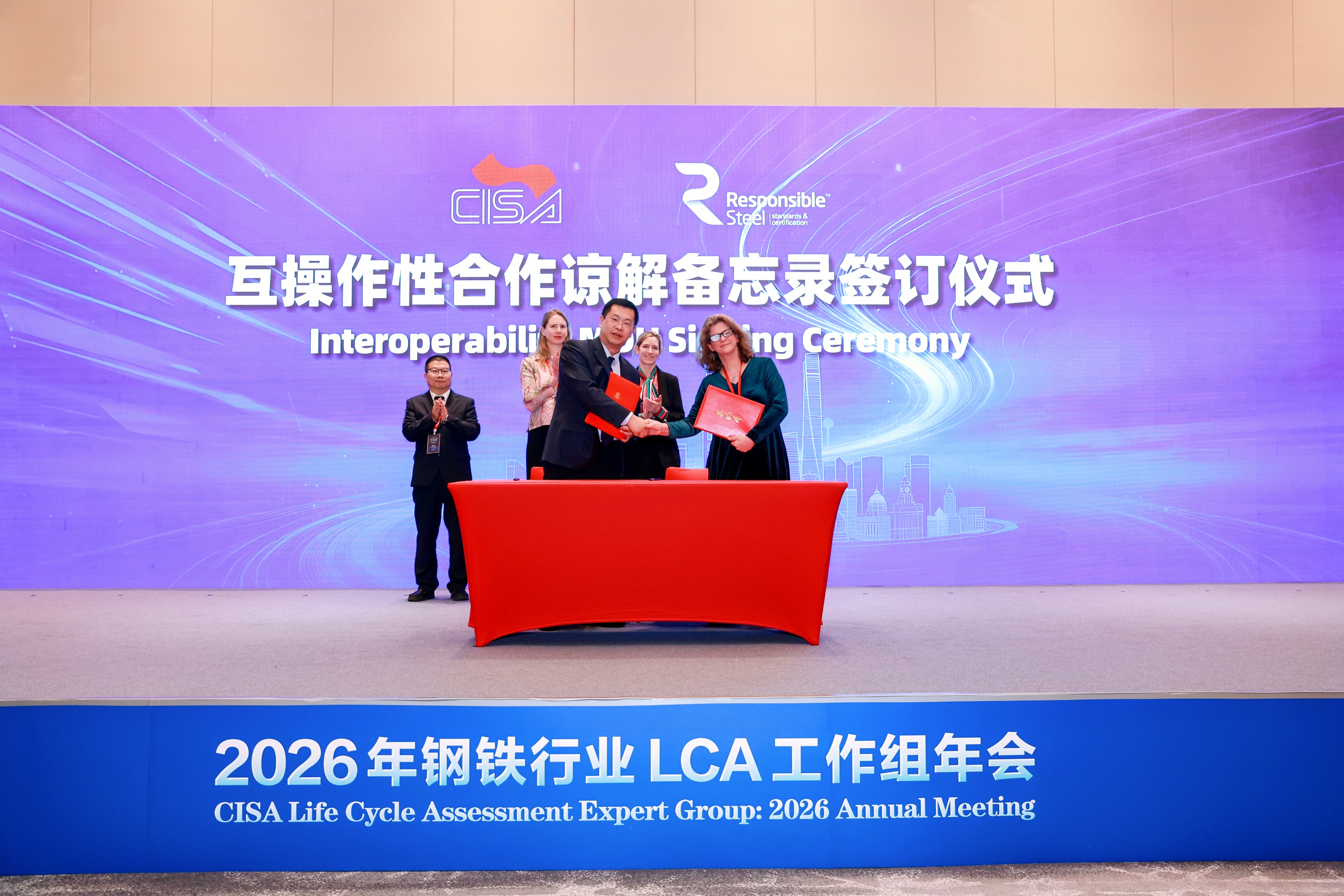
- Present to the Chinese steel value chain our C2F (China's low-carbon emission steel standard) interoperability MoU at CISA's annual LCA conference.
- Connect with our Chinese members, including SKF, World Resources Institute (WRI), Climate Group, VAMA (Valin ArcelorMittal Automotive JV), Penglai Dajin, and some of our certification bodies working in China, including Afnor and China Quality Certification Centre (CQC).
- Get to work on our C2F-ResponsibleSteel Interoperability Project, structuring the discussions around our Framework for Credible Interoperability.
- Visit the 15mtpa Zhanjiang steel plant, where a new DRI-EAF line was launched in Dec 2025. This has involved the production to date of iron reduced with hydrogen in a 1mtpa DRI plant. Whilst this is currently produced from refined coke oven gas, the project is a hugely significant demonstration of the potential to produce hydrogen-based DRI at an industrial scale.
.jpg)
What do ResponsibleSteel's interoperability projects look like in practice?
In short, interoperability means measuring emissions using rules that are as aligned as possible, and recognising the differences, to enable comparison on a like-for-like basis. Imagine the benefit this would bring for anyone wanting to distinguish what good looks like, for example, procurement teams, investors, and policymakers.
But making interoperability work in practice requires a lot more if we want a reliable, credible and sustainable system that generates high-quality, comparable data.
We've outlined the key components of this in our Framework for Credible Interoperability, which will inform both our work with LESS and CISA:
- Aligned GHG accounting rules
- A reliable calculation tool
- A robust assurance mechanism
- Credible claims protocols
- Good governance, oversight and resourcing
- Appropriate data management
- Strong operations management systems
This is how markets are built: first with innovation, then with the necessary rules and systems that enable good information to flow – so that steel buyers can understand, investors can evaluate, and steelmakers can compete, based on emissions performance that everyone can trust.


ResponsibleSteel™ is Kicking off the Benchmarking of Mine Level Verification Programmes
Mining is a key supplier of materials to the steel sector and part of ResponsibleSteel’s mission is to ensure that certified steel sites source mined materials in a responsible manner. We aim to achieve this by recognising mine sites that demonstrate high levels of environmental, social and governance performance according to credible verification programmes. Building on joint work by ResponsibleSteel together with our associate members the Initiative for Responsible Mining Assurance (IRMA) and Mining Association of Canada’s Towards Sustainable Mining programme (TSM), we are now launching the development of a methodology to benchmark mine site verification programmes. Recognition by ResponsibleSteel will help raise the market profile and drive demand for credible mine site verification programmes.
The ResponsibleSteel certification programme is being developed to cover the entire steel supply chain from mine site or scrap collector through to the steel end user (e.g. the car, construction or white goods manufacturing company). The ResponsibleSteel Standard (version 1-0) can be applied directly at sites where raw materials are processed, and at steel making and steel processing sites. Upstream supply chain activities, such as mining or the collection of scrap, will be covered wherever possible through the recognition of existing programmes that set a similarly ambitious standard and run an equally robust assurance programme to ResponsibleSteel’s.
ResponsibleSteel has been working with IRMA and TSM to determine how ResponsibleSteel could use the outputs of their respective mine level verification programmes as the basis for such recognition. IRMA, TSM and ResponsibleSteel are also working with the Responsible Jewellery Council (RJC), with the support of the ISEAL Innovations Fund which is resourced through the Swiss State Secretariat for Economic Affairs (SECO), on the application of a ‘joint audit protocol’ to facilitate recognition across different programmes.
These efforts are now extended and ResponsibleSteel will soon present draft recognition criteria and a proposed assessment methodology to its members and stakeholders for feedback. Recognition of credible verification programmes is expected to include an assessment of:
- the standard(s) against which sites supplying material are assessed, for example mine site standards, or processing site standards, including consideration of the extent to which the standard addresses and aligns with the issues covered by the ResponsibleSteel principles and criteria;
- the system for determining whether the requirements of the standard have been met (verification), including consideration of the systems for resolving complaints or disputes in relation to such assessments;
- the extent to which the system and its outputs are transparent and accessible to stakeholders, and claims are clear and credible;
- the potential for multiple stakeholders to participate in the programme’s governance;
- commitment to ResponsibleSteel’s mission and vision, for example through ResponsibleSteel associate membership.
IRMA, TSM, International Tin Association (ITA) and Bettercoal have written to indicate that as soon as the criteria and process for ResponsibleSteel recognition have been finalised they will apply for formal assessment. The assessment methodology will be objective and transparent, and recognition is not guaranteed.
ResponsibleSteel welcomes expressions of interest from any additional programmes interested in applying for assessment.


ResponsibleSteel™ Welcomes ‘The Energy and Resources Institute’ (TERI) into Membership
ResponsibleSteel would like to welcome The Energy and Resources Institute (TERI) into membership.
TERI is an independent, not-for-profit research organization working in the fields of energy, environment, and sustainable development. TERI has pioneered conversations and activities in these areas for over four decades, having a transformative impact on industries and communities. TERI’s headquarters are located in Delhi, with most of their work focused in India, although their work also covers the broader South Asia, South East Asia, Middle East, and African regions. For more information, please visit: https://www.teriin.org/
Dr Ajay Mathur, Director General of TERI has said “TERI has been working on improving the energy efficiency and reducing carbon emissions of the steel sector in India for many years already. It is clear that greater international collaboration on technology innovation, policy development and, importantly, standard setting are required to accelerate further decarbonisation of this sector. To this end, TERI welcomes an opportunity to work with ResponsibleSteel to drive further action.”
“We are absolutely delighted to welcome TERI as an Associate member of ResponsibleSteel” said Ali Lucas, Executive Director, ResponsibleSteel. “Having TERI’s formidable and comprehensive knowledge of the energy sector, and their deep experience of working with a wide range of organisations across South and South East Asia will be incredibly helpful as we work to expand our work across these regions.”

Cobalt Institute (CI) joins ResponsibleSteel™
The Cobalt Institute (CI) is a non-profit Association composed of producers, users, recyclers, and traders of cobalt.
They promote the sustainable and responsible production and use of cobalt in all its forms. The CI acts as a knowledge centre for governments, agencies, academia, the media and civil society on all matters concerning cobalt. It represents the voice of the cobalt industry on all cobalt related issues and challenges including health, safety and environment, sustainability and responsible sourcing.
President of the CI, Dr Adam McCarthy said: ‘We are delighted to become part of the work of Responsible Steel, cobalt is found as an impurity in many forms of steel and we are committed to helping to ensure the sustainability of our value chain. The CI looks forward to contributing to this important work.
“Having the Colbalt Institute as an Associate Member of ResponsibleSteel is a really welcome addition” said Ali Lucas, Executive Director – ResponsibleSteel. “We know that the deep and broad knowledge and insight that the Institute has across the Cobalt sector, and the voices it represents will add real value to our work and discussions over the coming months and years.”

ResponsibleSteel™ Auditor Training Session Autumn 2020
Image Source: worldsteel / Seong Joon Cho
We are pleased to announce that we will offer another ResponsibleSteel online auditor training this year. The dates will be 29 September to 01 October 2020 with sessions each day from 14:00 CET to 19:00 CET, including breaks.
Note that participation in a training session is one of the prerequisites for becoming a ResponsibleSteel approved auditor. Only auditors that are affiliated with a certification body who are Associate Members of ResponsibleSteel and have been approved by ResponsibleSteel may carry out audits against the ResponsibleSteel Standard.
If any of your auditors or colleagues would like to register for this online training session, then please:
- Review the auditor approval and qualification requirements in the ResponsibleSteel Assurance Manual to see if you/they meet our requirements (1.5 and Annex 3)
- If so, complete the auditor application form in the Annex of the Assurance Manual (Annex 2)
- Send the completed application form, a full and up to date CV and all the mentioned documentation to mbammert@responsiblesteel.org by 15 September
- Prior to the training, participants must have studied the ResponsibleSteel Standard and Assurance Manual in full
Note that the training participation fee is 300 USD per auditor.
All the documentation listed above can be accessed via https://www.responsiblesteel.org/certification/.

ResponsibleSteel™ welcomes Heathrow into membership
Heathrow is the UK’s busiest airport, and in 2019 served over 81 million passengers. We pride ourselves on giving excellent service, our vision is to give the Best Airport Service in the World. We want to do this, whilst minimising our carbon footprint and operating as the hub airport for the UK, connecting people, families and businesses across the globe. As we work towards our recovery from the impacts of COVID 19, we are continuing with the activity of maintaining, enhancing and developing the airport, and our capital works programme (2019 capital spend at circa £650m), is highly dependent on key materials such as steel.
Darren Colderwood, Director of Infrastructure at Heathrow, said: “We are striving to develop low-carbon, sustainable solutions, where we use re-use existing hardware, reduce our use of new materials, optimise the materials that we do use, and reduce the carbon footprint of everything that we do, and we are delighted to be joining Responsible Steel. We see this as a key next step in our pursuit of working with sustainably-sourced, low-carbon products that help us to achieve our objectives whilst minimising our impact on the planet.”
“We are delighted to welcome Heathrow – one of the world’s busiest airports – as a business member of ResponsibleSteel” said Ali Lucas, Executive Director, ResponsibleSteel. “It is incredibly encouraging to see that companies such as Heathrow who, whilst navigating the challenges of recovering from COVID 19 – recognise that becoming a member of and working together with ResponsibleSteel can help to achieve their objectives of using low carbon, sustainable products.”

MobileGlobal joins ResponsibleSteel™
MobileGlobal operates in Western Australia as a consultancy for Technology, Mining and Energy companies. We believe that Green Steel provides a significant opportunity for business and the environment. Our philosophy is that Green Steel should be green end to end. Our approach is to apply our skills in equities research, economics, governance, risk and compliance and financial markets to provide a view of possible outcomes and scenarios in this vital and exciting area. We believe that these skills may be of assistance to ResponsibleSteel in future.
“Responsibly produced steel is clearly the future of the industry. The question is how is it likely to evolve? Economic and financial analysis provides the framework to the answer and MobileGlobal wants to be part of this” said Thomas Picton-Warlow, Managing Director, MobileGlobal.
“MobileGlobal join Responsible Steel at an important time as we continue to develop our certification and standards work.” Said Ali Lucas, Executive Director, ResponsibleSteel. “The experience that MobileGlobal bring with their skills in financial and economic analysis will be of real value as we navigate the next stages of this work programme, and we are extremely excited to welcome them as Associate Members.”

Teck joins ResponsibleSteel™ as a new Business Member
Teck is a diversified resource company committed to responsible mining and mineral development with business units focused on steelmaking coal, copper, zinc and energy, headquartered in Vancouver, Canada.
Teck’s approach to business has been guided by its pursuit of sustainability throughout its more than 100-year history, and responsible mining and mineral development has been fundamental to its long-term success.
Teck has recently updated its sustainability strategy to set new goals in eight strategic themes. This includes setting a goal to become a carbon-neutral operator by 2050. Teck is currently amongst the lowest-carbon intensity producers for steelmaking coal in the world, positioning it well for the transition to a low-carbon economy.
Marcia Smith, Senior Vice President, Sustainability & External Affairs, Teck, said: “Steel is an essential building block for society and Teck is committed to responsible production of steelmaking coal and zinc, which are both important inputs to the steelmaking process. Joining Responsible Steel is part of our focus on collaborating with our customers and mining peers to further improve environmental and social performance across the industry.”
“Having significant representation from all parts of the steel supply chain is extremely important to ResponsibleSteel which is why we are so delighted to welcome Teck as a Business Member.” said Ali Lucas, Executive Director, ResponsibleSteel. “Teck joins us at a critical stage in our development, we as an organisation have many projects underway, and having input from Canada’s largest diversified mining company will really strengthen our work programmes.”

An update from Matthew Wenban-Smith
A reflection from Matthew Wenban-Smith on his time as Executive Director:
Dear Friends and Colleagues,
I started working for ResponsibleSteel at the end of 2016, with a remit to review the work that had been completed to date on the establishment of the programme, and to propose ways forward. Three years later I am delighted to be passing on the management of that programme to Ali Lucas, my successor as ResponsibleSteel Executive Director.
I will continue to work for ResponsibleSteel as its Policy and Standards Director, along with my colleague Marnie Bammert in her expanded role as Assurance and Technical Director.
I would like to take a moment though to thank you all – members and non-members alike, and my board and colleagues on the secretariat team – for your help, encouragement and support over the last three years.
ResponsibleSteel is now an active collaboration of more than 60 member organisations, including leading mining companies, steelmakers, car makers, construction companies, civil society organisations, assurance bodies, consultancies and business associations – all committed to maximising steel’s contribution to a sustainable society. Together, we have developed the world’s first multi-stakeholder approved standard for responsible steelmaking, and we have launched an assurance programme to identify and support steelmakers who meet that standard.
And the most important word is ‘we’. I am proud to say that ResponsibleSteel is a genuine multi-stakeholder organisation. We work by bringing diverse organisations together, to create value that our members cannot achieve on their own: business value for our business members, and social and environmental impact for our civil society members and supporters.
There’s a long way to go, but we have made a start, and it has been a privilege to be involved. I wish Ali all the best in her new role.
And finally – if you believe in what we are doing, and are not yet a ResponsibleSteel member – what are you waiting for?
With my very best regards, and best wishes in these difficult times,
Matthew

ResponsibleSteel™ welcomes CarbonChain into membership
CarbonChain’s mission is to make supply chains green again. CarbonChain has built technology solutions to enable commodities companies to measure the greenhouse gas (GHG) emissions in their supply chains. This allows our customers to understand and mitigate the risks they face from carbon pricing and climate legislation, as well as unlock sustainability-linked opportunities such as interest rate discounts and access to green financing.
The CarbonChain platform allows metals traders, mining companies, and manufacturers to receive automated, detailed carbon reporting for their individual trades/transactions. Importantly, the reports include a carbon intensity figure showing the amount of carbon dioxide emitted per metric ton of product delivered to their end-customer (e.g. X tonnes of carbon dioxide emitted per Y tonne of steel produced and delivered). This enables customers to compare the carbon emissions intensity of their different supply chains and ultimately take action to mitigate their transition risk to moving to a low-carbon economy carbon risk (i.e., carbon taxes, green borders, etc).
Based in London, U.K., CarbonChain has been supported by the U.K. government’s innovation arm, Innovate UK, The Mayor of London’s Business Launch Program and the London Business School Incubator. In addition to metals & mining, they work with traders, producers, and manufacturers in oil & gas and agriculture sectors.
The CEO of CarbonChain, Adam Hearne, said: “Transparent supply chains are the hallmark of any sustainable businesses. We believe that taking proactive steps in carbon reporting is essential for measuring and managing carbon emissions. Given the importance that steel plays to achieving a low carbon future, we are excited to join ResponsibleSteel and work with its members to manage carbon emission reductions in a fair and responsible manner.”
Executive Director of ResponsibleSteel, Ali Lucas, said: “As ResponsibleSteel is involved more and more in the whole steel supply chain – from mining all the way through to end user – it is a really opportune time to welcome CarbonChain as an Associate Member. We are sure that with their deep skills and expertise in the supply chain arena we, and our other ResponsibleSteel members, will benefit greatly from their participation in our various work programmes and projects over the coming months.”

SCS Global Services joins ResponsibleSteel as an Associate Member
SCS Global Services is a global leader in third-party environmental and sustainability verification, certification, auditing, testing, and standards development. Its programmes span a cross-section of industries, recognising achievements in natural resource management, green building, product manufacturing, food and agriculture, consumer products, and more. Headquartered in Emeryville, California, SCS has representatives and affiliate offices throughout the Americas, Asia/Pacific, Europe and Africa. Its broad network of auditors are experts in their fields, and the company is a trusted partner to many environmental NGOs due to its dedication to quality and professionalism. SCS is a chartered Benefit Corporation, reflecting its commitment to socially and environmentally responsible business practices. For more information visit www.scsglobalservices.com.
“SCS Global Services has a long history with the Steel Industry which includes conducting Lifecycle Assessments for North American Steel and leading certification audits to standards in the mining and metals sector. Given that iron and steel make up over 90 percent of all the metal produced globally, a concerted effort on improving environmental and social performance in this sector is critical for our planet. SCS is looking forward to a productive partnership with Responsible Steel given the alignment of our missions,” states Stanley Mathuram, Vice President, SCS Global Services.
“This is a perfect time for SCS Global Services to join ResponsibleSteel. We are delighted to welcome them as an Associate Member, and really look forward to having them participate and share their knowledge and skills in a number of our priority programmes and projects over the coming months and years” said Ali Lucas, Executive Director, ResponsibleSteel.

ResponsibleSteel – AGM 13th May 2020
ResponsibleSteel held its 2020 AGM on 13th May at 19:00 Melbourne time. The annual financial report and Director’s & Co Chair’s Report were unanimously approved.
A notice of resignation of Directorship was received from Matthew Wenban-Smith effective 14 May 2020.
The following were voted in as Directors of the ResponsibleSteel Board:
Alan Knight – ArcelorMittal
Gerry Tidd – BlueScope Steel
Francis Sullivan – HSBC
Andrew Marjoribanks – Independent Board Member
Giulia Carbone – IUCN
Matthias Hartwich – IndustriALL
Thomas Maddox – Fauna & Flora
With the following elected Office Bearers:
Alan Knight as Co Chair
Gerry Tidd as Co Chair
Francis Sullivan as Deputy Chair
The Secretariat would like to take this opportunity to congratulate all the Directors on their elections and we look forward to working with them over the coming year.
If you have any questions or would like access to the detailed minutes, please get in touch with George Deslandes – gdeslandes@responsiblesteel.org

Public consultation on Steel Product Certification Requirements – schedule update
As announced in our last newsletter, ResponsibleSteel is in the process of developing additional requirements in relation to raw materials and greenhouse gas emissions. While meeting the requirements published in November 2019 will allow steel sites to make claims about the way their site is operated, meeting the additional requirements will enable sites to also make claims about their steel products.
In developing the additional requirements, we held working group meetings and discussed the received input with our Board. Over the next weeks, we will revise our draft requirements before publishing them for stakeholder consultation. ResponsibleSteel stakeholders are advised that the first public consultation will take place between late July and late September.
Further information on the working groups are available on the Resources page.
If you have any questions please feel free to get in touch with George Deslandes – gdeslandes@responsiblesteel.org
