

Reflections from China: ResponsibleSteel's CEO Annie Heaton discusses building interoperability across global standards
Interoperability: Building a bridge between global standards
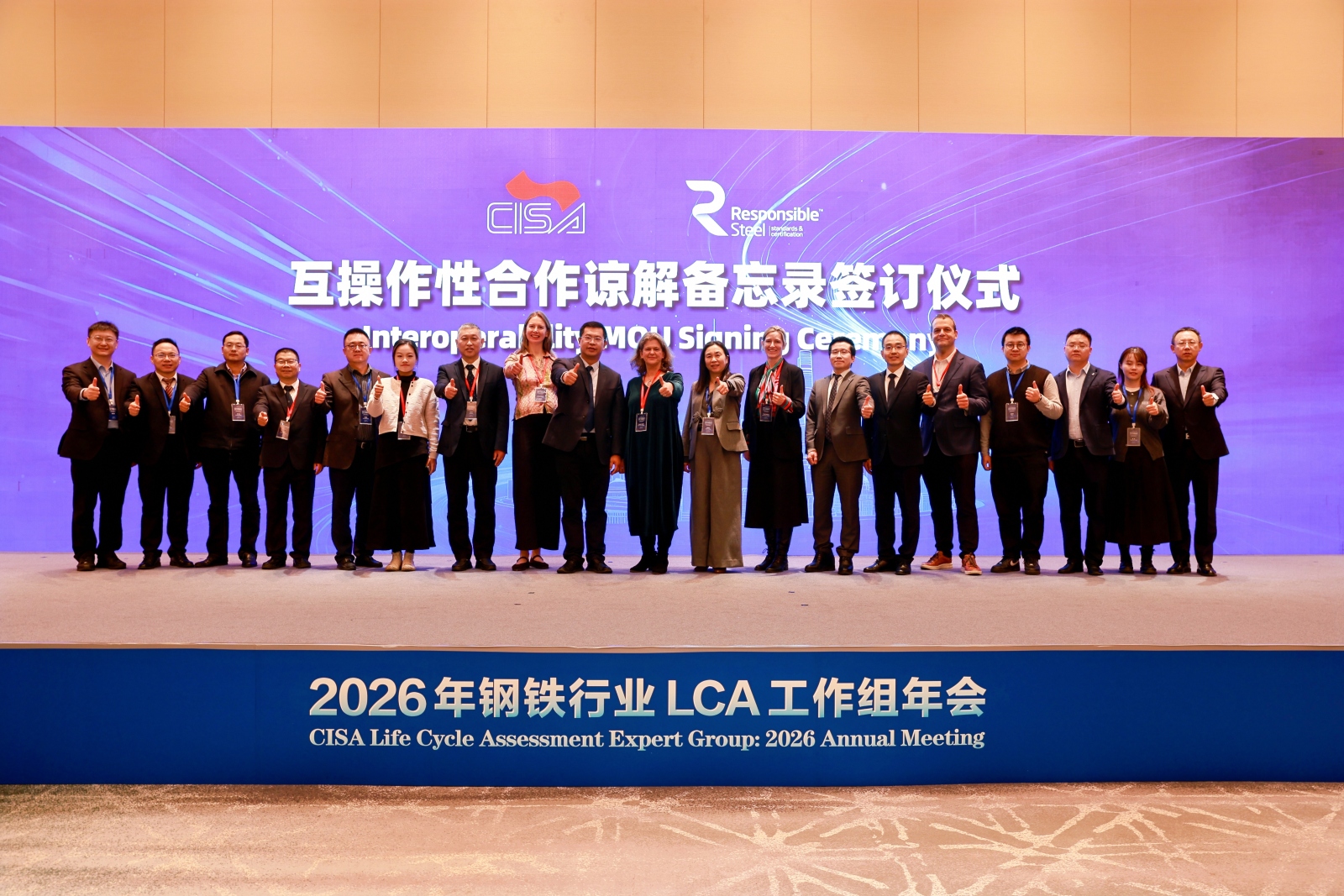
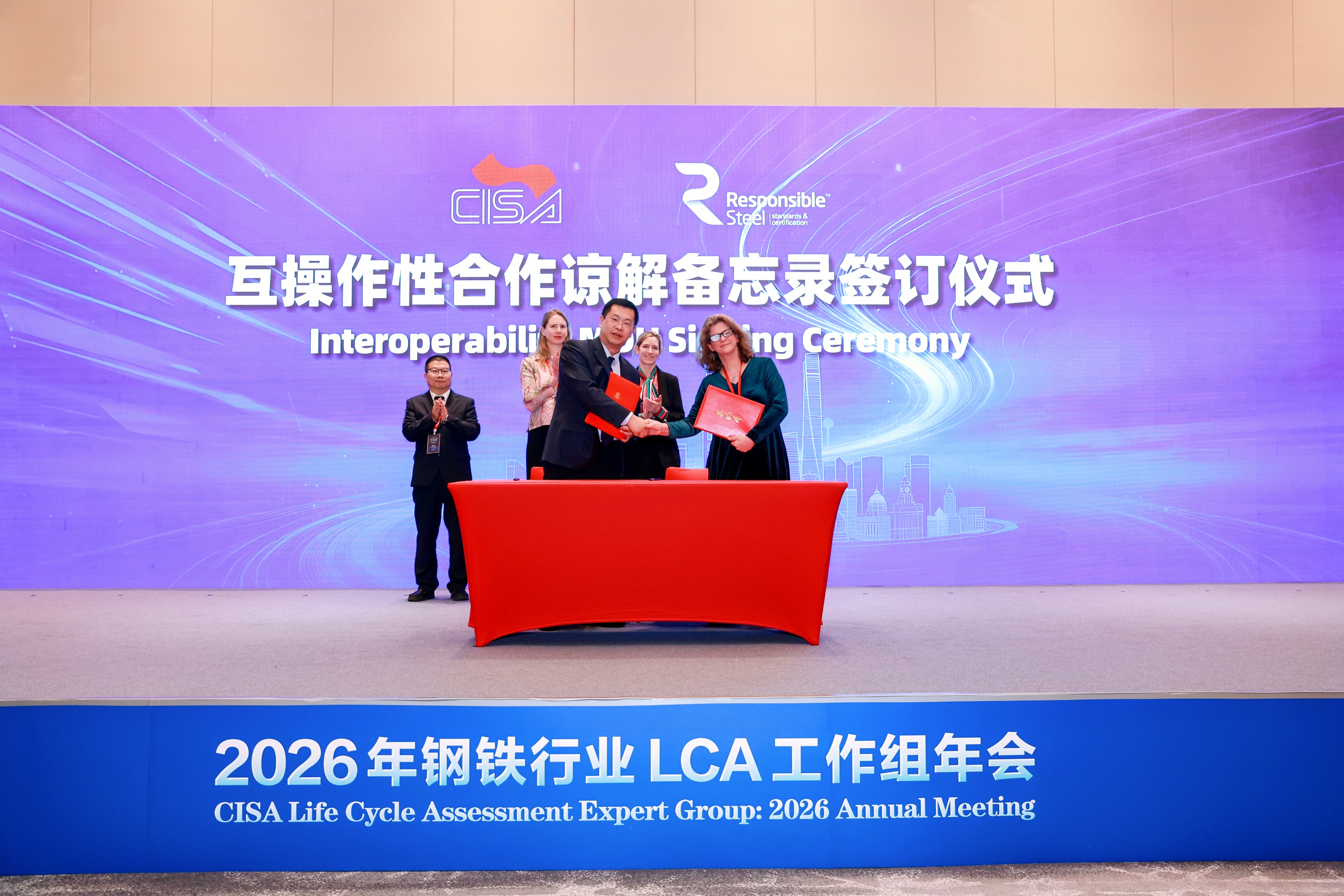
ResponsibleSteel's quest for a coherent market for decarbonised steel in 2026 got off to a constructive start this month. Following the announcement of our landmark agreements with the Chinese Iron and Steel Association (CISA) and the Low Emission Steel Standard (LESS) at COP30, ResponsibleSteel was in China in January to kick off our work on interoperability with CISA. This work in China complements our parallel project with Brussels-based LESS.
The goal? To build trusted data and claims on decarbonisation.
During our trip, our Director of Programmes, Amy Jackson, our Decarbonisation Lead, Alli Devlin, and myself had the opportunity to:
- Present to the Chinese steel value chain our C2F (China's low-carbon emission steel standard) interoperability MoU at CISA's annual LCA conference.
- Connect with our Chinese members, including SKF, World Resources Institute (WRI), Climate Group, VAMA (Valin ArcelorMittal Automotive JV), Penglai Dajin, and some of our certification bodies working in China, including Afnor and China Quality Certification Centre (CQC).
- Get to work on our C2F-ResponsibleSteel Interoperability Project, structuring the discussions around our Framework for Credible Interoperability.
- Visit the 15mtpa Zhanjiang steel plant, where a new DRI-EAF line was launched in Dec 2025. This has involved the production to date of iron reduced with hydrogen in a 1mtpa DRI plant. Whilst this is currently produced from refined coke oven gas, the project is a hugely significant demonstration of the potential to produce hydrogen-based DRI at an industrial scale.
.jpg)
What do ResponsibleSteel's interoperability projects look like in practice?
In short, interoperability means measuring emissions using rules that are as aligned as possible, and recognising the differences, to enable comparison on a like-for-like basis. Imagine the benefit this would bring for anyone wanting to distinguish what good looks like, for example, procurement teams, investors, and policymakers.
But making interoperability work in practice requires a lot more if we want a reliable, credible and sustainable system that generates high-quality, comparable data.
We've outlined the key components of this in our Framework for Credible Interoperability, which will inform both our work with LESS and CISA:
- Aligned GHG accounting rules
- A reliable calculation tool
- A robust assurance mechanism
- Credible claims protocols
- Good governance, oversight and resourcing
- Appropriate data management
- Strong operations management systems
This is how markets are built: first with innovation, then with the necessary rules and systems that enable good information to flow – so that steel buyers can understand, investors can evaluate, and steelmakers can compete, based on emissions performance that everyone can trust.


Member webinar: Understanding ResponsibleSteel's approach to climate change and greenhouse gases
Join us in this webinar to hear more about ResponsibleSteel's approach to tackling climate change and driving down greenhouse gas (GHG) emissions in the steel industry.
The webinar will take place via Microsoft Teams on Friday, August 2nd at 8 am (BST) and will last one hour. A second webinar will be held later in the day at 4 pm (BST) to accommodate other time zones.
Principle 10 of the ResponsibleSteel International Production Standard provides a comprehensive approach for the steel industry to drive down emissions. This webinar will provide members with an essential understanding of Principle 10 and how it can be applied.
Learn more about the Production Standard and Principle 10 here.
If you would like to join this webinar for ResponsibleSteel members, please contact our Head of Membership and Communications, Joe Woodruff.


Member webinar: Hear from the Roundtable on the Responsible Recycling of Metals on their recent findings and recommendations
Join us in this webinar to hear about the recently published findings and recommendations from the Roundtable on the Responsible Recycling of Metals (RRRM).
The webinar will take place via Microsoft Teams on Friday, July 19th at noon (BST).
RRRM is a multi-stakeholder initiative that seeks to ensure there are appropriate standards, systems and tools available for the responsible production and sourcing of recycled metals. The RRRM’s activities are driven by regular roundtable engagement, supported and coordinated by the secretariat and overseen by the Steering Group.
For over a year, RRRM has collaborated with stakeholders across the metals sector to better understand and make recommendations to improve ESG management and performance of recycled metal content and value chains.
The initiative has brought together metals recyclers, industry associations, voluntary sustainability standard setters, certification bodies, academics, NGOs, refiners and others and found that, while recycling delivers key socio-economic and environmental benefits, current approaches are insufficient to ensure recycled metals do not harm people or the environment.
A summary report, a 1-page route map, a risk profile, and three background reports with detailed findings and recommendations are all available on RRRM's website.
If you would like to join this webinar for ResponsibleSteel members, please contact our Head of Membership and Communications, Joe Woodruff.

ArcelorMittal Duisburg earns ResponsibleSteel certification
Following a two-year audit process conducted by GUTcert, ArcelorMittal Duisburg has achieved Core Site Certification against the ResponsibleSteel International Production Standard.
The site has been in operation since the mid-nineteenth century. Today ArcelorMittal Duisburg produces casted blooms and billets for rerolling, rolled billets for rerolling and forging, and wire rod for the automotive, energy and mechanical industries
Nico Dewachtere, Chief Operating Officer at ArcelorMittal Europe - Long Products, commented, “Achieving ResponsibleSteel certification is not only a milestone, but reflects our shared values and commitment to sustainability, integrity and responsible practices. It is our promise to the environment, to our communities and to future generations.”

ArcelorMittal Duisburg employs almost 1,000 workers and contractors. As part of the audit, 30 workers were interviewed as well as representatives from local authorities, NGOs, marginalised groups, and other stakeholders.
Annie Heaton, CEO of ResponsibleSteel stated, “We congratulate ArcelorMittal Duisburg on achieving this important step in their sustainability journey. The ResponsibleSteel International Production Standard covers the full spectrum of ESG issues from labour rights and health and safety to emissions reduction and water and waste management, providing the fullest picture of sustainability. Site certification comes with a clear commitment from the sites’ management team to making progress in line with the Standard, in particular on the social pillar. And as ArcelorMittal Duisburg looks to the future with the construction of its new EAF, we look forward to continuing to work with the site and support their progress on the journey toward lower emissions steel.”
The site has aligned itself with ArcelorMittal's corporate GHG target to reduce scope 1 and scope 2 emissions by 35% across European operations by 2030 against a 2019 baseline.
ArcelorMittal has plans to construct an EAF at the Duisburg site, which will be supplied with low-emission sponge iron from ArcelorMittal's Hamburg site. This will allow the transition of the Duisburg site away from production using blast furnace-based pig iron to the DRI-EAF production route.
Dr Cem Kurutas, Chief Executive Officer of ArcelorMittal Duisburg, praised the commitment of all involved in the certification process, saying, “I would like to express my sincere thanks to everyone who contributed to this success. To the project managers who drove the project forward with their vision and expertise, to the teams who worked tirelessly day in, day out, and to all the employees whose dedication and hard work made this possible.”
View the certificate and read the public audit summary here.

New report provides a comprehensive framework for charting the steel industry’s progress to 1.5°C
Leading steelmakers globally are beginning to take steps to decarbonise and low emissions steel options are emerging on the market. But new analysis from ResponsibleSteel demonstrates that radical shifts to reduce emissions by a select number of industry leaders or “first movers” will not be sufficient. The entire steel industry needs to take immediate action to make progress on the journey to net zero. And this progress needs to be mapped out in a universal language.
Today, ResponsibleSteel unveils a landmark report, "Charting Progress to 1.5°C through Certification." Using two base scenarios – the International Energy Agency’s (IEA) Net Zero Emissions by 2050, and the Mission Possible Partnership’s (MPP) Carbon Cost – the report offers a detailed mapping of the progress needed for the global steel industry to achieve climate commitments under the Paris Agreement. The report was reviewed in-depth by representatives from the IEA, the Energy Transitions Commission and Systemiq, and has been endorsed by industry, civil society and intergovernmental organisations including the OECD, Baowu Group, the Climate Group, and Lendlease.
According to the analysis, for the industry to meet its Paris Agreement obligations every steel plant in the world needs to be emitting less than today’s average emissions intensity by 2030. In other words, following a 1.5°C trajectory, today’s average emitters will become the industry’s worst offenders by 2030 if they do not take steps now to improve.
Annie Heaton, ResponsibleSteel’s CEO stated, “Transforming the steel industry will require bold and universal action. No one can sit on the sidelines. Our analysis shows how certification can be used both to plan and to track the progress of every site on an equitable basis. Those who are not certified cannot be tracked.”
The ResponsibleSteel International Production Standard is a powerful tool for steelmakers, policymakers, financial institutions, trade organisations, and campaigners, to track and drive the industry’s transition at pace and scale. The Production Standard’s Decarbonisation Progress Levels provide an internationally consistent framework that enables a like-for-like comparison of steel plants globally and incentivises all steelmakers to invest in decarbonised production processes whilst operating in a socially and environmentally responsible way at the same time.
ResponsibleSteel’s analysis of six key steelmaking regions clearly illustrates that there is a pathway for every part of the industry. Regional conditions such as scrap availability, natural resource endowments, climate policies, and available finance will likely impact the speed and nature of industrial change, but there is no room for inaction.
Furthermore, steelmakers must start to look beyond their physical site boundaries. Indirect supply chain-related emissions could make up about one-third of total average sectoral emissions by 2050, so reducing these will prove critical to the steel industry’s transition.
Ms Heaton continued, “ResponsibleSteel provides a trusted apparatus for measuring, comparing, and certifying progress in driving down emissions that steelmakers, buyers, investors, and policymakers can all get behind.”
Read the full report and interactive summary here.

June 2024 Newsletter
We have a lot coming up for members to get involved in, starting with a webinar on July 5th on our important upcoming report, 'Charting Progress to 1.5°C through Certification.' Later in July, we'll be hosting a webinar alongside the Roundtable for the Responsible Recycling of Metals following the launch of their findings in May. We're also asking members and stakeholders to support us on two projects, a new High Alloy and Stainless Steel (HASS) Working Group and a consultation on the recognition assessment for the Copper Mark. Make sure to get involved!
In this month's newsletter, you will find key updates including:
- ResponsibleSteel's first certification in Italy
- Upcoming ResponsibleSteel webinars
- New HASS working group
- Public consultation on the recognition of Copper Mark
- And more!
Click here to view ResponsibleSteel's June 2024 newsletter.
.jpg)
Call for stakeholder feedback on the Copper Mark recognition assessment
The steel sector relies heavily on mined and processed minerals as an input to production processes. To help ensure that steel companies can increasingly source minerals from responsible suppliers, ResponsibleSteel recognises input material programmes that are well placed to credibly verify ESG performance of suppliers. ResponsibleSteel has developed a comprehensive recognition methodology to assess the standards and assurance mechanisms, programme governance and management, as well as permitted claims and labelling of input material programmes.
Based on assessments against that methodology in 2022, our Board of Directors decided to recognise Bettercoal, the Initiative for Responsible Mining Assurance (IRMA) and Towards Sustainable Mining (TSM). As a consequence, these three programmes are anchored to varying degrees in Principle 3 (Responsible Sourcing of Input Materials) of the ResponsibleSteel International Production Standard. More information on these three recognition assessments can be found here.
Recently, the Copper Mark applied for ResponsibleSteel recognition for copper, molybdenum, nickel, and zinc sites participating in its programme. The Copper Mark and ResponsibleSteel engaged in extensive discussions to produce a draft recognition assessment. The results of this assessment are now opened up to stakeholders to give them an opportunity to provide feedback on the results.
The draft recognition assessment of the Copper Mark can be found on our Resources page under 'Input Material Programmes'. Stakeholders can complete this form to submit feedback or comment directly in the document and send us an email, citing the respective criterion of the assessment.
The deadline for stakeholder feedback is the end of the day on 28th July 2024. In case of questions and to submit feedback, please email assurance@responsiblesteel.org.
In addition, the Copper Mark and ResponsibleSteel agreed on two conditions to enable recognition. The Copper Mark will provide a supplemental document stipulating these conditions for sites that participate in its assurance framework and want to be ResponsibleSteel-recognised:
- The following criteria of the “Risk Readiness Assessment Criteria Guide” version of 19 October 2023, which is the Copper Mark’s criteria for responsible production, have to be considered not only by mine sites but also by stand-alone metal processing, downstream processing, manufacturing and recycling sites if these sites want to be ResponsibleSteel-recognised: Closure and Reclamation, Community Development, Indigenous Peoples' Rights, Land Acquisition and Resettlement, Cultural Heritage.
- The Copper Mark will explicitly stipulate that the requirements specified in the “Risk Readiness Assessment Criteria Guide” version 19 of October 2023 are binding.
Following consideration of any feedback and the finalisation of the assessment, a recommendation on recognition will be put to the ResponsibleSteel Board of Directors for their decision.
Submit feedback using this form or learn more about ResponsibleSteel recognition here.
Webinar: Charting progress to 1.5°C through certification
For the first time, we are drawing a clear connection between what’s required to deliver a 1.5°C-aligned pathway for the global steel sector and ResponsibleSteel’s Decarbonisation Progress Levels. 'Charting Progress to 1.5°C through Certification' - a report set for publication at the start of July - demonstrates how ResponsibleSteel certification can drive the change needed for the steel industry to achieve the Paris Agreement.
Join us for our next webinar to discuss ResponsibleSteel's analysis and find out what it will take to get the industry on track for 1.5°C.
The webinar will take place via Microsoft Teams on Friday, July 5th at noon (BST) and will last one hour.
Learn more about certification against the ResponsibleSteel International Production Standard and ResponsibleSteel's Decarbonisation Progress Levels here.
If you would like to join this webinar for ResponsibleSteel members, please contact our Head of Membership and Communications, Joe Woodruff.

Arvedi Acciai Speciali Terni earns first ResponsibleSteel certification in Italy
Arvedi Acciai Speciali Terni (AST) is the latest to obtain core site certification against the ResponsibleSteel International Production Standard. The site in Terni is Italy's first site to become certified.
The Terni site, and its Service Center and Forging Division, were successfully certified following an independent audit by DNV. AST's certification is another step on the journey toward responsible steel production. The site aims to integrate sustainable practices into all business processes to ensure long-term value for stakeholders and the surrounding environment.
Annie Heaton, ResponsibleSteel's CEO, stated, “This first ResponsibleSteel site certification in Italy and for the Arvedi Group is another milestone for the steel industry. Acciai Speciali Terni, an EAF stainless steelmaker, has a strong focus on circularity, aiming to reduce waste as far as possible by increasing the use of recycled scrap, reusing refractories, and launching a project for recovering slag. The site has also set an ambitious interim target of reducing scope 1 and 2 emissions by 60% by 2028 on the road to net zero by 2050. Just as importantly, the site demonstrated a clear commitment to the wellbeing of its workers as evidenced by the site’s strong governance procedures and Health and Safety policies.”

The Terni site has been at the heart of the Italian steel industry since the location was chosen in 1884. AST is one of the leading stainless steel flat producers in Europe. The site also produces some of the largest forgings in special steels in the world through its Forgings Division. AST employs over 3000 workers and contractors and plays an important role in the surrounding community.
“By achieving Responsible Steel core site certification,” says Gianluca Gigli, Chief Technical Officer and Acciai Speciali Terni S.p.A. Board Member, “the company reinforces its way to responsible steel production, integrating sustainability into all business processes, in full compliance with ESG criteria. An achievement to be proud of, that will support the company towards environmental, economic and social transition with the aim to ensure long-term value for the benefit of all stakeholders and the local community. The certification process involved many of Acciai Speciali Terni’s departments and I would like to congratulate them for the result obtained.”
View the certificate and read the public audit summary here.

May 2024 Newsletter
May has been a busy month for ResponsibleSteel. We're excited to share two key highlights: the much-anticipated Version 2.1 of the Production Standard and the release of our first-ever Progress Report. We are also pleased to announce more certifications, including the first site certifications in Vietnam, Sweden, and Finland, marking significant milestones in our global growth. It's great to witness sites pursuing site certification, reaffirming their commitment to responsible practices. The next step is Certified Steel, which is now possible with the launch of Version 2.1.
In this month's newsletter, you will find key updates including:
- The launch of the ResponsibleSteel International Production Standard Version 2.1
- The first-ever ResponsibleSteel Progress Report
- New certifications and new members
- Upcoming ResponsibleSteel webinars and audits against the Production Standard
- News from our partners and more!
Click here to view ResponsibleSteel's May 2024 newsletter.

ResponsibleSteel and SteelZero: Aligning action to drive the steel industry toward net zero
What does SteelZero do? What sets the initiative apart from ResponsibleSteel? And how do we work together to drive the steel industry’s net-zero transition? Let’s answer these key questions.
SteelZero is a global initiative working to speed up the transition to a net-zero steel industry. While ResponsibleSteel provides a pathway for steelmakers and a forum to bring the steel supply chain together in pursuit of a responsible industry, SteelZero mobilises steel buyers to aggregate and amplify the voice of the demand side.
How do they do this? Businesses that join SteelZero must make a public commitment to use lower emissions steel for 50% of their steel requirement by 2030, which sets a clear pathway to achieving 100% net-zero steel by 2050 at the latest. This interim commitment includes purchasing lower emissions steel which is aligned to ResponsibleSteel’s Decarbonisation Progress Level 2.
Any business that uses, specifies, or procures steel and is looking to address its emissions is eligible to join SteelZero. Likewise, SteelZero members can also choose to join ResponsibleSteel to work with steelmakers and other members of the value chain to help shape ResponsibleSteel’s standards. One can’t underestimate the impact these commitments are having. For the first time, steel-using businesses are creating and expanding the market for lower emissions and near-zero emissions steel. They’re saying to their suppliers, you can have the confidence, as well as the business rationale, to invest in the net-zero transition and new ways of steelmaking which do away with fossil fuels. Because who are steelmakers going to listen to more than their customers?
Over 40 businesses and counting including the likes of Ørsted, Volvo Cars, and Maersk have already joined SteelZero and set themselves clear time-bound pathways to clean up their steel-related emissions. The demand is clear and accelerating all the time. As it has to. Now, steelmakers must accelerate their efforts to decarbonise and scale up supply of lower emissions steel to achieve the reductions needed by 2030.

So how do ResponsibleSteel and SteelZero work together?
SteelZero and ResponsibleSteel’s work is like two sides of the same coin. Both organisations are dedicated to achieving the same goal, but what sets them apart is the area of the value chain they focus on, the angle at which they’re trying to mobilise action, to make it happen.
But a central question to the transition is what do we mean by lower emissions and near-zero emissions steel? What emissions intensity do these classifications constitute? Just as we need industry alignment between steelmakers and steel users on this to get us to a net-zero industry, ResponsibleSteel and SteelZero are aligning their action to unlock this potential.
Steel users need to know what they’re asking for once they’ve made their SteelZero commitment – what specifically do I need from my supplier for it to qualify as lower emissions steel and help me meet my commitment? And steelmakers need to know what their customers want so they can align operations and investments to meet customer demands. There can be no room for interpretation leaving space for uncertainty, delays, and inaction. All business and investment decisions need to be laser-focused on the most effective action.

As partner to SteelZero, ResponsibleSteel works directly with the initiative to do this. ResponsibleSteel has developed an International Production Standard through a transparent multistakeholder process and extensive data research to determine what constitutes an equitable, effective global framework to drive the steel industry's decarbonisation. SteelZero uses the emissions intensity thresholds in the ResponsibleSteel’s International Production Standard to help its members to answer the question: What do I need from my supplier for it to qualify as lower emissions steel and help me meet my commitment?
By holding members accountable to commitment pathways aligned with ResponsibleSteel, consumers (SteelZero members) can be confident that the commitment they’re making is in alignment with best practice and will genuinely help them get the solutions they need to clean up their supply chains whilst supporting equitable, sector-wide decarbonisation globally. Through a strong focus on engaging with its members, SteelZero can drive that action, fast.
This is why collaboration and alignment are so critical. Together SteelZero and ResponsibleSteel are collectively setting best practice for steel users and steel suppliers to achieve a net-zero steel industry.
Learn more about SteelZero.

ResponsibleSteel launches new version of International Standard to drive down steel emissions and improve sustainability across the supply chain
The global steel industry employs over 6 million people and contributes around 3.8% to global GDP. Yet it also contributes around 10% to global greenhouse gas emissions from energy and industry according to the International Energy Agency (IEA).
The ResponsibleSteel International Production Standard Version 2.1, launched today, will play a critical role in driving down global steel emissions and driving up standards across the steel supply chain. Developed in consultation with ResponsibleSteel members and stakeholders from across the steel value chain and civil society, Version 2.1 strengthens ResponsibleSteel’s Progress Level requirements for responsible materials sourcing and climate change and greenhouse gas emissions.
As global leaders look for ways to mitigate the impacts of climate change, it’s more important than ever that the steel industry moves to decarbonise and adopt more responsible production practices. Version 2.1 of the Standard provides the steel industry with a technical roadmap to net zero and allows producers to demonstrate tangible progress not only on decarbonisation but across other key environmental and social issues such as biodiversity, water stewardship, pollution, labour rights and more.
Gerry Tidd, Chairman of ResponsibleSteel’s Board of Directors commented, “The ResponsibleSteel International Production Standard is the result of extensive development and stakeholder input and has been widely endorsed by highly respected organisations such as the International Energy Agency. We have listened to feedback from across the steel industry, civil society and others and updated the Standard to ensure it is both effective and workable. We are proud to launch Version 2.1 of the industry’s most robust, high-quality standard - one that is built on a foundation of integrity and transparency.”
Steelmaking sites globally are already making progress. ResponsibleSteel has over 80 sites in 19 countries certified against the International Production Standard’s Core requirements. With the revisions incorporated in Version 2.1, steelmakers are now set to pursue the next step on ResponsibleSteel’s certification journey: certified steel.
Steelmakers who meet the revised Progress Level requirements for responsible materials sourcing and decarbonisation will for the first time be able to label and market their products as ResponsibleSteel certified.
“This will give steel buyers – all the architects, automakers, builders and manufacturers - confidence that the steel they are procuring has been produced responsibly following a credible independent assessment,” Mr Tidd said.
Annie Heaton, CEO of ResponsibleSteel stated, “An increasing number of players have opinions about what so-called ‘green steel’ means. The ResponsibleSteel International Production Standard provides a clear, credible and consistent way to define it not only by providing a fair and universal benchmarking system for low-emissions steel globally but by charting a roadmap towards responsible steelmaking every step of the way.”
She continued, “We must also remember that truly responsible steelmaking goes beyond mitigating carbon, to other environmental and social impacts, including the rights of the millions of people working in the industry and across the supply chain as well as local communities.”
Now is the time for the steel industry to pick up the pace to meet the goals of the Paris Agreement and the Sustainable Development Goals, by meeting the Progress Level requirements of the ResponsibleSteel International Production Standard Version 2.1. This way, we will create a universally consistent, credible market for responsible low-emissions steel.
Learn more about the ResponsibleSteel International Production Standard V2.1 here.

Outokumpu earns ResponsibleSteel certification for all of its production sites in Europe
Outokumpu has achieved ResponsibleSteel certification for all seven of its production sites in Europe. The sites are spread across Germany, Finland and Sweden making Outokumpu the first to obtain certification in the latter two countries as well as the first in the Nordic region more broadly.
Outokumpu, a global leader in the stainless steel industry, became a member of ResponsibleSteel in 2019. For Outokumpu, the ResponsibleSteel International Standard provided a tool to evaluate and strengthen the company’s sustainability work through an ambitious industry-level framework with a beyond-compliance approach.
Heidi Peltonen, Vice President of Sustainability at Outokumpu, stated, “The ResponsibleSteel Standard is highly needed to provide a systematic framework to evaluate the sustainability of steel holistically. While the steel industry accounts for 7–9% of global greenhouse gas emissions, at the same time it plays a pivotal role in the green transition. Outokumpu has an ambitious climate commitment to keep global warming at 1.5 degrees. Beyond that we are committed to the UN Guiding Principles on Business and Human Rights across our value chain and follow the highest standard for ethical business conduct. ResponsibleSteel addresses environmental, social and governance topics and drives companies' sustainability work forward in all these areas. We are extremely proud to receive the certificates as the first mover in the Nordics, enabling us to create value for our customers by supporting them to choose sustainably produced stainless steel with a third-party validation.”
The certification process was conducted between 2021 and 2023 and included rigorous independent audits carried out by DNV. The auditors highlighted the strong commitment of the sites to health and safety and interviews with workers across the sites demonstrated a high employee satisfaction rate. Collectively, the seven sites employ over 5,800 workers and contractors.
.jpg)
“The ResponsibleSteel certification is both about the process and the result. The certification process was extensive, including for example site-specific self-assessments with related audits and on-site interviews with workers and contractors. As for the result, we received excellent feedback on our achievements, especially on decarbonisation and our efforts to ensure a good and safe place to work. The process also helped us to identify further actions to build on our sustainability ambition – such as those related to stakeholder engagement, social responsibility as well as biodiversity and water management across our value chain. It also increased credibility and transparency of our overall sustainability work,” said Anna Vainikainen, Head of Human Rights at Outokumpu.
Outokumpu is committed to the Science Based Targets initiative's 1.5 degree target and is the only stainless steel producer with a target approved by the initiative. To meet this target, Outokumpu are working to improve energy efficiency in its operations. In 2022, over 85% of the company's electricity was already coming from low-carbon sources.
Annie Heaton, CEO of ResponsibleSteel, commented, “Outokumpu has already set a near-term science-based target to reduce emissions from all three scopes by 42% by 2030 compared to 2016. This site certification process has provided a tool for Outokumpu to develop its sustainability work and its transparency in line with best practice on ESG for the steel industry. The next step will be progress level certification and we look forward to working with Outokumpu as we develop Decarbonisation Progress Levels specifically for stainless steel sites to enable them to work towards certified steel.”
To learn more about these certifications, take a look at the certificates and read the public audit summaries here.

