

Reflections from China: ResponsibleSteel's CEO Annie Heaton discusses building interoperability across global standards
Interoperability: Building a bridge between global standards
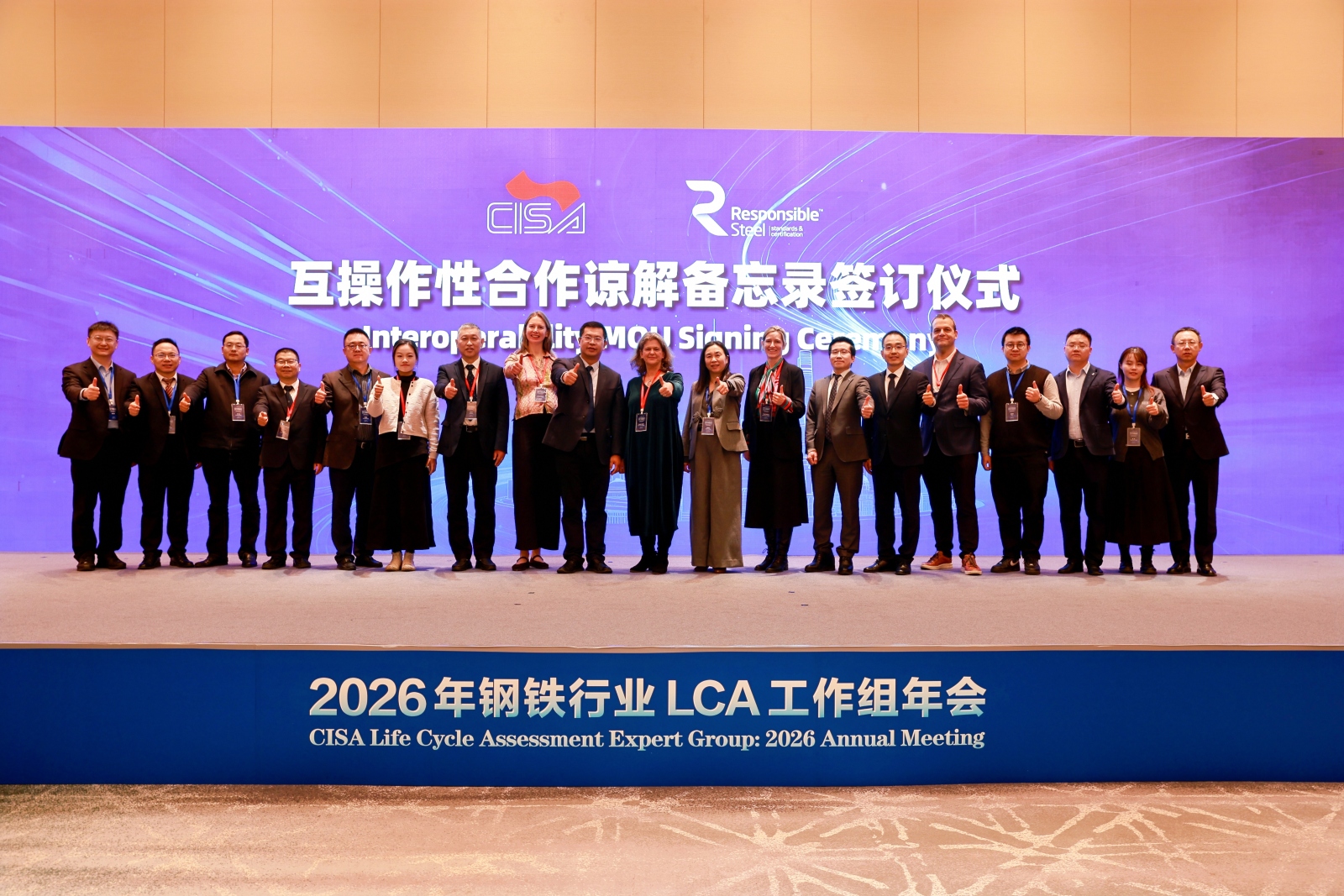
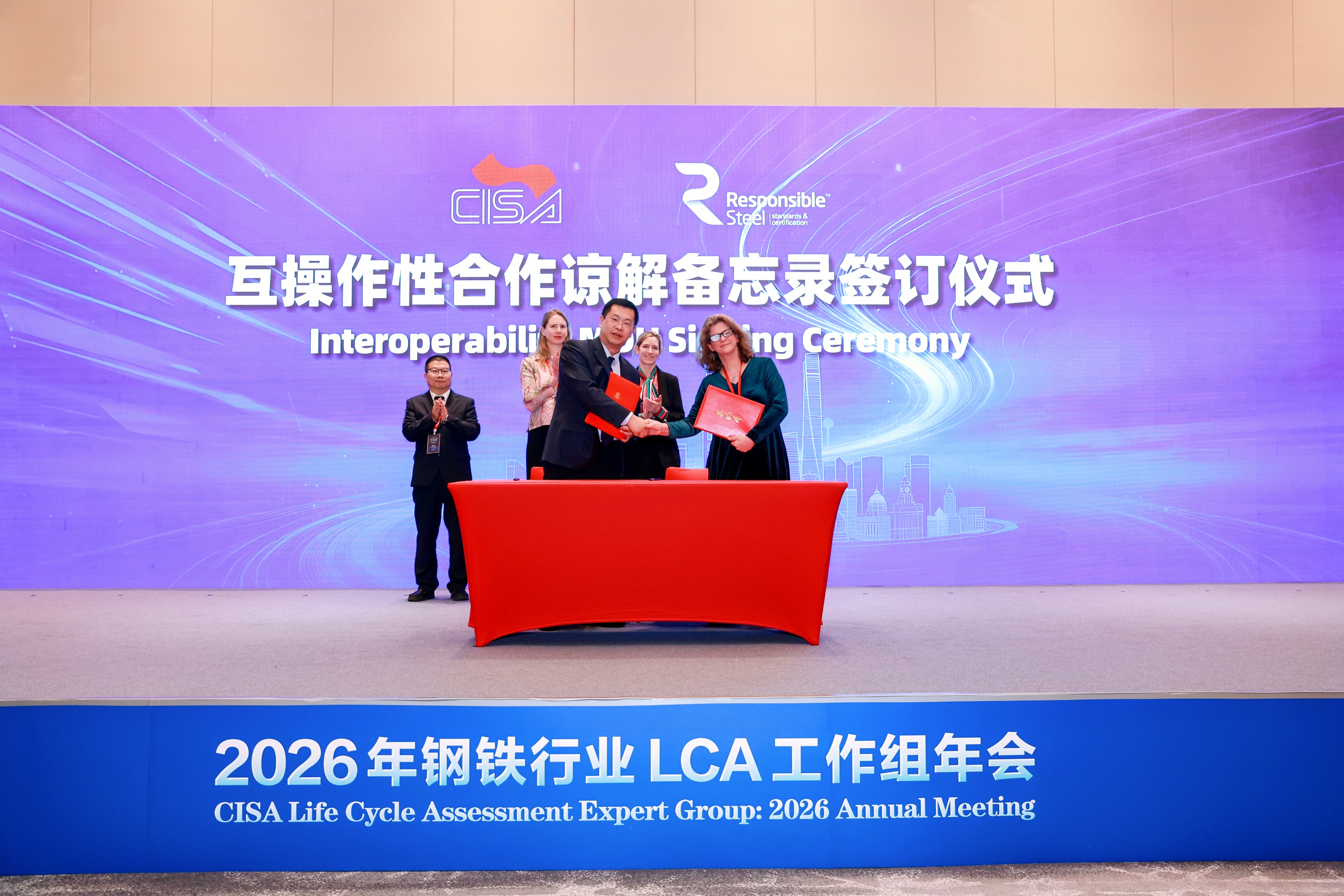
ResponsibleSteel's quest for a coherent market for decarbonised steel in 2026 got off to a constructive start this month. Following the announcement of our landmark agreements with the Chinese Iron and Steel Association (CISA) and the Low Emission Steel Standard (LESS) at COP30, ResponsibleSteel was in China in January to kick off our work on interoperability with CISA. This work in China complements our parallel project with Brussels-based LESS.
The goal? To build trusted data and claims on decarbonisation.
During our trip, our Director of Programmes, Amy Jackson, our Decarbonisation Lead, Alli Devlin, and myself had the opportunity to:
- Present to the Chinese steel value chain our C2F (China's low-carbon emission steel standard) interoperability MoU at CISA's annual LCA conference.
- Connect with our Chinese members, including SKF, World Resources Institute (WRI), Climate Group, VAMA (Valin ArcelorMittal Automotive JV), Penglai Dajin, and some of our certification bodies working in China, including Afnor and China Quality Certification Centre (CQC).
- Get to work on our C2F-ResponsibleSteel Interoperability Project, structuring the discussions around our Framework for Credible Interoperability.
- Visit the 15mtpa Zhanjiang steel plant, where a new DRI-EAF line was launched in Dec 2025. This has involved the production to date of iron reduced with hydrogen in a 1mtpa DRI plant. Whilst this is currently produced from refined coke oven gas, the project is a hugely significant demonstration of the potential to produce hydrogen-based DRI at an industrial scale.
.jpg)
What do ResponsibleSteel's interoperability projects look like in practice?
In short, interoperability means measuring emissions using rules that are as aligned as possible, and recognising the differences, to enable comparison on a like-for-like basis. Imagine the benefit this would bring for anyone wanting to distinguish what good looks like, for example, procurement teams, investors, and policymakers.
But making interoperability work in practice requires a lot more if we want a reliable, credible and sustainable system that generates high-quality, comparable data.
We've outlined the key components of this in our Framework for Credible Interoperability, which will inform both our work with LESS and CISA:
- Aligned GHG accounting rules
- A reliable calculation tool
- A robust assurance mechanism
- Credible claims protocols
- Good governance, oversight and resourcing
- Appropriate data management
- Strong operations management systems
This is how markets are built: first with innovation, then with the necessary rules and systems that enable good information to flow – so that steel buyers can understand, investors can evaluate, and steelmakers can compete, based on emissions performance that everyone can trust.
.png)

ResponsibleSteel publishes first-ever Annual Progress Report
Over the last eight years, ResponsibleSteel has gone from strength to strength. During that time, ResponsibleSteel has built up a thriving community of over 150 members and created the first-ever International Standard to drive the responsible production of net-zero steel, globally.
We’re driving industry progress
We now have certified sites in 14 countries employing over 220,000 workers and producing over 120 million tonnes of steel. In this first annual Progress Report, we take stock of the enormous strides ResponsibleSteel and our members have made to deliver on our shared mission and celebrate our collective achievements.
We also look forward as we build momentum toward some exciting announcements coming up this year. Version 2.1 of the ResponsibleSteel International Standard will be published this month and a new Downstream Chain of Custody Standard later this year. Most significantly, we expect the first steelmaking sites to achieve ResponsibleSteel certified steel this year, a global first for the industry.

We’re recognised globally
ResponsibleSteel continues to be recognised as a leader amongst sustainability initiatives, most notably by the IEA in their second report to the G7 on ‘Emissions Measurement and Data Collection for a Net Zero Steel Industry’ and more recently, Lead the Charge in their ‘Assessment of Third-Party Assurance and Accreditation Schemes in the Minerals, Steel and Aluminium Sectors’. And as more initiatives focusing on steel sustainability emerge, we’re playing a critical role in convening the sector and driving industry alignment to accelerate a net-zero future.
Come with us
This is only the beginning. We have a long journey ahead of us, but with the support of our members and stakeholders, we will continue to work to drive industry progress.
Read our full 2024 Progress Report here.


BlueScope Vietnam earns first ResponsibleSteel certification in Southeast Asia
The NS BlueScope Vietnam Phu My site is the company’s third site certification following BlueScope Port Kembla in 2022 and Western Port last year.
The site began construction in 2002 and opened its doors two years later in 2004. At the time, it was the first metal coating line in Vietnam to apply zinc and aluminium technology to its products. Now, the site produces 187,000 tons of coated and uncoated cold-rolled coil annually and employs over 200 workers and contractors.
Annie Heaton, CEO of ResponsibleSteel commented, “What singles the certification of BlueScope Vietnam out is that it is the first certification in the country, the first in Southeast Asia. This demonstrates real leadership.”
Obtaining ResponsibleSteel site certification is the latest step in NS BlueScope Vietnam’s broader plan to implement responsible practices and urge its partners and suppliers to do likewise in order to build a more sustainable steel community. In 2022, NS BlueScope Vietnam was also the first coated steel manufacturer in Vietnam to earn the Singapore Green Building Council’s ‘Green Label’ certification.
.png)
Mr. Vo Minh Nhut, President of NS BlueScope Vietnam, stated, “This is a proud milestone in our sustainable development journey aligned with NS BlueScope's ESG standards, further affirming that we are not only a technology leader in the pre-painted steel industry but also a pioneering business in ESG practices. We sincerely appreciate the support and companionship of our esteemed partners during this time, which has motivated us to continue growing and increasingly contribute towards building a sustainable and thriving business community.”
Extensive interviews with the site’s workers also emphasised the site’s focus on risk management, health and safety, and employee engagement including issue resolution and grievance, feedback and support mechanisms, training and development opportunities, reward and recognition mechanisms, and support with flexible working arrangements. Notably, at the time of the audit, 41% of the site’s workers and contractors were female and the importance placed on promoting diversity and fostering an inclusive workplace was clear.
The BSI audit team commended the site’s commitment to becoming ResponsibleSteel certified, noting the effort made to align with the ResponsibleSteel International Standard including expanding and revising some of the site’s existing policies and procedures. The auditors particularly highlighted the strength of the site’s water stewardship and stakeholder engagement programmes. NS BlueScope Vietnam has also set a target to reduce GHG emissions (scope 1 and 2) by 30% by 2030 against a 2018 baseline.
Click here to view BlueScope Vietnam's certificate and audit summary.
.png)

April 2024 Newsletter
This month has been busy for our certification programme. SIJ earned the first certification in Slovenia and three years on from the first certifications back in 2021, sites are now beginning to undergo re-certification against the Standard. And we have a lot more coming up in May, kicking off with a joint webinar with SteelZero and culminating in our AGM and the launch of Version 2.1 of the Standard.
In this newsletter, you will find updates on:
- Standards developments
- New certifications
- Upcoming audits and events
- Public consultation reminder
Click here to view ResponsibleSteel's April 2024 newsletter.

Member webinar: Find out more about SteelZero
We invite ResponsibleSteel members to join this upcoming webinar to get to know SteelZero better and understand the opportunities available for engaging with their work and their members. The webinar will include speakers from ResponsibleSteel and SteelZero, and you will have the opportunity to ask questions to both organisations.
The webinar will be hosted via Microsoft Teams on Wednesday, May 8th at 1:00 pm (GMT+1).
SteelZero is an initiative hosted by the Climate Group in partnership with ResponsibleSteel. SteelZero brings together downstream companies in the steel supply chain to send strong demand signals to global markets, shifting them towards the production and sourcing of net-zero steel. The initiative’s members make a public commitment to procure 50% of their steel by 2030 from producers on the pathway to net zero and to procure 100% net-zero steel by 2050.
Register for the webinar here.

Revisions to ResponsibleSteel’s Principle 10: Greenhouse Gas Emissions and Climate Change
Following a 12-month test phase and a public consultation, ResponsibleSteel has introduced revisions to Principle 10 of the ResponsibleSteel International Standard including revised Progress Levels to assess steel decarbonisation and encourage increased recycling rates.
The launch of additional requirements for greenhouse gas emissions in September 2022 as part of the ResponsibleSteel International Standard Version 2.0 was a crucial step in driving industry progress towards near-zero steel. The Principle 10 Progress Levels were designed to not only accelerate the production of low-emissions steel by individual steelmakers, but to also drive the decarbonisation of the entire global industry and avoid a dash for scrap that would deliver no net gains.
Currently, there is no reliable data on the average emissions across the steel industry. As part of the work on Principle 10, ResponsibleSteel developed a unique dataset to enable the evaluation of emissions from any tonne of steel produced anywhere in the world with any level of scrap content. Reviewing and refining this dataset and revising our decarbonisation thresholds ensures the ResponsibleSteel Progress Levels remain the reliable benchmark for steel globally.
During the test phase for Principle 10, the ResponsibleSteel Secretariat tested the rigour of the Progress Level requirements by convening a working group of steelmakers. The proposed revisions to Principle 10 subsequently underwent a public consultation to obtain additional stakeholder feedback. We’re now pleased to announce that these revisions have been finalised and accepted by the ResponsibleSteel Board of Directors.
ResponsibleSteel is committed to continuously accelerating progress towards near zero on a global scale. The revisions to Principle 10 represent a 150 kg CO2e/t crude steel increase in the emissions intensity thresholds for Progress Level 1 on the high-scrap end of the scale. This revised Progress Level 1 and the corresponding changes to Levels 2 and 3, reflect the current state of steel industry emissions and the shallower gradient aims to encourage increased recycling rates within the bounds of end-of-life scrap availability. These revisions, as well as other revisions relating to waste energy and non-ferrous metal and ferro-alloy additives, will be incorporated into Version 2.1 of the ResponsibleSteel International Standard expected to be published in May 2024.
.png)
ResponsibleSteel’s Progress Levels are designed using a scrap variable approach to reward improvement across both scrap-based and primary steelmaking (i.e. steelmaking using iron ore) to drive down steel emissions globally. Progress Level 1 represents a distribution of existing steel sites where approximately 50% sit ‘below’ the threshold while Progress Level 4 is designed to align with the near-zero threshold of the International Energy Agency (2021) and Levels 2 and 3 provide regular points of progress on the journey from Levels 1 to 4.
It’s time to pick up the pace. To ensure a 1.5C degree future, we need every steelmaking site in the world to have achieved Progress Level 1 and significant progress made toward Progress Levels 2 and 3 by 2030. And we cannot rely on the deep decarbonisation efforts of a select number of sites alone. We must work to move the whole industry towards near zero at speed.
For more details on the revisions to Principle 10, read our summary of Principle 10’s Consultation Outcomes. If you have any questions on the revisions or want to find out more about how ResponsibleSteel’s Decarbonisation Progress Levels are supporting steel makers on the journey to near zero, please contact standards@responsiblesteel.org.

SIJ Group earns its first ResponsibleSteel site certification in Slovenia
SIJ Group (Slovenian Steel Group) has achieved ResponsibleSteel certification for its SIJ Acroni and SIJ Metal Ravne sites, placing Slovenia on the global map of responsible steel production.
SIJ is a leading producer of stainless steel and special steels in Europe and is one of Slovenia’s leading exporters. The certification covers two steel mills, both operating Electric Arc Furnaces (EAFs), as well as hot and cold rolling mills, and a forging shop.
“SIJ has long made efforts to be at the forefront of sustainable practice in the industry. SIJ’s first EAF opened in the 1960s, and today around 78% of its steel input is scrap. But sustainability must go beyond circularity, and beyond decarbonisation. Most recently as part of the certification audit process, SIJ has made real strides to meet ResponsibleSteel International Standard’s social and governance criteria, committing to strengthening and improving the protection of worker’s rights and health and safety systems,” said Annie Heaton, CEO, ResponsibleSteel.
SIJ is one of the largest employers in Slovenia and collectively, the newly certified sites employ over 2,600 workers. Since 2007, SIJ has invested over 800 million euros in new technology, aimed at streamlining processes, improving working conditions, and mitigating environmental impacts. The company has set a target of reducing emissions by 51% by 2030 against a 2020 baseline and aims to be carbon neutral by 2050 in line with the Paris Agreement. The group has also set targets in the field of occupational health and safety. By 2026, SIJ aims to have six sites operating in accordance with ISO 45001 for occupational health and safety.
Andrey Zubitskiy, President of the Management Board for SIJ commented, “Obtaining ResponsibleSteel certification represents a new sustainability milestone in the history of SIJ Group, following our transition to steel production based on circular economy principles four decades ago. We are now part of a select group of steelmaking companies worldwide that are setting standards for sustainable practices in our industry. It reflects our commitment to our employees, the community and the environment in which we operate.”

He continued, “Steel is the most widely used material in the world. With our products, we are a reliable partner for automotive, mechanical engineering, infrastructure, construction, power generation and other industries that require the assurance that the materials they use have been obtained through sourcing and production processes based on responsible practice. The goal of ResponsibleSteel is to satisfy such requirements with a management approach that combines economic development, social inclusion, environmental sustainability and transparent governance, in order to contribute to the creation of a more sustainable future for people and the planet.”
However, certification isn’t the end of the journey. ResponsibleSteel certificates are valid for three years. Around 12 to 18 months in, the sites will undergo a surveillance audit by the contracted certification body, AFNOR, which will involve additional stakeholder interviews and a review of the sites’ progress on any minor non-conformities that were identified in the initial audit.
As said by Dr Tadeja Primožič Merkač, Director of Quality, Sustainability and Corporate Management, SIJ Group. “While sustainability has always been an important topic for us, ResponsibleSteel has taught us to take a more management systems-based approach and has helped us improve our understanding of the importance of even better working conditions for employees and a culture of health and safety at work. Today, we are proud of our achievement, but we are aware that the path of sustainable development is a continuous process of learning and improvement, which we will demonstrate every year and a half through recertification.”
To find out more details on this certification, please read the audit summary here.

March 2024 Newsletter
Please view the March 2024 newsletter by clicking the link below:

What’s coming up for ResponsibleSteel?
We have some exciting developments on the horizon which we’re keen to share with our members and stakeholders. Here are a few key moments to look out for in the next six months.
Standards Development
Public Consultations
Two important public consultations started in mid-March – one on Principle 3 (responsible sourcing) of the International Standard, and one on a new draft Downstream Chain of Custody Standard. Learn more about the consultations here or visit our Standards Development page to submit your feedback.
Members and wider stakeholders can also join a webinar on 26 March to find out more about the consultations. Register here.
International Standard V2.1
We’re busy working to produce Version 2.1 of the ResponsibleSteel International Standard by mid-May. This will provide the green light for steelmakers in the race to achieve the first ResponsibleSteel Certified Steel – and for downstream businesses to line up to procure Certified Steel products.
Upcoming Publications
Progress Report
ResponsibleSteel and its members have come a long way since its inception. In Q2, we will publish our first annual Progress Report using data on the scale and the impacts of certification to show progress towards our mission.
Certification Pathway to Net Zero by 2050
Later in Q2 we’re aiming to publish our analysis on the extent of transition progress required over time for the steel sector to fulfil its Paris Agreement obligations. Not another trajectory, but a demonstration of net zero pathways through a new lens – that of the four ResponsibleSteel Progress Levels.
Upcoming Events
ResponsibleSteel will be participating in the SteelZero events in Washington D.C. on 24 April, Seoul on 21 May, and Brussels on 19 June, and we are looking at how to maximise value for our members during these events – more details to come shortly.
The ResponsibleSteel AGM will be held online on 22 May.
We will be participating in and running many more events during the year, and will publicise these as soon as more details are confirmed. In particular, we will also be engaging with stakeholders in India, Japan and Korea throughout the year to deepen our presence within these important markets.
Webinar Series
We will be offering members a set of ‘Meet the Expert’ webinars covering topics such as just transition, biodiversity, targets, downstream demand and much more. If you have a suggestion for a topic that you would like us to cover, please contact our new Head of Membership and Communications, Joe Woodruff.
ResponsibleSteel Groups
Members can also get involved with one of our groups:
Steelmakers Reference Group
The Steelmakers Reference Group is an opportunity for member steelmakers to engage in technical discussions around the Standards and Assurance Programme. Contact Rodrigo de Prospero, our Head of Standards and Assurance, for more information.
Civil Society Reference Group
The Civil Society Reference Group provides a forum to share ResponsibleSteel’s latest plans with civil society members and to seek their engagement, input and feedback. Contact Shiv Kumar, our Development and Innovation Director, for more information.
Finance Working Group
An opportunity for the finance sector and steel industry to come together to discuss how to effectively use the ResponsibleSteel Standard as a verification tool to raise capital to accelerate steel decarbonisation. Contact Shiv Kumar, our Development and Innovation Director, for more information.
Find out more
If you have any questions about the above, or suggestions for events, publications or webinars, please do get in contact with our new Head of Membership and Communications, Joe Woodruff.

ResponsibleSteel Launches Public Consultations on New Downstream Chain of Custody Standard and Revised Responsible Sourcing Requirements
Today, ResponsibleSteel has launched two public consultations as part of our ongoing standards development work. We are inviting feedback on a draft of a new downstream chain of custody standard, as well as revisions to the ResponsibleSteel International Standard’s Principle 3: Responsible Sourcing of Input Materials.
Downstream Chain of Custody Standard
Developing a downstream chain of custody standard is crucial to building demand for ResponsibleSteel certified steel. This initial draft has been developed following extensive discussions with our downstream claims and chain of custody member working group between December 2022 and July 2023. The working group concluded with two recommendations:
- ResponsibleSteel should provide a downstream chain of custody standard based on physical traceability with full segregation (i.e. all ResponsibleSteel-certified steel products would be made with 100% certified steel).
- The downstream chain of custody standard would be accompanied by a complementary ‘Book & Claim’ system that would create value for ResponsibleSteel certified steelmakers and downstream steel users, based on claims that do not require the physical tracking of ResponsibleSteel certified steel through the supply chain. This will be developed in future following additional research and consultation with members and stakeholders.
Acting on the first of these recommendations, ResponsibleSteel has drafted a downstream chain of custody standard based on physical traceability with full segregation which we are now inviting stakeholders to share their feedback on. This 60-day public consultation is open from March 15th to May 14th. A second public consultation will be held later this year.
Get involved: If you would like to give feedback on the first draft of ResponsibleSteel’s Downstream Chain of Custody Standard, please visit our Standards Development page. Submissions will be open until May 14th, 2024, 23:59 GMT.
Additionally, ResponsibleSteel will be pilot-testing the downstream chain of custody standard to test its in-practice applicability. If your organisation is interested in carrying out a pilot test at one or more of your sites, please contact us at standards@responsiblesteel.org.
Principle 3: Responsible Sourcing of Input Materials
In September 2022, we launched the ResponsibleSteel International Standard V2.0. In addition to the core requirements steelmaking sites can be audited against, Version 2.0 introduced additional progress-level requirements for the responsible sourcing of input materials (Principle 3) and climate change and greenhouse gas emissions (Principle 10).
During the 12-month test phase of Version 2.0, ResponsibleSteel received requests for revisions to Principle 3. Some of these requests would involve significant changes to the requirements and throughout January and February 2024, a member working group was convened to understand the issues, provide ideas, and test and improve proposals for revision. The working group brought together civil society, steelmaking and mining companies as well as traders and other member organisations. The presentations and discussion notes of these working group meetings can be found here.
The proposed revisions to Principle 3 are open for public consultation for 30 days and include the introduction of an on-ramp transitional period into the specification of the materials sourcing Progress Level 1 in criteria 3.2 and 3.4, as well as some proposed corresponding changes to guidance and annexes to the requirements.
Following the consultation, ResponsibleSteel will review any feedback before seeking approval for an urgent revision to Principle 3 from the ResponsibleSteel Board following the Urgent Revision Mechanisms specified in our International Standards Development Procedures. Final revisions will be incorporated in Version 2.1 of the ResponsibleSteel International Standard later this year.
Get involved: If you would like to give feedback on the revisions to the ResponsibleSteel International Standard’s Principle 3: Responsible Sourcing of Input Materials, please visit our Standards Development page. Submissions will be open until April 14th 2024 23:59 GMT.
Find Out More
Join us on Tuesday 26 March, 12:00-14:00 (GMT) for a member and stakeholder webinar to find out more about the consultations. Register here.
If you have any questions regarding either of these public consultations, please contact the ResponsibleSteel Secretariat at standards@responsiblesteel.org.


Tata Steel Earns Two New ResponsibleSteel Certifications
Following the certification of the Jamshedpur site in 2022, Tata Steel has achieved certification of its Kalinganagar and Meramandali sites, marking a significant next step in Tata’s sustainability journey.
Over 90% of Tata’s steel production in India is now covered by ResponsibleSteel site certification. Meramandali produces 5.6 mt annually while Kalinganagar produces around 3.3 mt. Collectively the sites employ over 46,000 workers and contractors.
Annie Heaton, CEO of ResponsibleSteel commented, “With the audit process for these two new site certifications, Tata Steel has demonstrated its commitment to openly progress its social and environmental responsibilities. During the audits, both sites’ GHG emissions reduction strategies and water stewardship programmes were highlighted for their robustness. The ResponsibleSteel Standard goes further, beyond managing a site’s environmental impacts, and aims to support sites to ensure the wellbeing of the site’s workers and local communities.”
Annie continued, “Tata Kalinganagar has demonstrated continued determination to work with the community following a history of protests and the relocation of local people, working to provide quality housing and improved health and education through the Tata Steel Medica Hospital and the Loyola School. Likewise, interviews with a range of external stakeholders at the Meramandali site pointed to the commitment of the site to the community and workers reported improved health and safety procedures following Tata’s acquisition of the site. Steelmaking is a complex and often hazardous process, and the site and the company’s commitment to continuously bettering health and safety to mitigate future risk is well noted. Overall, the auditors were encouraged by the continued progress both sites are committed to making through the ResponsibleSteel certification programme.”
Both sites set up steering committees to drive the implementation of the ResponsibleSteel Standard and up robust internal and external stakeholder mechanisms to address grievances.
T. V. Narendran, CEO & MD of Tata Steel, said, “The ResponsibleSteel Certification for our sites is a testament to Tata Steel’s unwavering commitment to sustainability. It reflects our proactive approach towards addressing the evolving challenges of the steel industry and shaping a better tomorrow. I sincerely appreciate the ResponsibleSteel team, the auditors, the assurance panel, and the team at Tata Steel for their efforts in achieving this milestone. We are progressing well towards our target of certifying all our existing steelmaking sites in India by 2025.”
View the public audit summaries here.

ArcelorMittal Dofasco Achieves ResponsibleSteel Certification
Following a successful audit completed by SRI Quality System Registrar (USA) ArcelorMittal Dofasco has become the first ArcelorMittal site in North America to achieve ResponsibleSteel certification against V1.1 of our Standard.
ArcelorMittal Dofasco employs over 5000 workers and contractors and actively engages with the local community through its Community Liaison Committee. The site has implemented strong management systems in line with the ResponsibleSteel Standard, particularly in the areas of health and safety, biodiversity and water management.
Annie Heaton, CEO of ResponsibleSteel commented, “Becoming the first steel site in Canada and the second in North America to achieve certification against the ResponsibleSteel International Standard is an enormous milestone. Having been founded over a century ago, this site has a long history within the community. This certification is a real testament to the dedication of the site’s workers and leadership, and their willingness to invest in a responsible future. Today, ArcelorMittal Dofasco produces over 100 different grades and around 4.5 million tons of steel and has taken the initial steps to become the first site in North America to transition from coal to DRI by 2028, reducing emissions by around 3 million tonnes. Alongside this, the site has used the ResponsibleSteel Standard to strengthen its management systems and environmental action plans. We look forward to working with Dofasco as it progresses on all fronts in the years to come.”
In 1954, Dofasco became the first site in North America to start using a basic oxygen furnace. Now, the site is working towards becoming the first integrated site in North America and one of the first globally to transition from coal. The removal of coal by 2028 will result in around a 60% decrease in emissions, keeping the site on track for net-zero by 2050.
Commenting on the certification, Ron Bedard, ArcelorMittal Dofasco President and CEO said: “Earning this ResponsibleSteel certification is a commitment to all our stakeholders. Increasingly, our customers have expectations that the materials they work with are produced by sites that respect the highest social and environmental standards. Similarly, our employees, suppliers, governments, non-governmental organizations (NGOs), community partners and members have the same expectations around responsibility, transparency and accountability. Our certification is a big first step and from here we will look to drive continuous improvement.”
ArcelorMittal continues to drive responsible practices through certification. Dofasco joins over 40 ArcelorMittal certified sites across Europe and South America.
Read the public summary here.
