

Reflections from China: ResponsibleSteel's CEO Annie Heaton discusses building interoperability across global standards
Interoperability: Building a bridge between global standards
ResponsibleSteel's quest for a coherent market for decarbonised steel in 2026 got off to a constructive start this month. Following the announcement of our landmark agreements with the Chinese Iron and Steel Association (CISA) and the Low Emission Steel Standard (LESS) at COP30, ResponsibleSteel was in China in January to kick off our work on interoperability with CISA. This work in China complements our parallel project with Brussels-based LESS.
The goal? To build trusted data and claims on decarbonisation.
During our trip, our Director of Programmes, Amy Jackson, our Decarbonisation Lead, Alli Devlin, and myself had the opportunity to:
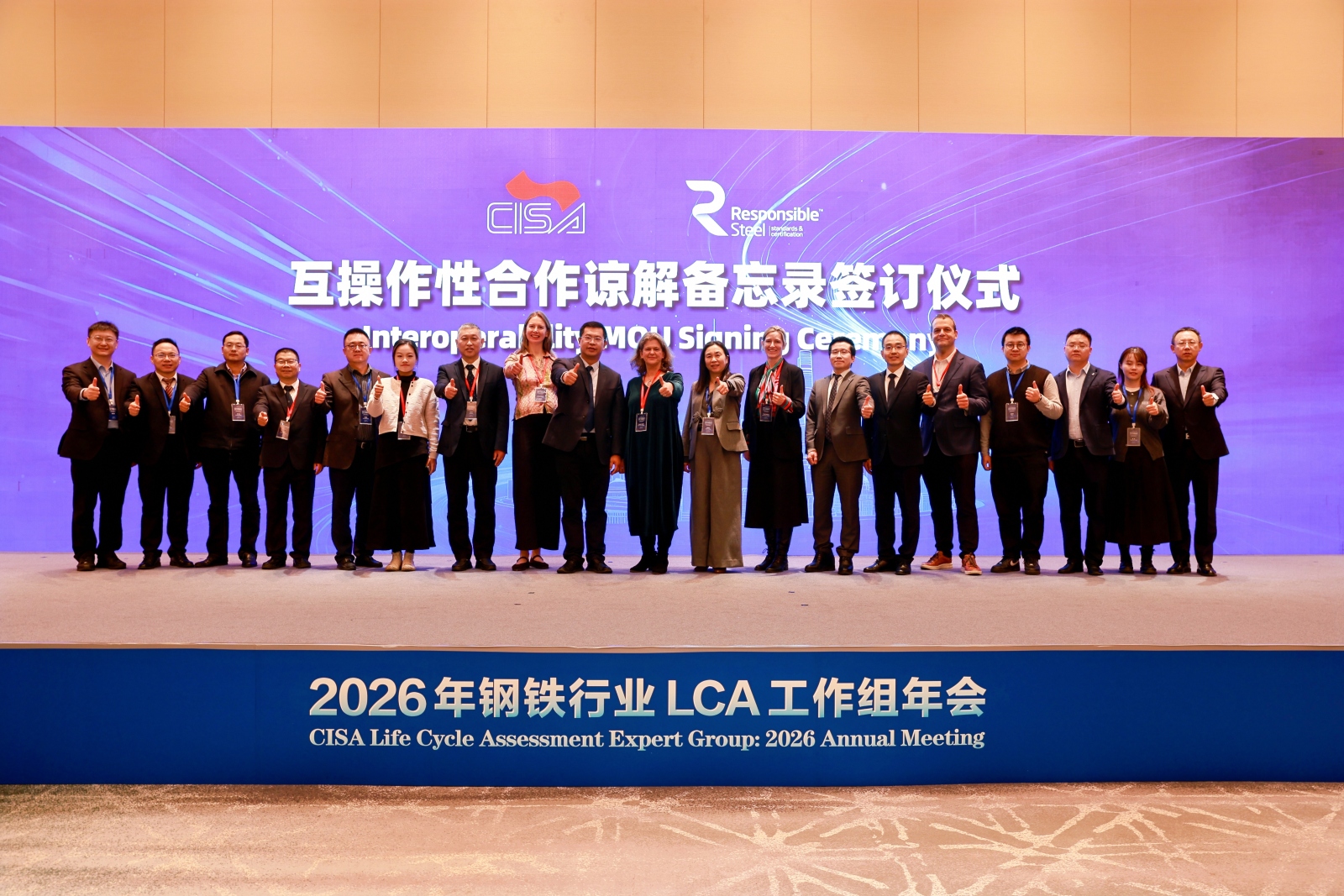
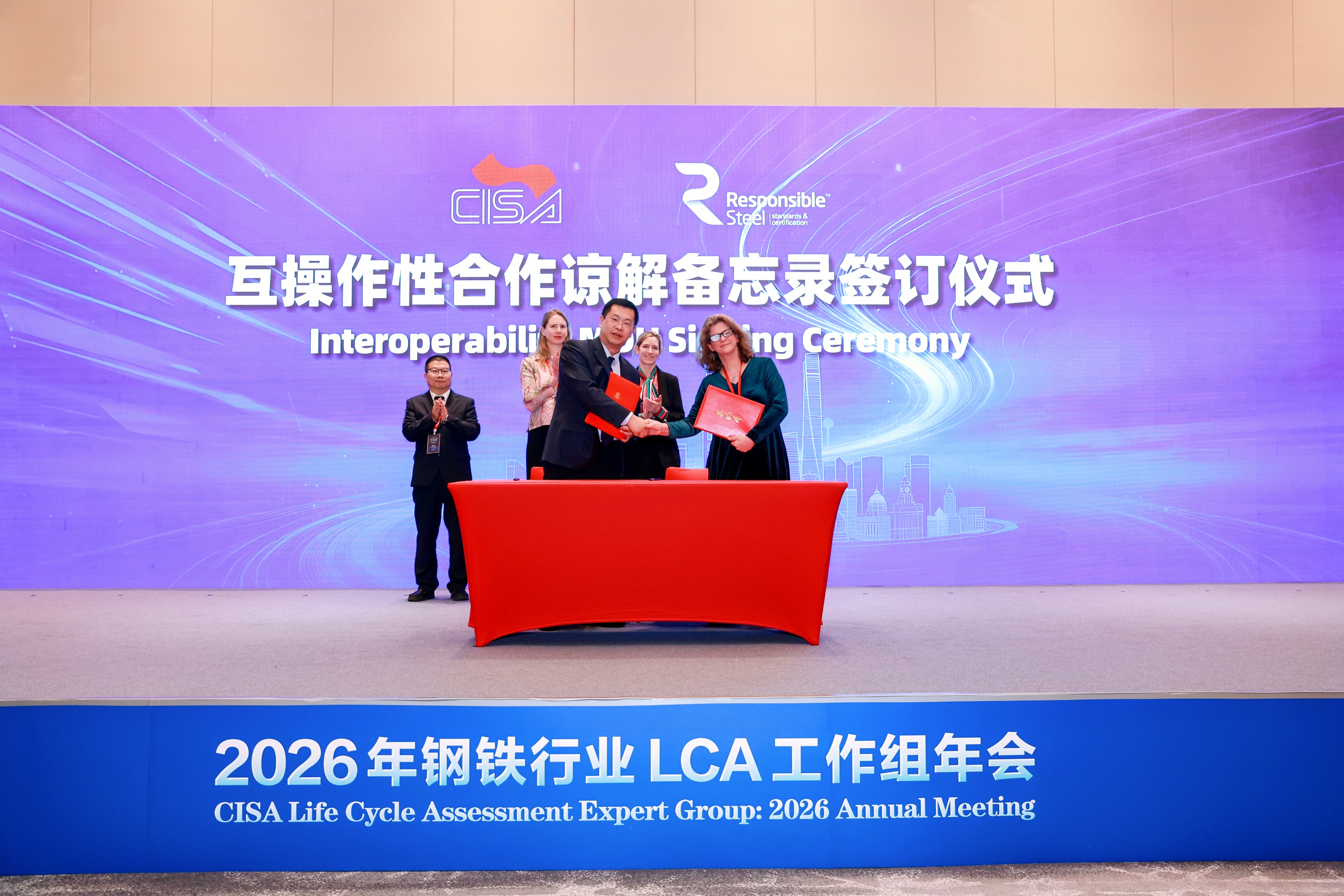
- Present to the Chinese steel value chain our C2F (China's low-carbon emission steel standard) interoperability MoU at CISA's annual LCA conference.
- Connect with our Chinese members, including SKF, World Resources Institute (WRI), Climate Group, VAMA (Valin ArcelorMittal Automotive JV), Penglai Dajin, and some of our certification bodies working in China, including Afnor and China Quality Certification Centre (CQC).
- Get to work on our C2F-ResponsibleSteel Interoperability Project, structuring the discussions around our Framework for Credible Interoperability.
- Visit the 15mtpa Zhanjiang steel plant, where a new DRI-EAF line was launched in Dec 2025. This has involved the production to date of iron reduced with hydrogen in a 1mtpa DRI plant. Whilst this is currently produced from refined coke oven gas, the project is a hugely significant demonstration of the potential to produce hydrogen-based DRI at an industrial scale.
.jpg)
What do ResponsibleSteel's interoperability projects look like in practice?
In short, interoperability means measuring emissions using rules that are as aligned as possible, and recognising the differences, to enable comparison on a like-for-like basis. Imagine the benefit this would bring for anyone wanting to distinguish what good looks like, for example, procurement teams, investors, and policymakers.
But making interoperability work in practice requires a lot more if we want a reliable, credible and sustainable system that generates high-quality, comparable data.
We've outlined the key components of this in our Framework for Credible Interoperability, which will inform both our work with LESS and CISA:
- Aligned GHG accounting rules
- A reliable calculation tool
- A robust assurance mechanism
- Credible claims protocols
- Good governance, oversight and resourcing
- Appropriate data management
- Strong operations management systems
This is how markets are built: first with innovation, then with the necessary rules and systems that enable good information to flow – so that steel buyers can understand, investors can evaluate, and steelmakers can compete, based on emissions performance that everyone can trust.


ResponsibleSteel Virtual Members’ Meeting 2020
The ResponsibleSteel Members’ Meeting is taking place this year on 24th and 25th June. This will be a chance for our members – full members as well as associate members – to discuss ongoing ResponsibleSteel developments.
The meeting this year focuses on two specific issues: the requirements that steelmakers will need to meet to make claims about the steel products they produce and sell; and the development of the new ResponsibleSteel constitution.
Restrictions to control the coronavirus pandemic mean that the meeting will be virtual, rather than in person. Since we want to cover multiple time zones we cannot do full day sessions. Instead, we will hold 2-hour sessions and will repeat them so that all our members have an opportunity to participate.
On the 24th June, we will focus on the additional requirements in relation to GHG and raw materials that we are currently developing. The ResponsibleSteel Board has decided to give Members more opportunity to engage in the development of these additional requirements before they are launched for public consultation and we want to use the Members meeting to provide that opportunity. Draft proposals will be circulated in advance of the meeting, and the formal public consultation process will take place after the Members’ have had the opportunity to review and comment.
On 25th June ResponsibleSteel will seek feedback from members on a new draft constitution.
There is still time to join ResponsibleSteel in advance of the Members’ Meeting. If you would like to know more, please look at the membership pages of our website, or contact George Deslandes at gdeslandes@responsiblesteel.org for more information.


ResponsibleSteel Stakeholder Panel on Coronavirus
On 31st March ResponsibleSteel board members from IUCN, IndustriALL, ArcelorMittal and BlueScope Steel took part in an on-line panel to reflect on how the coronavirus crisis was affecting them personally and professionally, and to consider potential long-term effects.
The breadth and depth of impacts across such diverse organisations and across all geographies was striking. Giulia Carbone of IUCN noted that 2020 was to have been a ‘super year’ for biodiversity. But the pandemic has disrupted the quadrennial World Conservation Congress, the meeting of the Convention on Biological Diversity and the launch of a new global framework to protect life on earth. Alan Knight and Gerry Tidd, of ArcelorMittal and BlueScope Steel considered that while steelmaking is used to economic cycles, the severity, suddenness and global nature of the crisis created by the coronavirus is unprecedented. Markets are drying up and companies are fighting for survival. And Matthias Hartwich of IndustriALL observed that the crisis has put workers’ health at risk as companies try to continue to operate, and yet also threatens workers’ rights as businesses lay workers off without proper consultation or provision.
But perhaps just as striking were the personal commonalities. All four speakers were speaking from their homes. All four organisations were having to cope with new ways of working, trying to keep staff safe while maintaining core tasks, and having to deal with restrictions on travel and meetings.
And all four drew attention to surprising linkages – the impacts on small NGOs as their partnerships with businesses are affected, just as small and large businesses are struggling financially with knock on effects through global supply chains. The fact that 80% of the oxygen supplied to hospitals in New South Wales is a by-product of BlueScope’s steelmaking. Or that ArcelorMittal’s 3D printing capacity has been repurposed for the manufacture of ventilators.
Looking to the future Alan Knight reflected on what the crisis may mean for sustainable development and the climate debate. While it is too early to know, he hoped that there would be recognition of the deep connections between different systems, and the strength and resilience of governments, NGOs and businesses working together towards common social and environmental goals.
Thank you to all our speakers.
Please follow these links for more insight into how ArcelorMittal, BlueScope Steel, IndustriALL and IUCN are responding to coronavirus covid-19.

ERM CVS joins ResponsibleSteel™
ERM CVS is the independent Certification and Verification business within the ERM global sustainability services group with access to a network of 5500 practitioners in 40 countries to deliver innovative 3rd party assurance to manage sustainability challenges.
ERM CVS’ relationship with the metals, mining and manufacturing sectors cuts across all types and size of business and has created an informed and client driven approach. ERM CVS is a long standing provider against many schemes related to the Responsible Steel Standard with access to technical, sustainability and social experts to ensure our outputs reflect the goals of our clients in driving improvements in systems implementation and performance through the value chain.
Mick Jenkins, Managing Partner at ERM CVS, said: “We are very pleased to be able to make an active contribution to the responsible steel market through our independent and impartial services. The scheme links intentionally with our other certification and assurance services towards fuller sustainability sourcing and social balance through the value chain.”
Matthew Wenban-Smith, Executive Director, ResponsibleSteel, said: We are delighted to welcome ERM CVS as a Responsible Steel Associate Member. Ensuring we have a range of certification and verification organisations within our membership is crucial to ensure we get expert input to help us continue to develop the highest quality standard for the steel sector.”

SteelZero First Workshop
“SteelZero”, brought to you by The Climate Group and ResponsibleSteel held its first workshop on April 16th. SteelZero is an initiative to drive a major shift in the global market for the responsible sourcing and production of steel. SteelZero provides a forum for leading steel buyers across multiple sectors to co-create and support a powerful commitment to sourcing steel in a net zero economy, alongside a roadmap of action.
This first workshop was attended by a total of 46 individuals, representing 14 demand side businesses and business associations across the following sectors: construction & property, consumer products, automotive, finance and renewable energy. Additionally, 9 civil society organisations were represented to contribute to the conversation.
Key focus areas of the workshop were to explore what a commitment around the procurement of responsible low/zero carbon steel may look like and discuss if there are specific workstreams a group could take on to help make the procurement of responsible low/zero carbon steel a practicality. All participants had the opportunity to actively contribute to smaller group break-out discussions exploring commitments and workstreams.
A number of presentations were given by stakeholders to help shape the discussions. Presenters included the Energy Transitions Commission (ETC) on their Net-Zero Steel Initiative and the World Green Building Council on their Advancing Net Zero project, specifically covering the work both organisations have done regarding demand signals. ArcelorMittal presented the producer’s perspective of issues that need to be overcome to bring responsible low/zero carbon steel to the market and the importance of the demand signal from steel buyers.
There was a very high level of engagement during the workshop from both business and civil society participants. The SteelZero project team gained a clearer understanding of what is required by participants. The next stage is for the project team to have a series of follow up conversations with businesses to shape a formal commitment to the procurement of responsible low/zero carbon steel.”
More to follow on this project as it develops, in the meantime please feel free to have a look through a presentation that can be found here on the ResponsibleSteel website.

ResponsibleSteel™ welcomes The Nickel Institute into membership
The Nickel Institute is the global association of leading primary nickel producers. Their mission is to promote and support the appropriate use of nickel in appropriate applications. One of the main applications being its use in the production and strengthening of stainless steel.
While its role is often hidden, nickel is an enabler of many technologies required for sustainability. Nickel contributes to various of the UN Sustainable Development Goals. Thanks to its outstanding physical-chemical properties, nickel makes articles more durable, ensures an increased lifetime and results in less maintenance. Due to the high economic value, nickel is moreover a metal with highest recycling efficiencies and contributes therefore to a circular economy.
The nickel value chain is also a significant contributor to economic development. And the science and technical know-how shared freely by the Nickel Institute contribute knowledge to enable nickel to be used safely and efficiently.
“We appreciate the opportunity to join the ResponsibleSteel initiative as an Associate Member. Stainless steel accounts for more than two third of all nickel uses globally. It is therefore important for us – on behalf of our member companies – to closely cooperate with the carbon and stainless steel industry in view of responsible sourcing” said Dr Veronique Steukers, Global Director Public Policy.
Matthew Wenban-Smith, Executive Director, ResponsibleSteel, said: “Having the Nickel Institute as a new Associate Member of ResponsibleSteel is extremely good news – both for the organisation as a whole but also for all of our other members who will greatly benefit from the input and experience that the Nickel Institute will bring to our projects and programmes.”

The Climate Bonds Inititive joins ResponsibleSteel™
The Climate Bonds Initiative is an investor-focused not-for-profit, promoting large-scale investment in the low-carbon economy. Climate Bonds carries out market analysis, policy research, market development; advises governments and regulators; and administers a global green bond Standards and Certification Scheme. Please visit http://www.climatebonds.net. ”
“Transitioning to low carbon operations is one of several challenging, but unavoidable sustainability objectives for the global steel industry. ResponsibleSteel is taking a lead in supporting positive change in multiple companies across the sector. Climate Bonds Initiative is happy to join ResponsibleSteel and looks forward to working cooperatively in the future on sustainability projects.” said Sean Kidney, CEO, Climate Bonds
Matthew Wenban-Smith, Executive Director, ResponsibleSteel, said: We are excited to welcome the Climate Bonds Initiative as an Associate Member to ResponsibleSteel. Focusing on the investment and financing opportunities for the steel sector in the transition to a low-carbon economy is a priority for us as we continue to expand our work on our standard and certification programme and associated projects.”

ResponsibleSteel™ welcomes the Green Building Council of Australia (GBCA) into membership
Established in 2002, the Green Building Council of Australia (GBCA) is the nation’s authority on sustainable buildings, communities and cities. Our vision is for healthy, resilient and positive places for people. Our purpose is to lead the sustainable transformation of the built environment. The GBCA represents more than 550 member companies including major developers, professional services firms, banks, superannuation funds, product manufacturers, retailers, utilities and suppliers. We also work with 35 local government members, 25 state government departments and land organisations, and 22 universities.
Jorge Chapa, Head of Market Transformation said: “ResponsibleSteel is doing some inspiring work to ensure steel is contributing toward a more sustainable built environment. We’re pleased to work with them as we lead the sustainable transformation of buildings, cities and communities.”
Matthew Wenban-Smith, Executive Director, ResponsibleSteel, said: We are extremely pleased to welcome GBCA as an Associate Member of ResponsibleSteel. So much of the work that we are involved in will directly benefit from the GBCA’s specialist experience and expertise in the built environment and we are really looking forward to having GBCA participate in our ongoing work programme and projects.”

BHP joins ResponsibleSteel™
BHP extracts and processes minerals, oil and gas, with more than 72,000 employees and contractors, primarily in Australia and the Americas. BHP is among the world’s top producers of major commodities, including iron ore, metallurgical coal and copper. The company also has substantial interests in oil, gas and energy coal.
BHP’s purpose is to bring people and resources together to build a better world.
The company’s approach to environmental management is based on the robust identification, assessment and control of material risks across all phases of its business, from exploration to development, operation and closure. BHP aims to avoid or, where this is not possible, minimise its impacts, while contributing to lasting environmental benefits across the regions where the company operates.
Fiona Wild, Vice President, Sustainability and Climate Change, BHP, said: “At BHP we take a product stewardship view of how our commodities are used through the value chain. We are pleased to join Responsible Steel and continue to partner with our customers to help improve sustainability and emissions standards in the steel making value chain.”
Matthew Wenban-Smith, Executive Director, ResponsibleSteel, said: “We are delighted to announce that BHP has joined as our newest Business Member. Having one of the largest resource and mining companies in the world as a member sends a very strong signal and commitment to the steel sector to help achieve the responsible sourcing and production of steel. BHP’s membership will ensure that as we further develop our ResponsibleSteel standard to include three additional components: requirements for the responsible sourcing of raw materials; requirements related to the measurement and reporting of GHG emissions and the claims that certified sites can make about the steel products they produce, we will have additional input, expertise and experience from an organisation committed to helping the sector reach higher levels of sustainability.”

ResponsibleSteel™ Steel Product Certification Working Groups
The first meetings of the ResponsibleSteel working groups on steel product claims, greenhouse gas emissions and raw materials all took place on 22 April. The three groups each met in two sessions to allow participation from working group members based in Australia, Europe and the Americas. Working group members then reconvened in joint sessions on 24 April to listen and comment on the headline findings.
All three working groups are considering the requirements that will need to be met in order for claims to be made about the ResponsibleSteel certified status of steel products.
The meetings were originally scheduled to have taken place face to face, but in common with many organisations around the world ResponsibleSteel has had to adapt to the measures being taken to respond to the coronavirus pandemic and implement a virtual process.
Some 60 participants took part across the three working groups, including active participation from mining and steelmaking businesses and interest groups, downstream steel users, civil society organisations, assurance bodies and consultancy organisations. Participants responded to a series of high-level questions that had been introduced in an earlier briefing session on 11 March, and built on their comments on a draft ‘Steel Product Certification Requirements’ document circulated in advance of the meetings.
A recording of the 11 March Briefing session and the accompanying slides are available on the Resources page of the ResponsibleSteel website, together the slides for the working group meetings on 22 April, the headline feedback from those meetings, and the collated anonymised comments submitted in advance of the working group sessions.
The next step in the process will be to publish and circulate a revised draft set of requirements, taking account of the working group feedback, for a formal 30-day public stakeholder consultation. Comments will be welcome from ResponsibleSteel members and non-members alike.

Australian Steel Mill Services joins ResponsibleSteel™
ResponsibleSteel welcomes Australian Steel Mill Services (ASMS) as a new Member.
ASMS is a joint venture between Cement Australia Group and the Edward C Levy Co (USA), providing slag-handling services to BlueScope Port Kembla. ASMS is focused on the sustainable, value-added utilisation of steelmaking co-products into applications such as cement, concrete, civil infrastructure and agriculture.
Mark Cross, General Manager, ASMS, said: “The comprehensive ESG agenda laid out by ResponsibleSteel for industry participants mirrors key areas of focus for ASMS. These include environment, safety and community concerns, as well as the effective utilisation and recovery of resources. ASMS looks forward to participating in the ResponsibleSteel initiative in moving towards the goal of a more sustainable future for our industry.”
Matthew Wenban-Smith, Executive Director, ResponsibleSteel, said: “We welcome Australian Steel Mill Services as a new Member. The involvement of more companies in the Australian steel supply chain will greatly contribute to achieving responsible production throughout the industry, both in Australia and worldwide.”
Changes to upcoming ResponsibleSteel™ meetings
The health and safety of our Members is of utmost importance and so, like many organisations, we are making some changes to our scheduled meetings, to reduce the risk of infection of coronavirus, and in light of travel restrictions.
The Working Group meetings scheduled for 22 and 23 April 2020 will be held virtually, with the meetings on 23 April rescheduled to 24 April. Participants will be advised how to join the meetings. There will be four sessions in total, with a morning and evening session on both days, in order to cover most time zones.
22 April 8:00am – 10:00am UK Summer Time: Three separate working group meetings (GHG, Raw Materials, Steel Product Claims) to take place in parallel, Session 1
22 April 5.00pm – 7.30pm UK Summer Time: Three separate working group meetings taking place in parallel, Session 2, starting with 30 minute resume of Session 1 progress.
23 April: No meeting. The Secretariat will collate and circulate developments from 22 April, for discussion the following day.
24 April 8:00am – 10:00am UK Summer Time: Combined group meetings to take place, Session 1
24 April 5.00pm – 7.30pm UK Summer Time: Combined group meetings to take place, Session 2, starting with 30 minute resume of Session 1 progress.
There will also be a virtual replacement for the Members’ meeting in June. Please keep 24-26 June free for virtual meetings of the Working Groups and Members. More details will be announced in due course.
We are considering organising an in-person Members’ meeting in the second half of the year, and will review and update on the situation as it develops.
We wish all our Members and friends well, personally and professionally, during these challenging times.
Photo credit: worldsteel library
Multi-stakeholder panel on the impacts of the coronavirus Covid-19 pandemic
The coronavirus Covid-19 pandemic is affecting people, businesses and organisations in every country of the world.
We invite ResponsibleSteel members and stakeholders to hear our board members Alan Knight of ArcelorMittal, Gerry Tidd of BlueScope Steel, Giulia Carbone of IUCN) and Matthias Hartwich of IndustriALL discuss how the crisis is impacting on their own organisations, how they are responding, and their thoughts for the future.
The webinar panel discussion will take place on Tuesday 31st March from 8.00am to 9.00am British Summer Time (9.00am to 10.00am Central European Summer Time).
Call-in details to follow shortly, if you are not a member of our mailing list and would like an invitation please use the contact details below.
If you have any questions please get in contact with George Deslandes (Operations Coordinator), gdeslandes@responsiblesteel.org.
