

Reflections from China: ResponsibleSteel's CEO Annie Heaton discusses building interoperability across global standards
Interoperability: Building a bridge between global standards
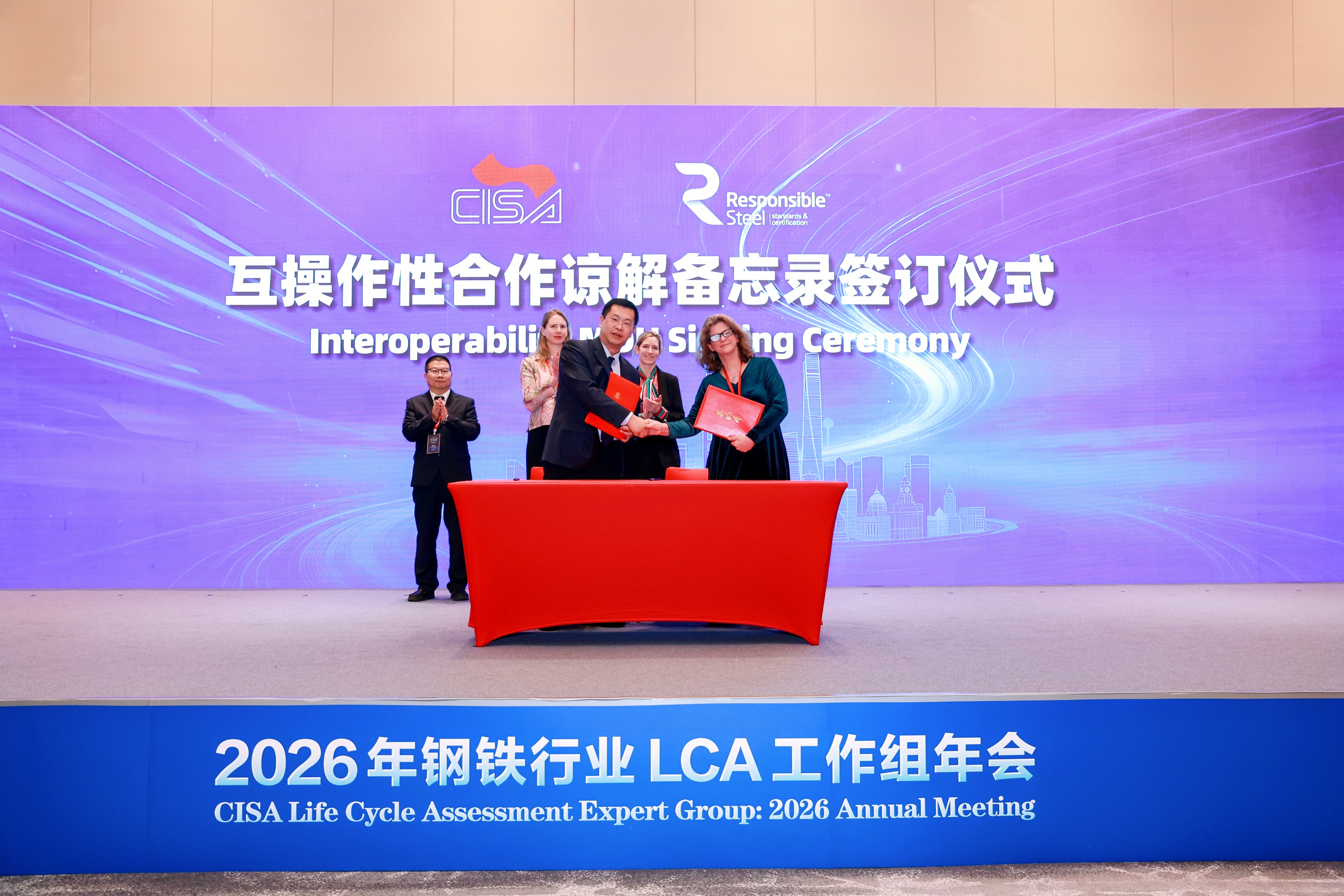
ResponsibleSteel's quest for a coherent market for decarbonised steel in 2026 got off to a constructive start this month. Following the announcement of our landmark agreements with the Chinese Iron and Steel Association (CISA) and the Low Emission Steel Standard (LESS) at COP30, ResponsibleSteel was in China in January to kick off our work on interoperability with CISA. This work in China complements our parallel project with Brussels-based LESS.
The goal? To build trusted data and claims on decarbonisation.
During our trip, our Director of Programmes, Amy Jackson, our Decarbonisation Lead, Alli Devlin, and myself had the opportunity to:
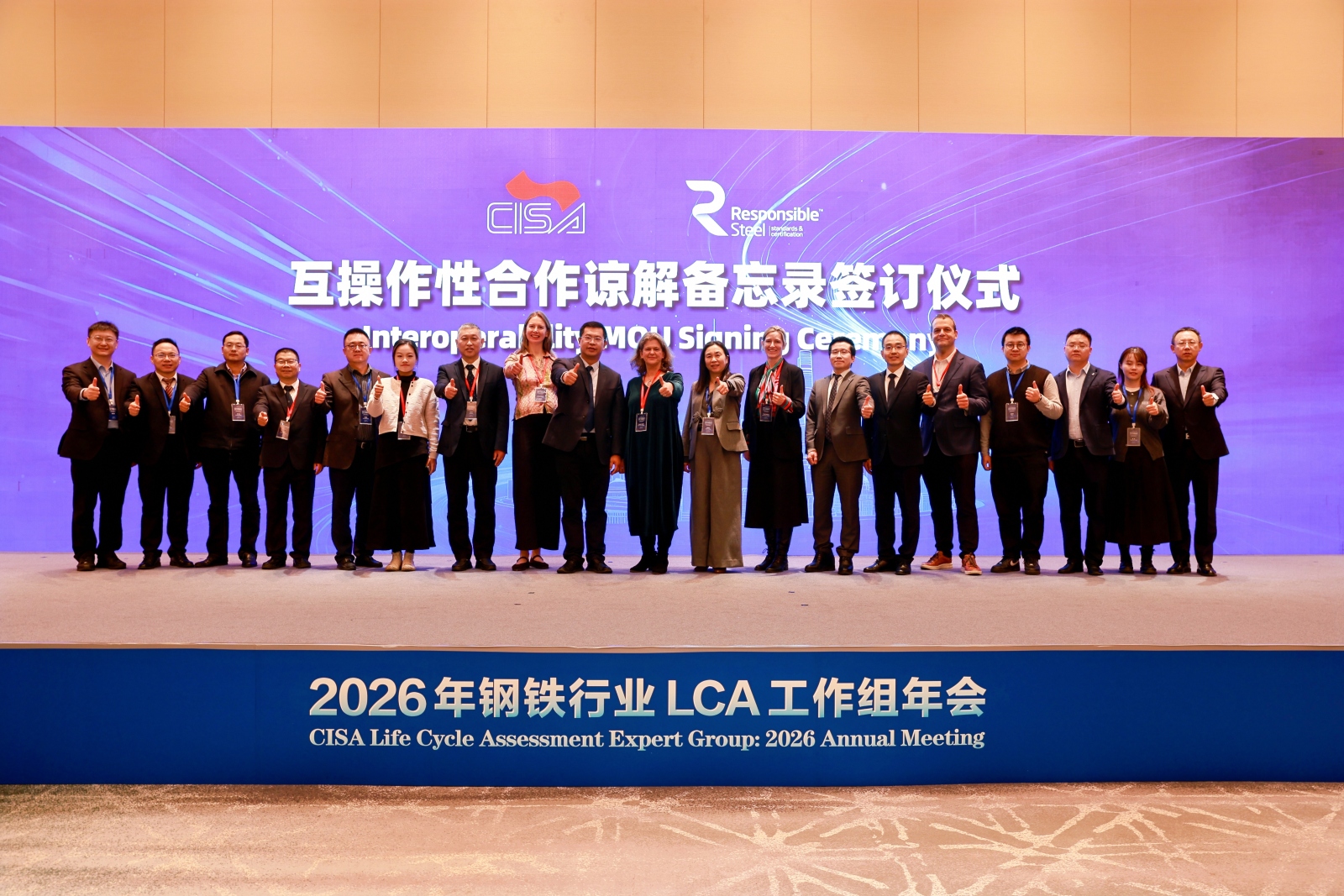
- Present to the Chinese steel value chain our C2F (China's low-carbon emission steel standard) interoperability MoU at CISA's annual LCA conference.
- Connect with our Chinese members, including SKF, World Resources Institute (WRI), Climate Group, VAMA (Valin ArcelorMittal Automotive JV), Penglai Dajin, and some of our certification bodies working in China, including Afnor and China Quality Certification Centre (CQC).
- Get to work on our C2F-ResponsibleSteel Interoperability Project, structuring the discussions around our Framework for Credible Interoperability.
- Visit the 15mtpa Zhanjiang steel plant, where a new DRI-EAF line was launched in Dec 2025. This has involved the production to date of iron reduced with hydrogen in a 1mtpa DRI plant. Whilst this is currently produced from refined coke oven gas, the project is a hugely significant demonstration of the potential to produce hydrogen-based DRI at an industrial scale.
.jpg)
What do ResponsibleSteel's interoperability projects look like in practice?
In short, interoperability means measuring emissions using rules that are as aligned as possible, and recognising the differences, to enable comparison on a like-for-like basis. Imagine the benefit this would bring for anyone wanting to distinguish what good looks like, for example, procurement teams, investors, and policymakers.
But making interoperability work in practice requires a lot more if we want a reliable, credible and sustainable system that generates high-quality, comparable data.
We've outlined the key components of this in our Framework for Credible Interoperability, which will inform both our work with LESS and CISA:
- Aligned GHG accounting rules
- A reliable calculation tool
- A robust assurance mechanism
- Credible claims protocols
- Good governance, oversight and resourcing
- Appropriate data management
- Strong operations management systems
This is how markets are built: first with innovation, then with the necessary rules and systems that enable good information to flow – so that steel buyers can understand, investors can evaluate, and steelmakers can compete, based on emissions performance that everyone can trust.


International Tin Association joins ResponsibleSteel™
ResponsibleSteel welcomes International Tin Association as a new Associate Member.
The International Tin Association (ITA) is dedicated to supporting discussion and action on important regional and global issues affecting the tin industry. ITA brings together the world’s major tin producers to ensure an innovative, competitive, and sustainable tin supply chain that contributes to sustainable development and improved quality of life.
ITA’s leading responsible sourcing initiatives, including ITSCI and the tin Code of Conduct, help companies source minerals by embedding Environmental, Social, and Governance (ESG) considerations into their decisions and practices.
Kay Nimmo, Head of Sustainability, International Tin Association, said: “Tinplate is an effective packaging material in which tin protects steel against corrosion and contributes to the preservation of food. We are delighted to partner with ResponsibleSteel in its mission to maximise steel’s contribution to a sustainable society. This partnership demonstrates the leadership of both organisations to inspire and drive sustainable and ethical production in the metal sector.”
Matthew Wenban-Smith, Executive Director, ResponsibleSteel, said: “It is important to collaborate with members from every stage of the steel supply chain and we welcome International Tin Association as a new Associate Member. We recognise ITA’s focus on responsible sourcing initiatives and the Code of Conduct, which complements the ResponsibleSteel Standard.”


Challenge Sustainability joins ResponsibleSteel™
ResponsibleSteel welcomes Challenge Sustainability as a new Associate Member.
Challenge Sustainability provides consultancy services to international companies on sustainability strategy, reporting and communications. The organisation has extensive experience working in the steel sector and other related industries, and has been involved in the development of the ResponsibleSteel Standard.
Jon Woodhead, Director, Challenge Sustainability, said: “We see the ResponsibleSteel Standard as an important opportunity for steel sector companies to demonstrate how they are working to meet the sustainability challenges associated with the responsible sourcing and production of steel. We expect that the ResponsibleSteel Standard will support core business success for steel sector companies.”
Matthew Wenban-Smith, Executive Director, ResponsibleSteel, said: “We are delighted to welcome Challenge Sustainability as a new Associate Member and look forward to benefitting from the organisation’s expertise.”

ResponsibleSteel™ assurance programme gains momentum
The assurance programme is well underway with two certification bodies approved, two auditor training sessions delivered, and the first audit site visit completed.
Certification bodies: Two certification bodies have been approved to carry out ResponsibleSteel audits – AFNOR Certification and GUT Certifizierungsgesellschaft für Managementsysteme mbH. More details here.
Auditor training: The second auditor training took place on 11-13 February in London. The next auditor training is scheduled for 30 March – 1 April at the DNV GL offices in London.
Audit site visit: The first audit site visit was completed in February, for the Belgium sites of ArcelorMittal. More details here.
Photo credit: worldsteel library

Russia’s leading mining and metallurgical companies discuss sustainable practices
On 27 February 2020, over 60 representatives of leading metallurgical and mining companies in Russia, attended a seminar at KPMG Russia, introducing best practices for sustainable development.
The seminar participants focused on the issues of certification of metallurgical sites to comply with the ResponsibleSteel Standard, as well as how to reduce the carbon footprint of businesses, including through the implementation of forest and climatic projects.
Matthew Wenban-Smith, Executive Director, ResponsibleSteel, presented an update on the current development of the ResponsibleSteel Standard, certification and assurance programme, including news of the first site audit completed at ArcelorMittal in Belgium.
Andrey Ptichnikov, a representative of ResponsibleSteel member Institute of Geography, spoke about a number of pressing certification issues, such as the demand for certified low-carbon steel in a number of market sectors. The participants showed a keen interest in the ResponsibleSteel Standard, and the dialogue with Russian businesses will continue.

ResponsibleSteel™ is looking for a new CEO
ResponsibleSteel is recruiting a New CEO to take the organisation into its next exciting phase of growth.
Our current Executive Director, Matthew Wenban-Smith who has been the driver of our success and growth over the last two years has signalled his wish to focus on the policy and standards development of ResponsibleSteel. With this in mind he has asked to transition his contribution from full time Executive Director to Policy Director, with an extended handover period this year.
Therefore we are on the look-out for a new CEO, who will play a critical commercial role building ResponsibleSteel into a global entity recognised and respected as a leader in the sustainability performance of global steel producers. The new CEO will be working closely with an experienced and collegiate Board, to develop and execute the strategy, identify and secure funding and membership in relevant sectors and geographies, and represent the initiative to public, private and civil society stakeholders in an international setting.
This position represents a unique opportunity to play a key role in furthering the sustainability performance of the world’s largest materials industry, ultimately providing businesses and consumers worldwide with confidence that the steel they use has been sourced and produced responsibly at all levels of the supply chain.
We are considering candidates who are able to work in either the UK or Australia (London, Sydney or Melbourne)
If this is of interest to you or you would like more information then please contact our recruitment specialists Acre here.
Photo credit: WorldSteel library

A thank you to our technical partner DNV GL
We have been proud to work with DNV GL as our technical partner for the last two years.
ResponsibleSteel wants to take the opportunity as this formal partnership comes to an end to thank them for their support of ResponsibleSteel, which has been hugely appreciated as we have developed and grown our programme.
We look forward to continuing to work closely with DNV GL and all of our members and stakeholders on many aspects of the steel standard and certification system over the coming years.

Lloyd’s Register Germany joins ResponsibleSteel™
ResponsibleSteel welcomes Lloyd’s Register Germany as an Associate Member. Lloyd’s Register employs hundreds of auditors and operates worldwide with a number of standards in areas including health-care, management systems and sustainability.
Starting out in 1760 as a marine classification society, Lloyd’s Register is today one of the world’s leading providers of professional services for engineering and technology – improving safety and increasing the performance of critical infrastructures for clients in over 75 countries worldwide. Lloyd’s Register is committed to help find sustainable solutions and therefore sees joining ResponsibleSteel as a logical step.
Lloyd’s Register’s profits fund the Lloyd’s Register Foundation, a charity which supports engineering-related research, education and public engagement, and supports its purpose of working together for a safer world. Lloyd’s Register also meets the Foundation’s charitable objectives through its work in assuring the safety of critical infrastructure worldwide.
Lloyd’s Register’s work to create a sustainable future includes the areas of sustainable decommissioning, food safety, low carbon power, digital innovation, and cyber security. In 2018, Lloyd’s Register became a signatory of the UN Global Compact and a founding member of the UN’s Sustainable Oceans Action programme.
James Sutcliffe, Group Sustainability and Environment Manager at Lloyd’s Register, said: “Sustainability is no longer a side issue and we can all make a difference by taking collective action to address planetary-scale challenges and achieve a more sustainable world.”
Matthew Wenban-Smith, Executive Director, ResponsibleSteel, said: “We welcome Lloyd’s Register Germany as a new Associate Member. As the first audits against the ResponsibleSteel Standard will be carried out very soon, we will benefit from Lloyd’s Register Germany’s expertise in auditing, as well as the company’s commitment to sustainable infrastructure.”

Steel Research & Technology Mission of India joins ResponsibleSteel™
ResponsibleSteel welcomes Steel Research & Technology Mission of India (SRTMI) as an Associate Member. SRTMI is a Government-Industry initiative with an objective to spearhead R&D programmes of national importance, in collaboration with industry, national R&D laboratories and academic institutes. SRTMI works closely with the Ministry of Steel, Government of India, especially in relation to fulfilling India’s National Steel Policy 2017.
Its vision is to develop an industry – institution interface for making the iron and steel industry globally competitive, by utilizing expertise from academic and research institutes, collaborating with international organizations to develop cost effective, environment friendly, state-of-the-art-technologies for optimum utilization of natural resources, and strengthening design and equipment manufacturing capability in the country.
SRTMI’s sustainability initiatives include minimizing CO2 emissions in iron and steel manufacture; 100% utilization of waste and by-products through the 6Rs principle of Reduce, Reuse, Recycle, Recover, Redesign and Remanufacture; and zero discharge through 100% recycling of waste water by effective waste water treatment solutions.
Dr. Mukesh Kumar, Director, Steel Research & Technology Mission of India, said: “Keeping in view the new age obligations of ensuring safe industrial working, resource conservation, energy optimization and environmental sustainability, there is a need to develop radically-new, disruptive and path-altering technologies in-house, which are more attuned to the country’s resources and capabilities. Association with ResponsibleSteel shall enable us to hold continued focus and share innovative ideas on developing future-ready capabilities in identified areas of national importance for iron and steel manufacture.”
Matthew Wenban-Smith, Executive Director, ResponsibleSteel, said: “We are pleased SRTMI is joining ResponsibleSteel as an Associate Member, and are particularly interested in this government-industry approach to increasing responsible steel production in India.”

International Manganese Institute joins ResponsibleSteel™
ResponsibleSteel welcomes the International Manganese Institute (IMnI) as an Associate Member. IMnL is a not-for-profit industry association that represents 83 major manganese producers and consumers in 30 countries.
Founded in 1975, with headquarters in Paris, France, IMnI’s mission is to provide vision and guidance to the manganese industry by promoting economic, social and environmental responsibility and sustainability to all stakeholders.
Currently the IMnI provides the manganese industry with the ability to: anticipate and track major regulations worldwide; develop economically sound industry safety standards; study and limit occupational health effects; and quantify and evaluate environmental life cycle and risk.
The Institutes sees sustainability and circularity as being vital for the success of the manganese industry. As such, IMnI supports the UN Sustainable Development Goals and works with key leaders to ensure that the manganese industry obtains the highest standards of sustainability within the industry and its communities.
Brandon Cline, HSE & Regulatory Affairs Manager, International Manganese Institute (IMnI), said: “Responsible Steel is a natural partner, not only to achieve sustainability for the steel industry, but also for the manganese industry. Steel is manganese’s primary downstream customer and we are excited to join a platform that can close the circularity loop within our industries.”
Matthew Wenban-Smith, Executive Director, ResponsibleSteel, said: “We are proud to have members from every stage of the steel supply chain and welcome IMnl as an Associate Member. Collaboration between all stakeholders within the steel supply chain will help us fulfil our mission of maximising steel’s contribution to a sustainable future.”

ResponsibleSteel™ seeks Assurance Panel members
Help us make sure that ResponsibleSteel certificates are credible and justified
The first audits against the ResponsibleSteel Standard will be carried out very soon. Third party auditors will conduct steel site assessments, consult with external stakeholders and make certification decisions. However, before they can make such decisions, their audit report will be reviewed by an independent Assurance Panel. Only if that Panel is satisfied with the quality of the audit report and its conclusions, can the auditors decide whether the site should be certified or not. The Assurance Panel thus plays an important quality control function in the ResponsibleSteel programme.
We are in the process of recruiting Assurance Panel members and are inviting applications from individuals that meet the following criteria:
• Long-standing expertise in one or more of the following areas: steel making, environmental or social issues in heavy industries, certification and auditing
• Not working for a steel company or a steel sector association, to avoid conflict of interest.
Assurance Panel members will be trained on the ResponsibleSteel system and on their role, and will be paid a fixed fee for each audit report they review. We expect the time requirement to be about 0.5 to 1 day per month. If you are interested, please send an expression of interest email and full CV to assurance@responsiblesteel.org.

Update on new ResponsibleSteel™ Working Groups
ResponsibleSteel is convening three new Working Groups on Greenhouse Gas Emissions, Raw Materials and Steel Product Claims. Participants are being invited to join the Working Groups, with initial briefings starting in March.
The Working Groups Terms of Reference are:
1. Greenhouse Gas Emissions (GHG)
• To agree a standard to measure and report the GHG emissions intensity for crude steel production consistently for all steel producers, as the basis for subsequent claims about the GHG emissions associated with ResponsibleSteel certified steel products.
• To agree one or more performance levels in relation to the GHG emissions intensity of steel production that will need to be met in order to make claims about the ResponsibleSteel certified status of steel products.
2. Raw Materials
• To agree the criteria for recognition of mine level assurance programmes by ResponsibleSteel.
• To agree the requirements to be met for the sourcing of the raw materials for steelmaking, in order to make claims about the ResponsibleSteel certified status of steel products.
• To agree one or more performance levels in relation to raw material sourcing, that will need to be met in order to make claims about the ResponsibleSteel certified status of steel products.
3. Steel Product Claims
• To agree the framework for making claims about the ResponsibleSteel certified status of steel products, that will drive the greatest improvements in social and environmental performance related to the sourcing and production of steel.
Photo credit: worldsteel image library
ResponsibleSteel™ Members Meeting to be held on 25-26 June 2020 in Europe
Save the Dates – 2020 Working Group Meetings and 2020 Members Meeting
ResponsibleSteel Members and Associate Members are invited to a Members Meeting on 25-26 June 2020. The meeting will take place in Europe, with the location to be confirmed.
Working Groups on raw materials, greenhouse gases, and steel product claims will meet in person on 22 and 23 April, and then again on 24 June immediately prior to the Members Meeting itself. A further meeting is expected to take place in September, with the date to be confirmed. More information on the working group schedule and participation will be circulated shortly.
The 2020 ResponsibleSteel Members Meeting will take place on 25 and 26 June. The programme will cover more technical issues on the 25 June, including discussion of the draft standard for Steel Product Claims. The programme for the 26 June will include review of ResponsibleSteel’s revised constitution.
Please save the dates in your diaries. More details, including locations, will be communicated in due course.
Photo credit: worldsteel image library
